
The Shs 5.5 Billion Coffee Controversy: Former Minister Musenero Defends Funding as Court Documents Reveal Multi-Million Dollar Debt and Corporate Overlap
A massive controversy is brewing at the intersection of Uganda’s Science, Technology, and Innovation (STI) sector and the country’s lucrative coffee industry. At the center of the storm is a Shs 5.5 billion taxpayer-funded allocation, a looming $1 million court judgment, and two similarly named coffee companies with overlapping directorships.
The saga began when the current Minister of Science, Technology and Innovation, Jonard Asiimwe, reportedly exposed widespread corruption within his ministry. According to a report by Daily Monitor, among the scandals is the disbursement of over Shs 5.5 billion in taxpayer funds to “Great Lakes Coffee Ltd”—a company whose physical location was purportedly unknown, yet was slated to receive additional government funding.
The revelation sparked immediate public outcry and parliamentary scrutiny, prompting a fierce defense from the former Minister of STI, Dr. Monica Musenero.
The Former Minister’s Defense
In a strongly worded letter addressed to Daily Monitor, Dr. Musenero, who served from June 2021 to June 2026, vehemently denied that her ministry ever funded the entity in question.
“I, @DrMusenero was the Minister for Science Technology and Innovation… Through that period, we never funded a company called Great Lakes Coffee Ltd, located in Ntinda,” Musenero stated. “The company we funded was Great Lakes Coffee Research and Development, whose address is in Industrial Area in Kampala, and it is doing extremely well.”
Musenero accused her detractors of waging a “desperate ongoing campaign to ‘Catch Musenero'” and misleading the Parliamentary Committee on Science, Technology, and Innovation (STI) with gross misinformation. She pointed to a letter dated October 28th, 2026, sent by the company to the STI Committee, which explicitly clarified the registered entity’s name and location prior to a scheduled field tour.
The letter, signed by Andreas Nicolaides, Venture Lead for Great Lakes Coffee Research & Development Limited (GLCR&D), noted a “minor correction regarding our company name,” confirming their operations at Plot 7, 1st Street Industrial Area, Kampala, and Kasese Municipality.
“Those leading the current crusade to attack on Musenero, at least sanitize your thinly veiled evil intents by doing some basic research to establish basic facts,” Musenero wrote, emphasizing the company’s role in value-added coffee exports and job creation.
The Court Battles and KCB Debt
However, court documents and public records reveal a complex corporate history that raises serious questions about the financial health of the original entity and the nature of the government bailout.
According to High Court of Uganda documents (Misc. Application No. 0059 of 2026), Great Lakes Coffee Company Ltd, alongside directors Andreas Nicolaides and Stamos Konstantinos, were sued by KCB Bank Uganda Limited (Civil Suit No. 261 of 2024). The bank sought the recovery of USD 1,104,419 (over Shs 4 billion), plus 10.5% interest, arising from a defaulted loan facility.
Judgment was entered in favor of KCB Bank on September 3, 2025. The company’s directors subsequently filed an application for a stay of execution pending an appeal, citing a “serious threat of execution” and arguing that execution would render their appeal nugatory.
A Google search AI overview confirms that Great Lakes Coffee Company Limited, owned by the Nicolaides family, entered receivership in 2023 amid debt disputes, with the High Court holding the directors personally liable under their guarantors for the KCB debt.
The Corporate Overlap: A “Phoenix” Company?
The crux of the controversy lies in the relationship between the defunct, debt-ridden “Great Lakes Coffee Company Ltd” and the newly funded “Great Lakes Coffee Research and Development (GLCR&D).”
Critics and analysts have raised pertinent questions regarding this transition. LinkedIn profiles confirm that Andreas Nicolaides is the Director of Great Lakes Coffee Uganda and Coffeelac SARL (DR Congo). Furthermore, PACEID (Presidential Advisory Committee on Exports and Industrial Development) website highlights Nicolaides as a roasting partner alongside Serbian investor Borris Stojkov.
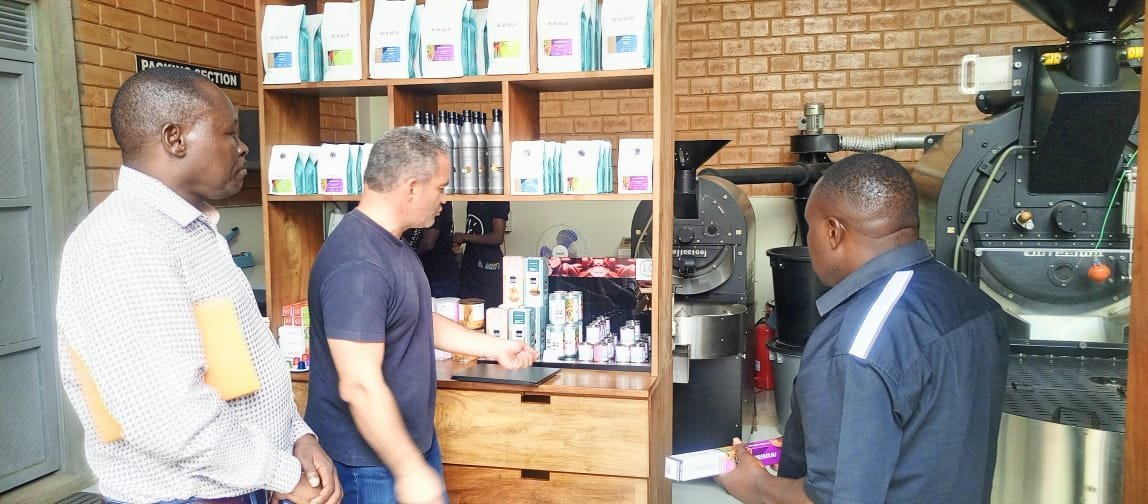
The parliamentary response document submitted by GLCR&D lists Andreas Nicolaides as the primary contact, with Konstantinos Stamos—who is also named as a defendant and personal guarantor in the KCB court case—listed as the point of contact for the Kampala HQ during the parliamentary field tour.
Observers are questioning if GLCR&D was birthed as a “phoenix company”—a new entity created to continue the operations of an insolvent business—to secure government funding that could indirectly service the massive KCB debt.
Questions Loom Over Taxpayer Value
The controversy has sparked a broader debate about the government’s due diligence and investment strategies. Key questions remain unanswered:
- Due Diligence: Was rigorous due diligence conducted before allocating Shs 5.5 billion in taxpayer funds to a newly branded entity with directors facing personal liability for a $1 million debt?
- Shared Directors: Does the government have a policy on funding entities whose directors are under active execution for commercial loan defaults?
- Local Players: Why was such a massive sum allocated to a foreign-owned (Greek heritage) family business connected to PACEID, rather than supporting local Ugandan coffee players who are struggling to scale?
- Accountability: What are the specific Key Performance Indicators (KPIs) for this Shs 5.5 billion grant under the GLCR&D banner, and how will Ugandans measure the return on investment?
As the STI Committee and COSASE continue their investigations, Dr. Musenero maintains that the achievements of the STI sector transcend individual interests. “This company… is benefiting Ugandan Coffee growers, creating jobs and has opened new export markets for Uganda’s Coffee… This might be the one which saves your son or grand daughter from unemployment,” she urged.
However, until the government provides transparent documentation detailing the exact nature of the funding, the physical auditing of the facilities, and the rigorous tracking of milestones, the Shs 5.5 billion coffee controversy will likely continue to percolate.
About The Author