
BREAKING HISTORY: 1931 Colonial Report Details Extensive Petroleum Discoveries in Bunyoro
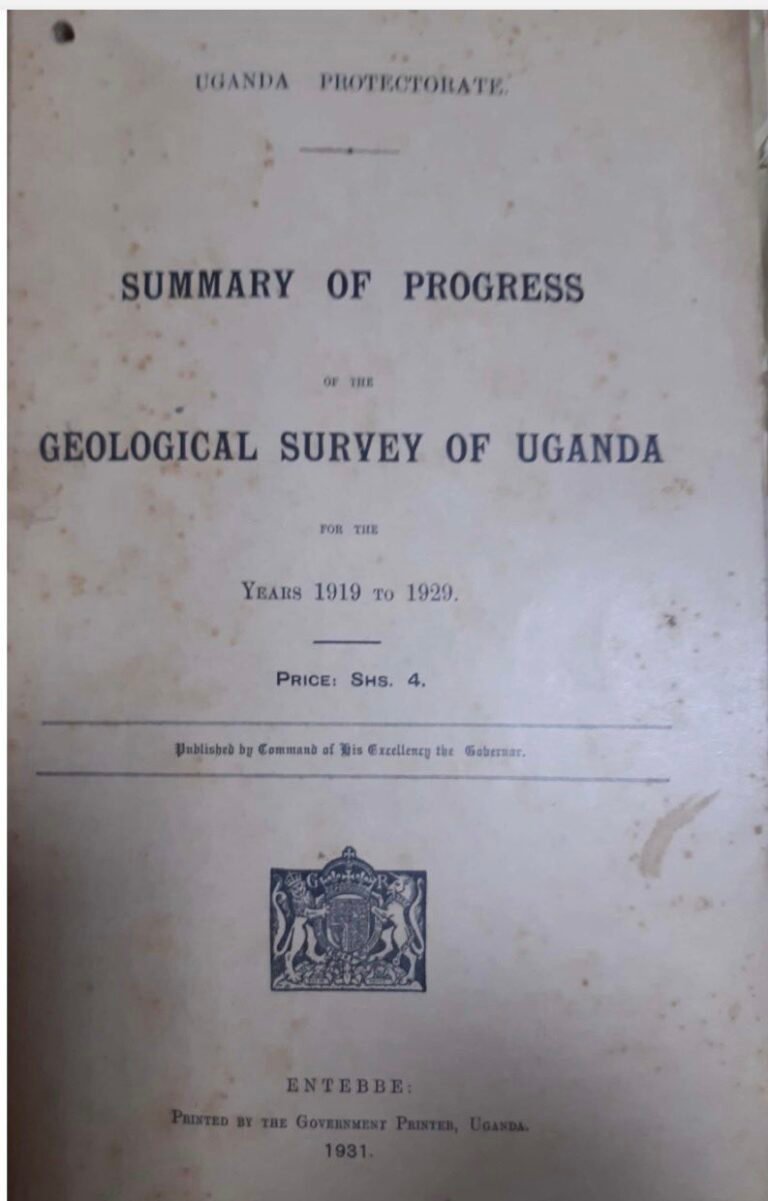
ENTEBBE, 1931 — A recently unearthed government publication, the Summary of Progress of the Geological Survey of Uganda for the Years 1919 to 1929, reveals the promising early scientific confirmation of petroleum resources in the Bunyoro region and around Lake Albert. Published in 1931 by the Government Printer in Entebbe, the report provides a detailed account of geological investigations into oil seepages that have long been known to locals.
The report, published by Command of His Excellency the Governor, highlights that the occurrence of petroleum seepage north of Kibiro has been known for some time. Following a detailed investigation that was published and entered into a second edition in 1926—referencing E.J. Wayland’s Memoir No. 1, Geol. Survey, Uganda—further extensive investigations were carried out.
International Geological Interest
The search for oil was not limited to the Ugandan side of the lake. The report notes that Belgian authorities conducted their own investigations on the western side of Lake Albert. Consequently, several new seepages were discovered in addition to the previously known sites of Kibiro, “Mswa,” and Kibuku.
According to the geological survey, five new seepages were identified, including one about five miles south of Mswa associated with hot springs, and another about 14 miles south of Mswa. Additional seepages were found where the Albertine depression passes into the Semliki rift.
The report specifically notes the observations of notable geologists of the era. Belgian geologist Mr. Max Delpierre, alongside Mr. Beeby Thompson and M. Simmons, observed a small intermittent seepage at the hot spring at Kibiro on the Bunyoro shore.
Chemical Analysis Reveals Commercial Potential
Beyond simply locating the seeps, the report details rigorous scientific analyses of surface samples conducted at the Imperial Institute. An analysis of the Kibiro asphaltic seep provided a detailed breakdown of the substance:
· Petroleum (matter soluble in acetone): 56.8%
· Asphaltic matter (matter soluble in chloroform): 42.5%
· Ash and non-bituminous organic matter: 0.07%
· Sulphur: 0.31%
The report further notes that the oil yielded a significant calorific value of 10,332 small calories, or 18,598 British thermal units. When dried, the oil was found to have a specific gravity of 0.961 at 15°C.
Fractional Distillation Results
To determine the potential commercial viability of the resource, the oil was subjected to fractional distillation. The results, outlined in a detailed table within the report, yielded the following breakdown:
· Light Petroleum (Up to 150°C): 1.1% yield
· Kerosene (150°—300°C): 12.4% yield
· Lubricating oils and solid hydrocarbons (Above 300°C at 300 mm. pressure): 55.6% yield
· Residue (coke and pitch): 30.9% yield
The findings of the 1919-1929 survey served as a crucial foundational document for the colonial administration, confirming that the intermittent seepages observed in Bunyoro were part of a larger, geologically significant petroleum system in the Albertine region.
About The Author