

Kampala, Uganda — 20th September 2026
Uganda’s Agriculture Minister Addresses Coffee and Cocoa Price Fluctuations, Cites Global Market Adjustments and Domestic Drought
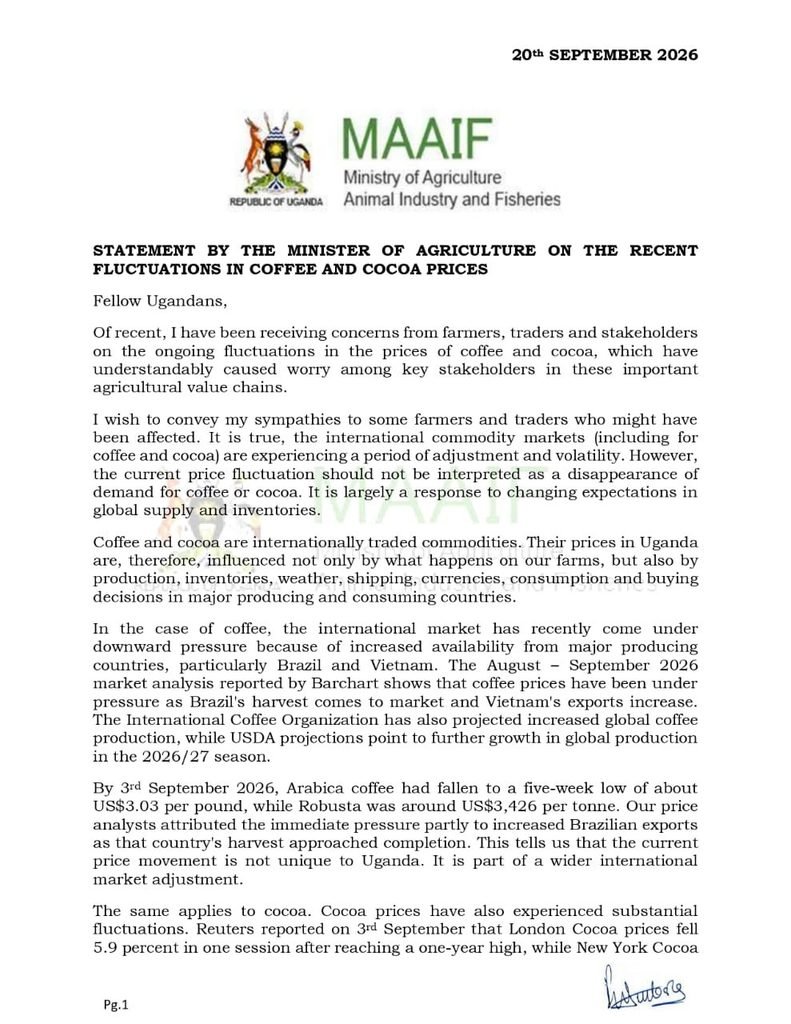
The Ministry of Agriculture, Animal Industry and Fisheries (MAAIF) has issued a statement addressing the recent volatility in global and domestic coffee and cocoa prices. The statement, signed by the Minister of Agriculture, seeks to reassure farmers, traders, and stakeholders that the current price movements are part of a wider international market adjustment rather than a disappearance of global demand.
Global Market Pressures
According to the statement, the international commodity markets are experiencing a period of adjustment and volatility. The Minister noted that coffee prices have recently come under downward pressure due to increased availability from major producing countries, particularly Brazil and Vietnam.
Citing an August – September 2026 market analysis by Barchart, the statement revealed that by September 3, 2026, Arabica coffee had fallen to a five-week low of about US$3.03 per pound, while Robusta was around US$3,426 per tonne. The International Coffee Organization (ICO) and USDA have both projected increased global coffee production for the 2026/27 season, contributing to the downward pressure.
Similarly, the cocoa market has experienced substantial fluctuations. Reuters reported that on September 3, London cocoa prices fell 5.9 percent in one session after reaching a one-year high, while New York cocoa also declined by 5.9 percent. By September 18, December New York cocoa had fallen about 7.1 percent in one day to a seven-week low. This correction is largely attributed to expectations of increased near-term supplies, with Ivory Coast’s cocoa harvest for June 2025–June 2026 increasing by 30 percent.
Divergent Domestic Price Trends
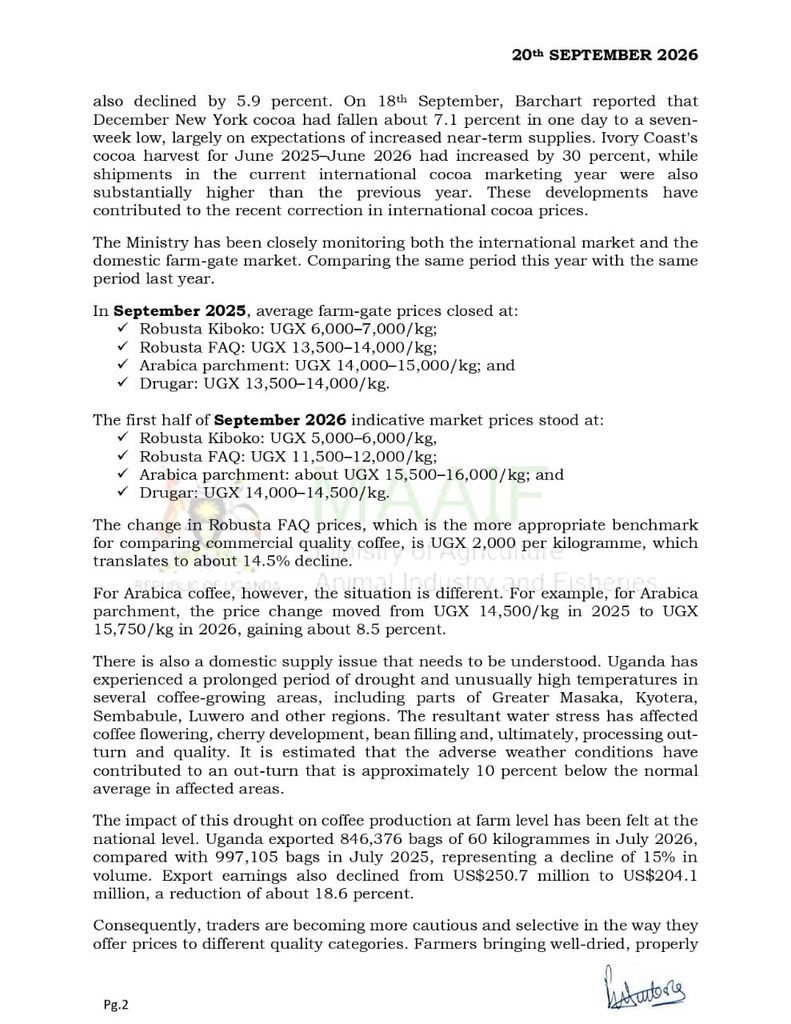
The Ministry has been closely monitoring the domestic farm-gate market. Comparing the first half of September 2026 with the same period in 2025, the data reveals mixed outcomes for Ugandan farmers:
· Robusta Kiboko: Dropped from UGX 6,000–7,000/kg (2025) to UGX 5,000–6,000/kg (2026).
· Robusta FAQ: Dropped from UGX 13,500–14,000/kg (2025) to UGX 11,500–12,000/kg (2026). This represents a decline of UGX 2,000 per kilogram, or about 14.5%.
· Arabica Parchment: Increased from UGX 14,000–15,000/kg (2025) to UGX 15,500–16,000/kg (2026), gaining about 8.5%.
· Drugar: Remained relatively stable, moving from UGX 13,500–14,000/kg to UGX 14,000–14,500/kg.
Domestic Supply and Drought Challenges
The statement highlighted a significant domestic supply issue: a prolonged period of drought and unusually high temperatures in several coffee-growing regions, including Greater Masaka, Kyotera, Sembabule, and Luwero. The resultant water stress has affected coffee flowering, cherry development, bean filling, and ultimately, processing out-turn and quality. It is estimated that these adverse weather conditions contributed to an out-turn approximately 10 percent below the normal average in affected areas.
Export Earnings Decline
The impact of the drought is reflected in national export figures. Uganda exported 846,376 bags of 60-kilogrammes in July 2026, compared to 997,105 bags in July 2025—a 15% decline in volume. Export earnings also declined from US$250.7 million to US$204.1 million, a reduction of about 18.6 percent.
Outlook
Consequently, the Ministry notes that traders are becoming more cautious and selective in the way they offer prices to different quality categories. The statement emphasizes that farmers bringing well-dried, properly processed coffee are better positioned in the current market environment. The Ministry reiterated its commitment to closely monitoring both international and domestic markets.
About The Author