
Uganda’s Oil Wells Drilled But Not Flowing: Parliament Questions Delays as First Oil Pushed to 2027
COSASE Scrutinizes UNOC Over Drilled Wells, Refinery Structure, and $2 Billion Vitol Financing
Uganda has drilled more oil wells than required to support its initial production target, yet commercial crude production remains elusive nearly two decades after oil was first confirmed in the Albertine Graben. Parliament is now demanding answers.
The Parliamentary Committee on Commissions, Statutory Authorities and State Enterprises (COSASE) this week questioned the Uganda National Oil Company (UNOC) over the status of drilled wells, processing and evacuation infrastructure readiness, the planned national refinery structure, and a US$2 billion financing facility with global commodities trader Vitol.
The scrutiny comes as Uganda transitions from exploration and development toward commercial production, while households and businesses continue facing elevated petroleum prices.
No Crude Extracted Yet, UNOC CEO Confirms
UNOC Chief Executive Officer Proscovia Nabbanja told MPs that none of the crude encountered during drilling has been commercially extracted or sold, rejecting reports that Ugandan crude had already been secretly evacuated from oil fields.
“There is no crude that has been taken,” Nabbanja told the committee.
According to the Petroleum Authority of Uganda (PAU), Tilenga reached 74% overall completion by June 30, 2026, with 234 wells drilled, while Kingfisher reached approximately 79% completion. The East African Crude Oil Pipeline (EACOP) — the 1,443-kilometre export pipeline linking western Uganda’s oil fields to Tanga Port in Tanzania — was about 90% complete at that time, with more recent updates placing it at 92–93%.
The Integration Challenge
Despite exceeding drilling thresholds, Uganda cannot yet move commercial crude from wellhead to international markets because the oil projects must operate as one integrated system.
Uganda’s two flagship upstream developments — the TotalEnergies-operated Tilenga project in Buliisa and Nwoya, and CNOOC’s Kingfisher Development Area in Kikuube — are being developed alongside processing facilities, feeder pipelines, and the EACOP export system.
The Petroleum Authority has said Uganda needs 170 Tilenga wells for first oil, a threshold already exceeded. At Kingfisher, the requirement was 19 wells, also surpassed.
The bottleneck is no longer whether Uganda has drilled enough wells. It is whether wellheads, flowlines, central processing facilities, feeder pipelines, heating systems, pumping infrastructure, and the export pipeline can be commissioned and operated safely as a single chain.
This is particularly critical because Uganda’s crude, branded Pearl Sweet, is waxy with a pour point of about 40°C. It must be heated to remain fluid for transportation. EACOP has been designed as a heated, insulated pipeline specifically for these characteristics.
A completed well cannot simply be opened and its crude trucked to market. The oil must enter an integrated production and evacuation system capable of processing, measuring, heating, and transporting it continuously.
Revised Timeline: First Oil Now Expected Early 2027
Earlier government targets pointed to first oil in 2026. However, in September, UNOC announced the appointment of Vitol to market Uganda’s crude, with first exports expected in early 2027.
The revised expectation means Uganda is moving closer to becoming an oil producer, but the commercial payoff has again been pushed beyond several earlier deadlines. For a country that has committed billions of dollars to upstream, midstream, and associated infrastructure, the final stretch is less about discovering additional resources than converting completed infrastructure into a functioning production system.
Refinery Controversy: Why Dubai Incorporation?
COSASE’s examination also turned to Uganda’s long-delayed 60,000-barrel-per-day refinery planned for Kabalega Industrial Park in Hoima.
Under the current structure, UNOC holds 40% of the refinery company while UAE-based Alpha MBM Investments holds 60%. The refinery is intended to process crude for Uganda and regional markets, reducing dependence on imported petroleum products.
MPs questioned why the project company, Kabaale Refinery Company Limited, was incorporated in Dubai rather than Uganda. UNOC told the committee that Alpha MBM requested the incorporation to facilitate access to financing from the United Arab Emirates, and that the arrangement received legal clearance while the project remains subject to Ugandan tax and regulatory obligations.
The issue raises public accountability questions: when a project is strategically important to Uganda’s energy security and involves 40% state interest, how much of its corporate and financing architecture should be visible to Ugandan regulators, Parliament, and taxpayers?
UNOC defended Alpha MBM’s participation, saying the investor committed approximately US$30–40 million toward preparatory activities and is providing equity financing for the estimated US$4 billion refinery project. The project is expected to use Honeywell UOP technology and provide opportunities for Ugandan technical training.
The refinery’s timetable has also shifted. Current reporting puts the Final Investment Decision at February 2027, with commissioning targeted for the first quarter of 2030.
First oil does not depend on refinery completion — crude can be exported through EACOP while the refinery is still under development. However, the refinery is central to the government’s longer-term objective of capturing more value domestically rather than exporting crude and importing refined petroleum products.
$2 Billion Vitol Facility Under Microscope
The other major area of COSASE scrutiny was UNOC’s US$2 billion financing facility with Vitol Bahrain E.C.
Parliament approved the borrowing for a seven-year period to support a portfolio of energy and infrastructure investments. UNOC says the facility is intended to finance projects across the petroleum value chain, including storage, pipeline infrastructure, refinery-related developments, and regional logistics investments.
Parliamentary records show the original financing proposal included development of the Kampala Storage Terminal, expansion of the Jinja terminal, acquisition of petroleum storage capacity in Mombasa, refinery construction, acquisition of shares in Kenya Pipeline Company, and extension of the Eldoret-Kampala products pipeline.
COSASE has demanded the full agreement to establish precisely what obligations Uganda has assumed, including assets or contractual commitments supporting the facility, conditions attached to the borrowing, and the mechanism through which UNOC will repay it.
The scrutiny is particularly important because commodity-trader financing differs from conventional sovereign or development-bank borrowing. Parliament was told when the facility was approved that Vitol would provide non-traditional financing to enable UNOC to accelerate strategic infrastructure when conventional financing had become more expensive.
UNOC has maintained the facility does not amount to pledging Uganda’s crude reserves as collateral — a point COSASE’s demand for underlying documents should clarify. As of September, UNOC had reportedly drawn US$150 million from the facility.
For Parliament, the question is not merely whether the borrowing is legal, but whether the terms, repayment obligations, security arrangements, and commercial benefits are sufficiently transparent and prudent for a state-owned company whose future revenues are tied to Uganda’s petroleum sector.
UNOC’s Expanding Role Beyond Crude Exports
The UNOC appearance also highlighted the company’s expanding role beyond future crude exports. The company is now deeply involved in petroleum-products supply and infrastructure.
Its downstream mandate was strengthened by the 2023 amendment to the Petroleum Supply Act, under which UNOC became the government’s designated importer of petroleum products. The law regulates importation, exportation, transportation, processing, supply, storage, distribution, and marketing of petroleum products.
UNOC says volumes handled under the sole-importation arrangement have grown from just over two billion litres in the first year to more than three billion litres in the most recent financial year.
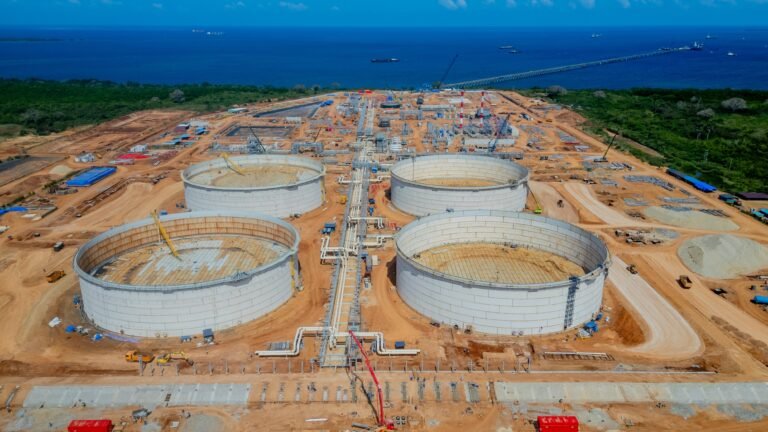
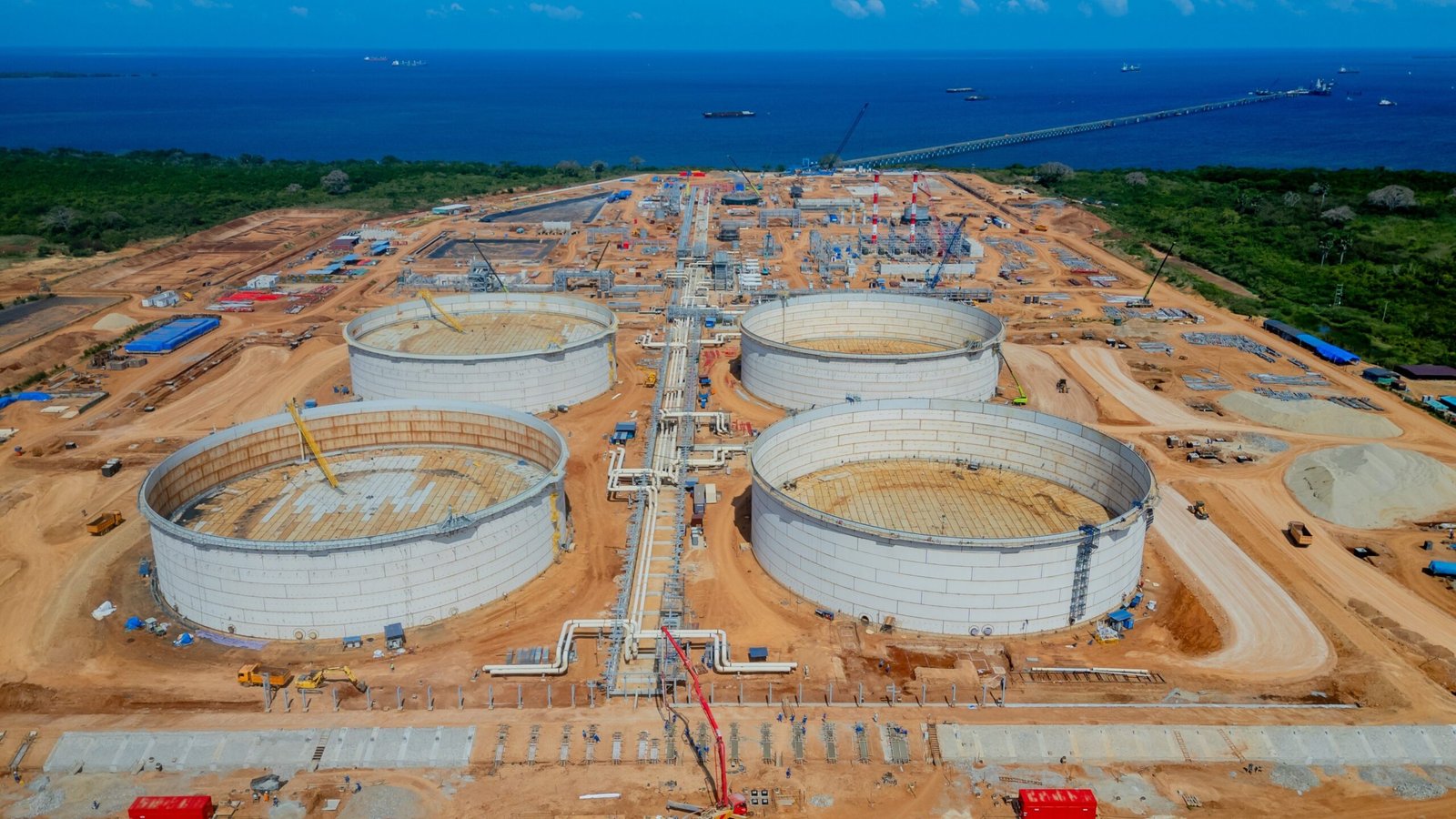
The company is simultaneously expanding storage capacity. Construction of the 320-million-litre Kampala Storage Terminal at Namwabula in Mpigi District formally began in September. The US$250–310 million project is intended to strengthen strategic reserves and improve Uganda’s resilience to external supply disruptions.
The existing Jinja Storage Terminal is being expanded from 30 million litres to 40 million litres through the addition of a 10-million-litre tank. At Kabalega Industrial Park, UNOC has contracted National Enterprise Corporation to construct 86 kilometres of internal roads, providing basic infrastructure for the planned refinery and wider industrial development.
These investments illustrate the broader strategy: Uganda wants UNOC to operate not merely as a vehicle for government participation in oil fields, but as a commercially capable national oil company spanning upstream interests, crude marketing, fuel imports, storage, pipelines, and downstream infrastructure.
Constitutional and Legal Framework
Uganda’s petroleum framework gives the emerging industry a strong public-interest mandate. Article 244 of the Constitution vests petroleum in its natural condition in the Government on behalf of the people of Uganda. The Petroleum (Exploration, Development and Production) Act, 2013, reinforces that principle, stating that petroleum rights are held by government “on behalf of and for the benefit of the people of Uganda.”
The Petroleum (Refining, Conversion, Transmission and Midstream Storage) Act, 2013 provides the broader legal framework for midstream petroleum infrastructure, while the Petroleum Supply Act governs the downstream supply chain.
These provisions make the COSASE inquiry more than an examination of corporate performance. They place questions about financing, ownership structures, contractual obligations, project delays, and petroleum revenues squarely within Parliament’s accountability mandate.
Documents Demanded, Questions Remain
COSASE has directed UNOC to provide outstanding documentation, including the complete Vitol financing agreement, environmental and social impact assessments, and information on oil marketing companies supplied under the sole-importation arrangement.
The documents could help answer several questions that will become increasingly important as Uganda approaches production:
· How much has the country spent to reach first oil?
· What remains to be financed before commercial production can begin?
· What are the repayment obligations attached to the Vitol facility?
· What security has been granted to the lender?
· What are the financial and governance implications of incorporating the refinery project company outside Uganda?
· How much revenue from Uganda’s crude will remain available for public investment after operating costs, financing obligations, participating interests, and other contractual commitments?
A Different Phase
Uganda’s oil story has entered a different phase. For years, the central question was whether commercial quantities of oil could be discovered and developed.
Today, the wells have been drilled, processing facilities are nearing completion, and the export pipeline is approaching readiness. EACOP has moved into its final construction and commissioning stages, while Uganda has already appointed a global trader to market its crude.
The challenge is no longer simply finding the oil. It is ensuring that the billions of dollars invested in Uganda’s petroleum system translate into a safe, functioning, and commercially viable chain from the wellhead to the international market — and that the public interest is protected all the way along it.
About The Author