
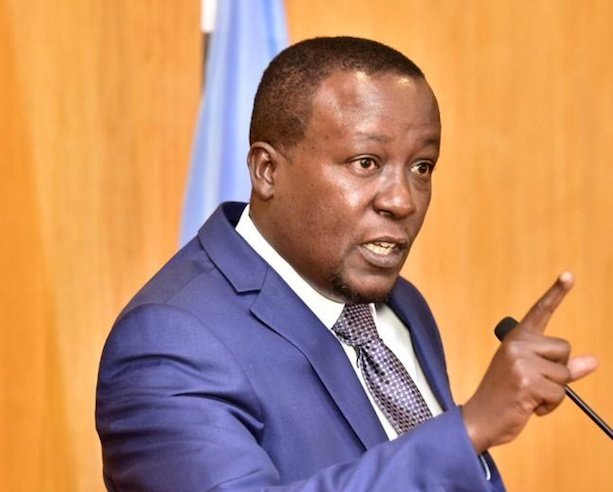
Headline: A House Divided: Kabuleta Dismisses Muhoozi’s Presidential Ambitions as a “Mirage” Amidst Calls for Institutional Respect
As Uganda navigates a tense political landscape following the recent elections, a stark divergence of opinion has emerged regarding the nation’s future leadership and the conduct of its most powerful figures. On one side stands opposition firebrand Joseph Kabuleta, who has delivered a scathing critique of General Muhoozi Kainerugaba, dismissing his presidential ambitions as a “mirage.” On the other, a voice from within the ruling establishment has made a rare appeal for restraint and respect for democratic institutions.
In a recent interview, Joseph Kabuleta launched a blistering attack on the Chief of Defence Forces, characterizing him as a leader who is “not the kind of person who can run a country.” Kabuleta argued that Gen. Kainerugaba’s influence is a direct result of his father’s presence, stating, “He’s going to get away with everything as long as the father is there,” but he’s ultimately “going nowhere .” “He is a mirage,” Kabuleta asserted, comparing the General to a deceptive pool of water on a hot road that vanishes upon approach.
Kabuleta’s condemnation was triggered by the recent arrest of lawyer Erias Lukwago. Lukwago, who is representing opposition figure Dr. Kizza Besigye, was detained and is now facing a treason-related offence after serving court papers on the military chief . Kabuleta argued that by arresting a lawyer for performing a constitutional duty, Gen. Kainerugaba displayed a fundamental lack of understanding of governance, relying instead on “entitlement” and “raw power.” “All he knows is entitlement,” Kabuleta stated, contrasting his actions with those of his father, President Yoweri Museveni, who Kabuleta claims has the ability to exercise power but does not do so “like that.” This incident has drawn widespread concern, with the Leader of the Opposition (LoP) Joel Ssenyonyi calling for Parliament to be recalled from recess to address what he describes as an escalating wave of human rights abuses and disregard for the rule of law .
This act of aggression has not been universally condemned, however. A contrasting appeal has emerged from within the pro-government camp. In a public message to Gen. Kainerugaba, a supporter identified as Tumukunde Tonny (IT) made a humble plea for mercy and political maturity. While expressing support for the General, Tonny urged him to allow the Leader of the Opposition, Joel Ssenyonyi, to continue his constitutional role without interference . “A strong government needs a strong opposition,” Tonny wrote. “Democracy thrives when institutions are respected, not weakened.” This rare appeal from within the ruling movement’s base suggests a concern that the harsh treatment of opposition figures is counterproductive and undermines the legitimacy of the government. It also alludes to the notion that a “balanced and reasonable opposition” is essential for governance to be considered legitimate.
These events unfold against a backdrop of significant political tension. Gen. Kainerugaba, who has a long history of controversial social media posts, has been open about his presidential aspirations . He has previously boasted about the killing and detention of opposition supporters and has established a powerful position within the military, leading many to believe he is being groomed as the heir to his father’s rule . However, he faces persistent criticism that his power is derived from his lineage rather than personal merit. As one analyst noted, the situation has led many Ugandans to “resign to the prospect of hereditary rule” .
The contrast between Kabuleta’s dismissive attack and Tonny’s conciliatory appeal highlights a critical juncture for Uganda’s political future. One vision sees a leader who rules by force and family legacy, while another calls for strengthening institutions to ensure a stable and democratic transition. Whether the government will heed the calls for institutional respect or continue to rely on raw power remains the central question shaping Uganda’s path forward.
About The Author