

Major Milestone Reached as East African Crude Oil Pipeline Nears Completion

KAMPALA/TANGA — The monumental East African Crude Oil Pipeline (EACOP) project has reached a pivotal stage, with construction now 79% complete and critical pump testing underway, putting the long-awaited project firmly on track for its 2026 operational launch.
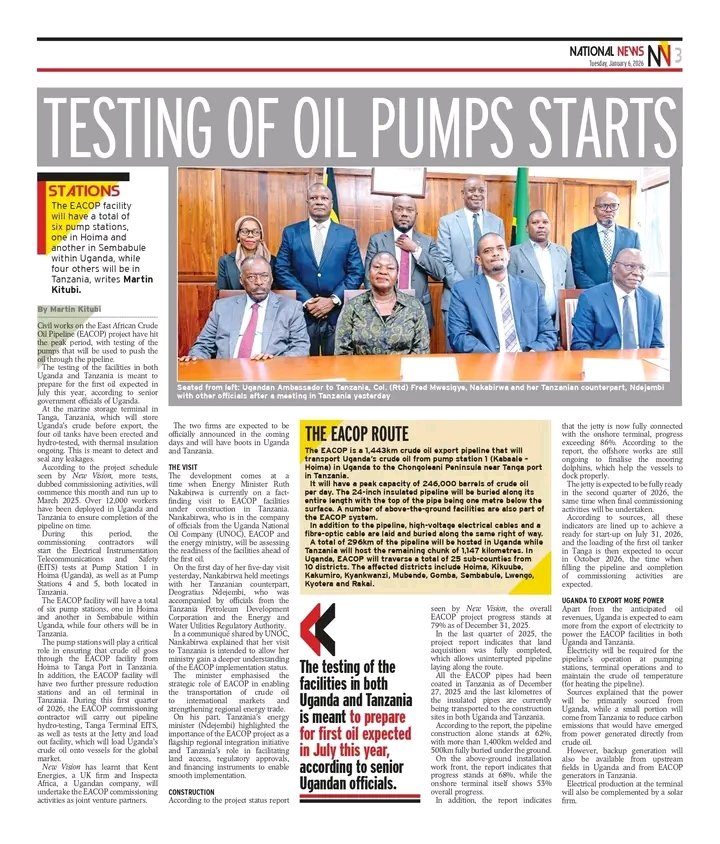
Senior officials from Uganda and Tanzania confirmed the commencement of pump testing this week, a key step in commissioning the 1,443-kilometer pipeline that will transport Uganda’s oil from Hoima to the Chongoleani Peninsula near Tanzania’s Tanga Port. The project is targeting mechanical completion and startup readiness by July 31, 2026, with first oil exports expected in October of that year.
“The testing of facilities is intended to ensure the readiness of key infrastructure,” said a project executive, noting that systems for pumping, electricity, telecommunications, and safety along the route are now being rigorously assessed.
The pipeline will be a central artery for Uganda’s nascent oil industry, carrying up to 216,000 barrels per day from the Tilenga and Kingfisher oil fields around Lake Albert. It will traverse 10 Ugandan districts before crossing into Tanzania, which will host the remaining 1,147 kilometers of the route.
Construction progress is visible across the entire route. Over 1,400 kilometers of pipeline have been welded, with approximately 500 kilometers already buried. At the marine terminal in Tanga, four massive crude oil storage tanks are complete, and offshore jetty work is 68% finished. Overall, pump station construction is at 62%, and the marine terminal stands at 55% completion.
Beyond infrastructure, officials highlight the project’s significant socio-economic footprint. More than 12,000 workers are currently engaged, with over 8,500 direct employees in Tanzania alone, creating thousands of jobs and skills training opportunities intended to improve local livelihoods.
“The EACOP is more than a pipeline; it is a catalyst for skills development and economic growth in our communities,” a Tanzanian official stated.
Project authorities have also reaffirmed their commitment to environmental safeguards, implementing measures to protect ecosystems and water resources along the sensitive route.
Once operational, the EACOP will mark the culmination of two decades of preparation for Uganda’s oil production, positioning itself as a transformative piece of regional energy infrastructure set to boost export revenues and deepen economic integration between Uganda and Tanzania.
About The Author