
The Otafiire-Muhoozi Rivalry: A Generational Clash Within Uganda’s Ruling Establishment
A Public Spat Reveals Deeper Fault Lines
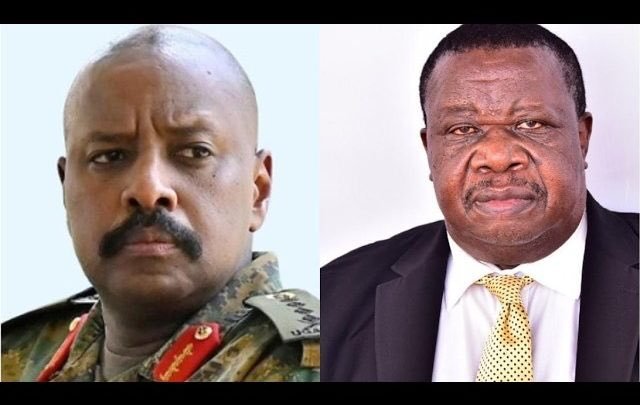
Chief of Defence Forces Gen. Muhoozi Kainerugaba’s recent threat to have veteran politician Maj. Gen. (Rtd) Kahinda Otafiire arrested has once again brought into sharp focus one of the National Resistance Movement’s (NRM) longest-running and most symbolic internal rivalries.
The latest public confrontation erupted after Otafiire, the Minister of Water and Environment, criticized alleged extrajudicial killings within the Uganda Police Force’s Crime Intelligence Directorate. In a post on X this Friday morning, Muhoozi warned that Otafiire was “dangerously close to being arrested” after the veteran politician accused some police officers of carrying out extrajudicial killings.
“A cabinet Minister who claimed he is a leopard and condemned the Great officers of Crime Intelligence of Uganda Police, has provoked lions enough and is dangerously close to being arrested,” Muhoozi wrote.
The comments were widely interpreted as a response to Otafiire’s recent appeal to newly appointed Internal Affairs Minister Prof. Ephraim Kamuntu. “Hon. Professor Kamuntu, I forgot to tell you, please don’t tolerate any form of extrajudicial killings especially by some few rogue officers in the Crime Intelligence Directorate,” Otafiire posted on X.
Beyond the Surface: A Deeper Contest for Influence
For political observers, the exchange is about far more than security agencies. It represents the latest manifestation of a deeper contest between the NRM’s historical generation and a newer centre of power increasingly represented by Muhoozi.
The fault line between the two men became particularly visible during the heights of the Muhoozi project debate, and for many within the ruling establishment, the recent exchange is merely the latest chapter in an uneasy relationship that has endured for years.
Otafiire: The Veteran Revolutionary
Otafiire stands as one of the most influential surviving figures of Uganda’s liberation struggle. A founding member of FRONASA, the guerrilla movement led by President Museveni, Otafiire fought in the bush war and has remained a central figure within the NRM since the movement captured power in 1986.
Over the years, he has served in several senior cabinet positions, including:
· Minister of Internal Affairs
· Minister of Justice and Constitutional Affairs
· Minister of Local Government
· Minister of East African Community Affairs
A seasoned intelligence operative and veteran of the liberation struggle, Otafiire commands significant influence within both the ruling party and sections of the security establishment. His reputation for bluntness and ideological purism has made him one of the NRM’s most respected, and sometimes feared, historicals.
Muhoozi: The Rising Force
Muhoozi, on the other hand, represents a newer generation of power within the movement. As Chief of Defence Forces and the President’s son, Muhoozi has, over the past decade, steadily built a formidable political and military profile.
He has attracted a loyal following through the defunct MK Movement (now PLU) and his extensive social media presence, positioning himself as a powerful voice for a younger generation within Uganda’s ruling establishment.
A Symbolic Rivalry
The ongoing tension between these two figures symbolizes a broader generational contest within the NRM. On one side stands the old guard—the liberation heroes who fought in the bush war and have shaped Uganda’s political landscape for nearly four decades. On the other stands a newer centre of power, one that represents the future of the movement and, potentially, the country.
As Uganda looks toward an uncertain political future, the Otafiire-Muhoozi rivalry serves as a reminder of the complex dynamics at play within the country’s ruling establishment—a struggle between the revolution’s past and its possible successor.
About The Author