

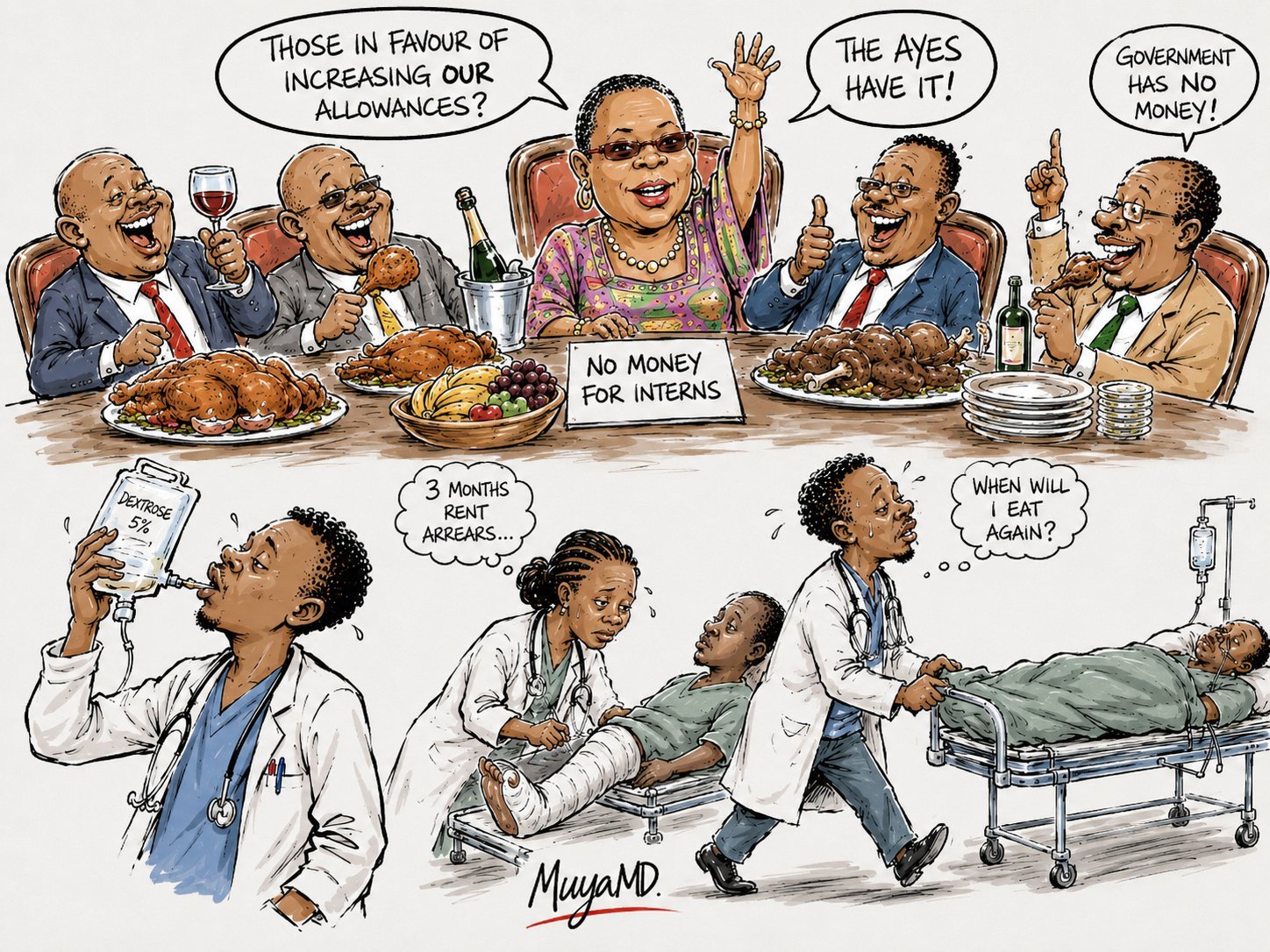
Opinion: It’s Not a Money Problem—It’s a Priority Problem. The Math on Uganda’s Medical Interns is Shameful
For months, Ugandans have watched a familiar, heartbreaking theatre play out: hundreds of medical interns are locked out of public hospitals, patients are crammed onto cold floors, and the Ministry of Health cries poverty. The government’s official position suggests the country cannot afford to pay its own doctors-in-training. But a sober look at the national budget tells a radically different story.
Let us be honest. The issue is not that medical interns are too many. It is not that Uganda has no money. The brutal truth is that medical interns are simply not being treated as a priority.
Consider the choices our leaders are making.
The Legislature vs. The Ward
While a doctor struggles to earn a living, Parliament is ballooning. The parliamentary budget has reportedly doubled to a staggering Shs 1.2 trillion. The money going to just 529 MPs jumped from approximately Shs 400 billion in 2020/21 to Shs 744.4 billion in 2026/27—an increase of Shs 344.4 billion. Ask the common Ugandan waiting in a crowded, understaffed hospital: what direct return are they getting from that investment?
If you want the clearest indictment of misplaced priorities, look at just two offices. In 2020/21, the combined budget for the Speaker and Deputy Speaker was about Shs 7.1 billion. In the proposed 2026/27 budget, that figure stands at roughly Shs 50.2 billion.
That is an increase of Shs 43.1 billion. For two offices.
To put that number in human terms: that increase alone could pay 3,000 medical interns a salary of Shs 1 million per month for a full year—with money left over.
Questionable Spending While Patients Suffer
The rot goes deeper. Scrutiny of the Speaker’s office budget lines for 2025/26 reveals spending that is hard to justify when emergency wards are collapsing:
· Shs 2.4 billion for foreign travel
· Shs 966 million for fuel
· Shs 4.8 billion for incapacity, death benefits and funeral expenses
· Shs 5.2 billion for donations
That is a total of Shs 14.2 billion. What lasting public health return does that produce compared to having actual doctors on the wards?
Then there is the expansion of political administrative structures. Uganda reportedly employs 748 RDC officials (146 RDCs, 170 Deputy RDCs, and 432 Assistant RDCs). Their proposed salary enhancement alone requires an extra Shs 29.079 billion every year. Add Shs 30 billion for LC I to LC V political leader facilitation, and you have roughly Shs 59 billion—enough to pay every eligible medical intern several times over.
Donations Over Doctors
Perhaps the most galling comparison is State House donations. Over seven financial years, these reportedly consumed Shs 751 billion. In 2023/24 alone, donations were budgeted at Shs 18.1 billion, but actual spending ballooned to Shs 80.18 billion.
If tens and hundreds of billions can be found for discretionary donations, how does Shs 24 billion to Shs 36 billion for over 2,000 medical interns become mathematically impossible?
A Shrinking Commitment to Health
While political comfort zones expand, the Ministry of Health vote is shrinking. It fell from Shs 1.693 trillion in FY2023/24 to just Shs 1.344 trillion in FY2024/25—a brutal reduction of Shs 349 billion. Even the 2025/26 estimate of Shs 1.564 trillion remains below where we were two years ago.
This is the sector that touches mothers in labour, accident victims, children with malaria, and emergency patients in every public hospital.
The Math is Simple
Let us do the arithmetic the government refuses to do:
· 2,000 interns × Shs 1m × 12 months = Shs 24 billion per year
· 2,500 interns × Shs 1m × 12 months = Shs 30 billion per year
· 3,000 interns × Shs 1m × 12 months = Shs 36 billion per year
Even using the Ministry of Health’s own gross figure of Shs 15.6 million per intern per year, the reported 2,706 eligible interns would require about Shs 42.2 billion. That sum is still pocket change compared to what is being found for parliamentary luxury, RDC salaries, and political donations.
What is at Stake?
This money we are begging for is not a handout.
· ✨ It avails doctors on wards.
· ✨ It keeps emergency units covered.
· ✨ It supports maternity care.
· ✨ It fills staffing gaps in regional referrals.
· ✨ It protects patients.
So let us stop pretending. This is not a numbers problem. This is not a money problem. This is a priority problem.
Medical interns are doctors under apprenticeship, not free labour. Until the treasury and Parliament treat them with the same urgency as they treat their own fuel budgets and foreign travel, the blood of patients who die in understaffed corridors will be on their hands.
InternsNotSlaves
About The Author