
Uganda’s Great Chimpanzee Forests: Kibale National Park and Budongo Forest
The Ultimate Primate Destinations

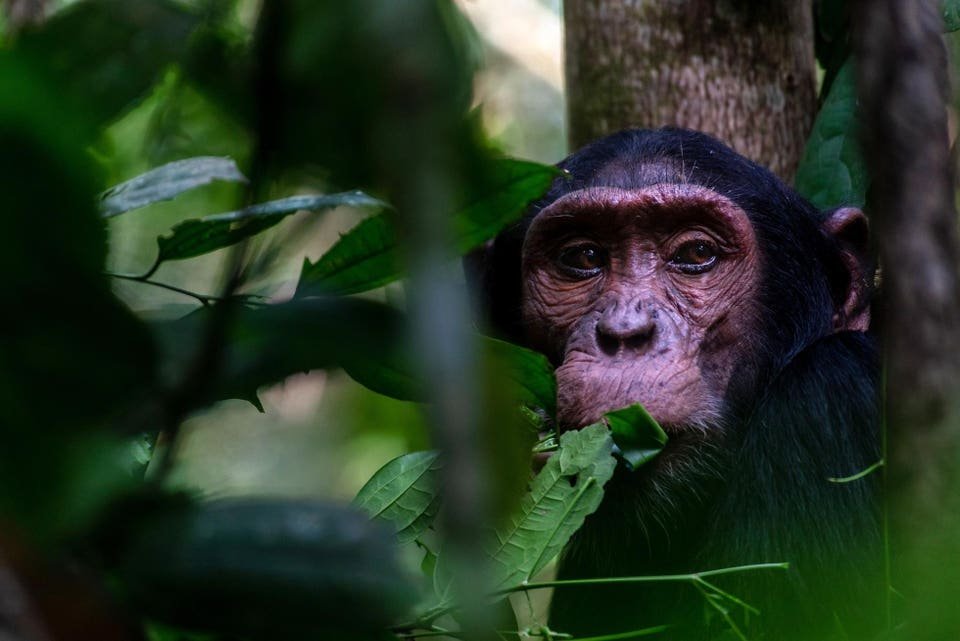
The first chimpanzee appeared so suddenly I almost missed it. One moment I was standing quietly beneath the towering rainforest canopy in western Uganda, listening to the calls of birds and the rustle of leaves overhead. The next, a dark shape moved through the branches above me. Then came a chorus of pant-hoots, echoing through the forest. Branches shook. A young chimpanzee swung effortlessly from one branch to another, while its mother sat calmly feeding nearby. For nearly an hour, I watched as one of mankind’s closest relatives went about its daily life in an ancient African rainforest.
A week later, I found myself in another Ugandan forest, 150 miles away. The experience here was different, but equally wonderful. The forest felt older, wilder and quieter. Massive mahogany trees towered overhead, filtering sunlight into green shafts that illuminated the forest floor. Once again, chimpanzees emerged from the canopy, reminding me that Uganda is one of the world’s great destinations for primate encounters.
While mountain gorillas often dominate the conversation around Ugandan wildlife tourism, the country’s chimpanzee experiences are among the finest on earth. Nowhere is that more evident than in two remarkable forests: Kibale National Park and Budongo Forest. Each offers visitors the opportunity to encounter wild chimps in their natural habitat, each plays a critical role in conservation, and each is home to a landmark lodge that places guests right at the heart of the experience.
Two Forests, Two Different Experiences
At first glance, Kibale National Park and Budongo Forest may seem remarkably similar. Both are tropical rainforests, both are globally important primate habitats, and both attract visitors looking for incredible primate encounters. Yet each possesses a distinct character.
Kibale National Park: East Africa’s Primate Capital
Located in western Uganda, Kibale National Park is often referred to as the primate capital of East Africa. Covering nearly 300 square miles, the park protects one of the continent’s richest concentrations of primates. Here you’ll find the highest concentration of chimpanzees in East Africa, along with:
· Red Colobus monkeys
· Black-and-White Colobus monkeys
· Red-tailed monkeys
· Olive baboons
· Vervet monkeys
· Blue monkeys
· Endemic Grey-cheeked Mangabeys
· Ground-dwelling L’Hoest Monkeys
· Rare, secretive, swamp-dwelling De Brazza’s monkeys
· Slow-moving, tree-dwelling Pottos
· Small, agile, nocturnal Bush Babies (Galagos)
The forest in Kibale is vibrant and energetic. Wildlife encounters are frequent, and the dense vegetation creates the atmosphere of an expedition into a natural cathedral.
Budongo Forest: A Wilder Rhythm
Part of the greater Murchison Falls Conservation Area, Budongo is the country’s largest natural tropical forest. Best known for its population of 600–800 chimpanzees, the forest is also home to nine different primate species, including Black-and-White colobus, Blue monkeys, Red-tailed monkeys, Grey-cheeked Mangabeys, Olive baboons, Bush-babies, and nocturnal Pottos.
Budongo offers a unique opportunity to participate in chimpanzee habituation activities, where visitors assist in acclimating chimps to the presence of people. This entails following unhabituated troops for several hours under the guidance of professional guides while observing and recording behavior. These troops are much more difficult to find, as they live deeper in the forest, often requiring a full day of searching and observation. The habituation process can take 2–3 years, and these experiences assist in that important work.
The Chimpanzees That Put Uganda on the Primate Map
The true stars of both forests are, of course, the chimpanzees. Sharing nearly 99% of their DNA with humans, chimps offer one of the most fascinating wildlife experiences available anywhere in the world. Their intelligence, social structures, complex emotions, and remarkable similarities to human behavior make for encounters that can feel incredibly personal.
In Kibale, visitors have access to one of Africa’s most successful chimpanzee tracking programs. Sightings here can be spectacular. The chimps’ vocalizations carry across the forest, regularly alerting you to their presence long before you see them, and they frequently descend to the forest floor, allowing unusually close views—it’s not uncommon to find yourself in proximity to a group of 30 or more chimps.
Budongo offers a subtly different experience. The Kaniyo Pabidi sector is home to a well-established chimpanzee community habituated over many years. Tracking here takes place beneath enormous mahogany trees, creating a dramatic backdrop unlike anywhere else in Uganda. The chimps in Budongo can be more challenging to follow, as they move rapidly through the canopy—but that unpredictability is part of the appeal.
What makes both destinations exceptional is reliability. While wildlife sightings can never be guaranteed, visitors stand an extremely high chance of seeing chimpanzees in both locations.
Conservation Through Tourism
Behind every successful chimpanzee encounter lies decades of conservation work. Chimps face countless threats across Africa, including habitat loss, disease transmission, and human encroachment. Protecting the forests chimps depend upon requires substantial resources and long-term commitment.
Tourism has become an important tool in that effort. Every tracking permit contributes to the management and protection of forest ecosystems, and revenue generated through tourism supports:
· Monitoring and habitat protection
· Scientific research
· Local employment opportunities
In Kibale, decades of conservation and research have helped establish the park as one of Africa’s leading primate conservation success stories. Budongo has similarly become an important center for chimpanzee research and monitoring. Scientists working in these forests continue to study chimpanzee behavior, ecology, and health, collating valuable information that informs conservation efforts throughout the region.
Just as important are the benefits to surrounding communities. Guides, lodge staff, drivers, suppliers, and local businesses all benefit from a thriving tourism economy. The result is a model where protecting forests and wildlife creates tangible economic opportunities for the people living nearby. As travelers increasingly seek experiences that deliver positive environmental impact, Uganda’s chimpanzee destinations provide a compelling example of conservation in action.
Where to Stay
Primate Lodge: Living in the Heart of Kibale
Location is everything when it comes to safari travel, and Primate Lodge definitely enjoys one of the most enviable addresses in Uganda. Situated within Kibale National Park itself, the lodge offers guests direct access to the forest and its wildlife.
Rather than driving to the start of chimpanzee tracking excursions, visitors wake up surrounded by the sounds of the rainforest. Bird calls echo through the canopy. Monkeys move through nearby trees. The forest wraps around the lodge. The accommodation is designed to blend naturally into the surrounding environment, with the rainforest as the central focus of the experience.
What makes Primate Lodge particularly attractive is convenience. The chimpanzee tracking headquarters are only minutes away, and for travelers whose primary goal is seeing chimpanzees, few properties are better positioned. This is a property that has helped define Uganda’s primate tourism sector and remains one of the country’s most iconic safari lodges.
Pabidi Lodge: Budongo’s New Eco-Luxury Retreat
If Primate Lodge is an established classic, Pabidi Lodge represents an exciting new chapter. This recently opened property has brought eco-conscious luxury to Budongo Forest. Located in the Kaniyo Pabidi sector, guests are just a 10-minute drive from one of Uganda’s premier chimpanzee tracking areas.
Pabidi’s greatest strength is its setting. Surrounded by rainforest and positioned to maximize forest views, the lodge truly feels part of the landscape. The property’s eco-lodge philosophy is evident throughout—natural materials, low-impact construction principles, a light footprint, and a strong emphasis on sustainability.
The lodge also occupies a strategic position between rainforest and savannah. Visitors can combine chimpanzee tracking in Budongo with game drives and boat safaris in Murchison Falls National Park, creating a diverse safari itinerary.
Why Uganda Offers the Best Chimpanzee Safari
For travelers interested in chimpanzees, few countries can rival Uganda. Kibale National Park and Budongo Forest offer two distinct but complementary experiences. One is celebrated as East Africa’s primate capital, the other increasingly recognized as one of the continent’s great rainforest destinations. Together, they tell a larger story about conservation, biodiversity, and the future of safari travel.
Standing beneath the canopy in both forests, watching chimpanzees move through the trees and across the forest floor, it becomes clear that these experiences are about far more than wildlife sightings. They are encounters with ecosystems that have survived for centuries and with species that remain profoundly connected to our own evolutionary story.
With Primate Lodge continuing to anchor the Kibale experience and the arrival of Pabidi Lodge bringing fresh energy to Budongo, Uganda now offers travelers two world-class gateways into the lives of wild chimpanzees. For those seeking Africa’s ultimate chimpanzee safari, the answer may not be choosing between them—it may be experiencing both.
Sarah Kingdom covers travel, with a focus on sustainable luxury.
Planning Your Visit
Best Time to Visit: Both forests are accessible year-round, though the dry seasons (December-February and June-September) offer easier trekking conditions.
Permits: Chimpanzee tracking permits are required and should be booked in advance through the Uganda Wildlife Authority.
Getting There: Kibale National Park is approximately a 5-6 hour drive from Kampala. Budongo Forest is located within the Murchison Falls Conservation Area, about a 4-5 hour drive from Kampala.
Accommodation: Primate Lodge Kibale and Pabidi Lodge Budongo offer premium eco-luxury experiences within their respective forests.
About The Author