
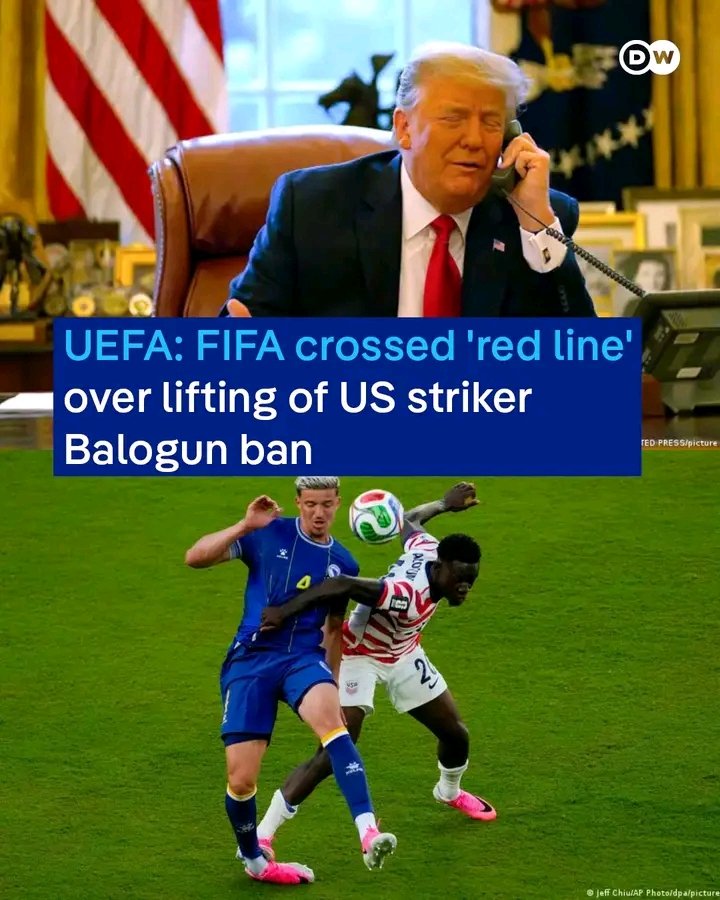
UEFA Accuses FIFA of “Crossing a Red Line” Over Balogun Ban Suspension

A major row has erupted in world football after UEFA formally accused FIFA of breaching its own regulatory boundaries by suspending the automatic one-match ban handed to United States striker Folarin Balogun during the 2026 World Cup.
Balogun, a key player for the U.S. team, had been set to miss Monday’s Round of 16 clash against Belgium after receiving a straight red card in the Round of 32 match against Bosnia and Herzegovina on Wednesday. Under FIFA’s official disciplinary code, a straight red card mandates an automatic one-game suspension—a rule that has long been applied uniformly across international tournaments.
However, in an extraordinary move, FIFA’s disciplinary committee opted to suspend the ban for a period of one year, effectively clearing Balogun to face Belgium. The global football body announced the review and subsequent suspension after reports emerged that U.S. President Donald Trump had personally urged FIFA President Gianni Infantino to reassess the punishment. While FIFA has not confirmed the extent of Trump’s influence, the timing and nature of the decision have fueled widespread skepticism.
UEFA, European football’s governing body, issued a sharply worded statement condemning the action. The organization said the decision was “unprecedented, incomprehensible and unjustifiable,” warning that it could fundamentally undermine trust in the rules of the game. UEFA further accused FIFA of “crossing a red line” by setting aside established disciplinary procedures in response to external political pressure.
The controversy has cast a shadow over what was already a high-stakes knockout match, with fans, pundits, and football officials questioning whether the integrity of World Cup regulations has been compromised. As of now, FIFA has not provided a detailed legal rationale for suspending the ban, nor has it addressed UEFA’s allegations directly. Balogun is expected to start against Belgium, but the fallout from this decision is likely to persist long after the final whistle.
About The Author