
EYEWITNESS ACCOUNT: The Fall of Mengo Through the Eyes of a Child – Kampala, January 1986
KAMPALA – As Uganda marks the anniversary of the National Resistance Army (NRA) capture of Kampala, personal accounts from civilians who lived through the fierce battle for the city provide a poignant, ground-level perspective of history. One such account comes from a family whose home in Kisenyi, nestled between the Lubiri Army Barracks and the Republic House (Bulange), became an unexpected front line.
For three tense days from January 24, 1986, rockets fired from Kololo Hill arced over their rooftop, targeting NRA advances in Busega and Nateete. The family of eight—a mother and her seven children—huddled together, their planned evacuations to Namirembe or Rubaga cathedrals abandoned after warnings that the elevated church grounds were themselves potential targets.
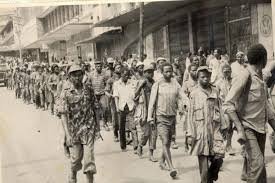
The defining moment arrived on the morning of Saturday, January 25. “We woke to an unforgettable sight,” the narrator recalls. A silent, weary column of retreating government soldiers (UNLA) moved through the Kisingiri Housing Estate. Heavily armed but without firing a shot, they trudged through banana groves and across the family’s compound, avoiding the direct route to Lubiri Barracks. Their solemn retreat was the first clear sign: Mengo, the seat of the army headquarters and key military depot, had fallen.
“Our mother repeatedly warned us to stay away from the doorway,” the account continues. But as children, they were captivated by the sight of the battle-worn soldiers. “I had only seen such images on war movie posters at The Odeon Cinema.” Miraculously, the defeated army passed without harming the civilians openly watching them.
The tide turned that same evening. As gunfire subsided, a new group of armed men entered the area. A familiar voice called out from the advancing group: it was “Byaka,” a childhood friend of the elder brother, now an NRA fighter. He reassured the family that Mengo was under NRA control but warned that operations in the city were ongoing. His arrival marked the moment of liberation, prompting cautious residents to emerge and greet the incoming forces.
The sobering reality of the conflict became starkly clear the next day. A walk through liberated Mengo revealed abandoned vehicles, scattered belongings, and the bodies of fallen soldiers and civilians. “We could not tell who had been combatants and who had been caught in the fighting. The scenes were heavy, sobering!” the narrator remembers, particularly noting the grim scenes below Mengo Hospital.
In a stark postscript that underscores the lingering dangers of war, curiosity nearly turned tragedy into triumph. The children collected abandoned bullets, and in a reckless experiment, tossed one into a fire. It exploded, sending them into a panic. “We had survived days of warfare, only to endanger ourselves afterward.” The remaining ammunition was hastily disposed of in a pit latrine.
Life began a slow return to normalcy with the announcement of a new government on Radio Uganda and a return to school, though displaced persons still occupied Mengo Primary School classrooms. The memory, however, remains indelible—a child’s-eye view of a nation’s violent transition, marked by fear, curiosity, miraculous survival, and the profound relief of peace finally dawning over the hills of Kampala.
This account is based on the personal memories of a witness who was a child in Kisenyi during the January 1986 capture of Kampala.
About The Author