
The Fire That Forged Modern Safety: The 1903 Iroquois Theatre Disaster
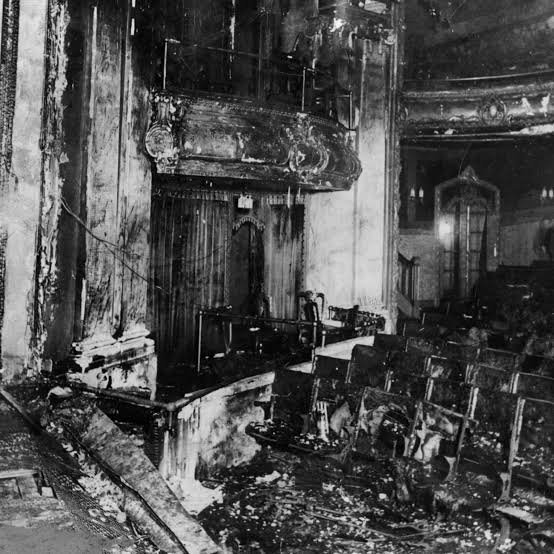
On December 30, 1903, as Chicago families enjoyed holiday entertainment at a lavish new theater, a catastrophic fire claimed over 600 lives in what remains the deadliest single-building fire in American history. The Iroquois Theatre disaster wasn’t merely a tragic accident—it was a predictable outcome of negligence that ultimately transformed building safety forever.
A “Fireproof” Death Trap
The Iroquois Theatre opened on November 23, 1903, at 24-28 West Randolph Street in Chicago’s bustling Loop district . Promoted as “absolutely fireproof” in advertisements and playbills, the venue was designed to attract daytime shoppers, particularly women visiting the city . Drama critics hailed it as “the most beautiful theater in Chicago,” with architectural features that prioritized elegance over safety .
But behind the opulent facade, warning signs had been ignored. Chicago Fire Department Captain Patrick Jennings conducted an informal inspection before the opening and discovered no sprinklers, no alarms, no telephones, and no water connections . When he reported these deficiencies, his superiors dismissed his concerns because the theater already employed its own fireman . William Clendenin, editor of Fireproof Magazine, toured during construction and noted multiple hazards: the absence of proper ventilation, exposed structural elements, abundant wood trim, and inadequate exits .
The theater’s design compounded these risks. A single grand staircase served all three balcony levels, violating Chicago ordinances requiring separate exits for each level. During performances, iron gates blocked stairways to prevent patrons from moving between sections . The asbestos fire curtain—the last line of defense against stage fires—would later prove useless, with a chemist determining it contained mostly wood pulp mixed with minimal asbestos .
The Afternoon of Horror
December 30, 1903, began as a festive day. The matinee performance of the popular musical Mr. Blue Beard drew a sold-out crowd estimated at 2,100 to 2,200 people—well exceeding the theater’s 1,602-seat capacity . Hundreds of patrons stood in the rear or sat in aisles. Most were women and children, enjoying holiday entertainment while school was out .
At approximately 3:15 p.m., during the second act number “In the Pale Moonlight,” disaster struck . An arc light used to create a blue-tinted night scene sparked or broke, igniting a muslin curtain . Stagehands scrambled to douse the flames with Kilfyre extinguishers—cardboard tubes filled with baking soda powder that proved useless against fire spreading high above the stage .
The fire raced upward to the fly gallery, where thousands of square feet of highly flammable painted canvas scenery hung like kindling . Stage manager James Cummings attempted to lower the asbestos curtain, but it jammed after descending only a few feet—blocked either by a light reflector protruding beneath the proscenium arch or by a trolley wire used for acrobats .
Comedian Eddie Foy, preparing to take the stage, ensured his young son was safe, then ran out to face the audience . “It struck me as I looked out over the crowd during the first act that I had never before seen so many women and children in the audience,” Foy later wrote. “Even the gallery was full of mothers and children” . He pleaded with patrons to remain calm and ordered the orchestra to keep playing . Despite his heroism, panic quickly overwhelmed his appeals as flames and smoke intensified.
Trapped by Locked Doors
The real horror began when patrons attempted to flee. Twenty-seven of the theater’s thirty exits were either locked or hidden behind draperies . Many doors featured unfamiliar bascule locks that patrons couldn’t operate in their desperation . Some doors opened inward—a fatal flaw when panicked crowds pressed against them, sealing themselves inside .
Former baseball player Frank Houseman managed to open one door only because his home icebox used a similar lock . He credited his friend Charlie Dexter with forcing open another. A third door yielded either to brute force or an air blast, but most remained impenetrable . Patients trapped in dead ends or trying to open windows designed to look like doors perished where they stood .
When someone finally opened a back door, the sudden influx of air created a fireball that roared through the backstage area . In the foyer where multiple aisles converged, bodies piled five to six feet deep . The dead included entire families—like Etta Spindler and her son Burdette from Lowell, Indiana, who died alongside Etta’s sisters Jennie Rife and Lillian Frady . Bessie and Nina Chapman, sisters from Cedar Rapids, Iowa, suffocated in the first balcony crush just feet from an exit . Kindergarten teacher Josephine Munholland reportedly reached safety but returned to rescue children and perished .
Within approximately fifteen minutes, the fire claimed 602 lives and injured 250 others . It remains the highest death toll of any single-building fire in American history, surpassed only by the September 11, 2001, attacks nearly a century later .
Justice Denied, Reform Demanded
In the aftermath, a grand jury indicted five men: theater owners Will Davis and Thomas Noonan, stage manager James Cummings for manslaughter, and Building Commissioner George Williams and Inspector Edward Laughlin for malfeasance . Evidence suggested city inspectors had accepted free theater tickets to overlook safety violations .
But justice never came. The defense successfully argued that Chicago’s fire ordinances were technically invalid, and the judge dismissed all charges . No one faced consequences for 602 deaths.
Public outrage, however, forced change. Chicago Mayor Carter Harrison Jr. ordered every theater in the city closed for six weeks of safety renovations . More importantly, the disaster sparked sweeping reforms that spread nationwide and internationally .
New regulations mandated that all exit doors must open outward and remain unlocked during performances . The tragedy directly inspired the development and widespread adoption of the “panic bar”—a horizontal bar that opens a door with simple pressure, allowing rapid escape even for those unfamiliar with the lock mechanism . New York and London implemented stricter theater safety rules almost immediately, and by 1904, New York had enacted comprehensive building standards for theaters .
Other critical reforms followed: required exit signs and emergency lighting, fire alarm systems in all public venues, proper maintenance of fire curtains, restrictions on maximum occupancy, and prohibition of doors that open inward for public assembly spaces . These changes were incorporated into the National Fire Protection Association’s Life Safety Code (NFPA 101), which continues to govern building safety today .
Legacy in Stone and Law
The Iroquois Theatre reopened as Hyde & Behman’s Music Hall in September 1904, later becoming the Colonial Theatre before demolition in 1925 . The Oriental Theatre (now the Nederlander Theatre) rose on the same site in 1926 .
But the true memorial exists in every public building where exit signs glow green, where doors swing outward, where panic bars await an emergency that may never come. The Iroquois fire demonstrated that negligence could transform a place of joy into a death trap within minutes. Its lessons, purchased at the highest possible price, remain embedded in building codes that protect millions of lives each day.
As one survivor account from the Lowell Tribune poignantly noted: “No tongue can tell, no pen can write the horrors of that awful half-hour, when the lives of 591 men, women and children, most the latter, went out and caused a night of gloom to settle over hundreds of homes” . From that gloom emerged a commitment to safety that transformed American architecture and law—a legacy that honors those lost by ensuring such a disaster can never happen again.
About The Author