
The Rosewood Massacre: The Tragic True Story and the Haunted Spirits of a Burned Florida Town
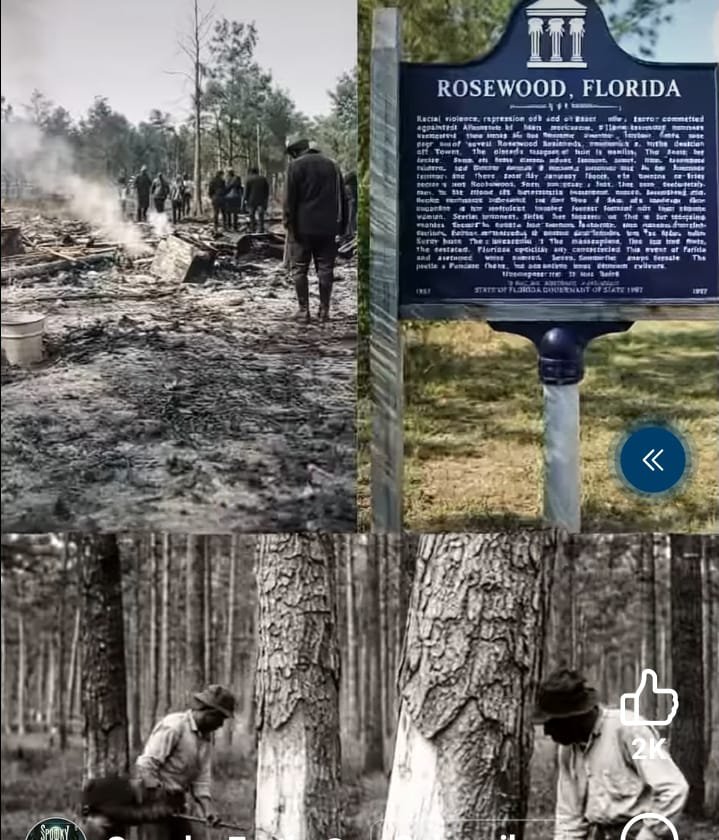
The image you shared hints at a chilling story: a “haunted burned town” where “spirits never found peace.” This is the legacy of Rosewood, Florida. While the hashtags point toward the paranormal, the foundation of this haunting is a harrowing true story of racial violence that erased a prosperous Black community from the map in 1923 . For the spirits of Rosewood, the trauma of the past ensures their story—and their unrest—lingers on.
A Prosperous Community Erased
To understand the ghosts of Rosewood, you must first understand the life that was stolen. By the 1920s, Rosewood was a quiet, self-sufficient town of about 200 Black residents. Located in Levy County, Florida, it was a place where families owned land, homes, and even businesses like a sugarcane mill, a turpentine mill, and a baseball team called the Rosewood Stars . It was, as one descendant later described it, a “Black Mecca” . But this peace was shattered in the first week of January 1923.
The tragedy was ignited by a lie. On January 1, 1923, Fannie Taylor, a white woman in the nearby town of Sumner, claimed she had been assaulted by a Black man . It was later believed she made up the story to cover up a beating from her white lover . Nevertheless, her accusation unleashed a storm of pre-existing racial hatred. A mob of white men, including members of the Ku Klux Klan who were in the area for a rally, formed to hunt for the alleged culprit .
What followed was a week of terror. Mobs scoured the area, targeting Rosewood’s Black residents. Aaron Carrier was dragged from his home and beaten . Sam Carter, a blacksmith, was tortured and lynched . On the night of January 4, a group of white men surrounded the home of Sarah Carrier, believing they were hiding a fugitive. A gun battle erupted; Sarah Carrier was shot in the head and killed, along with her son Sylvester, who also killed two white attackers in self-defense .
This violence escalated into the complete annihilation of a town. News spread, inflaming the situation and bringing even more white vigilantes to the area. They burned Rosewood’s churches, its homes, and its businesses to the ground . Survivors were hunted like animals; Lexie Gordon was shot and killed as she hid under her burning house . For days, many residents hid in the freezing, swampy woods, listening to the destruction of their homes . They were finally evacuated by train, thanks to the bravery of a few white families like John Wright, who sheltered them, and brothers John and William Bryce, who risked their safety to carry them away .
The official death toll was recorded as six Blacks and two whites, though many survivors and historians believe the number of Black victims was much higher, with some estimates reaching into the dozens . No one was ever arrested or prosecuted for the crimes .
The Haunting Legacy: Spirits That Never Found Peace
The town of Rosewood was never rebuilt. The survivors were too terrified to return, scattering across the country and often remaining silent about their past for decades . The physical town ceased to exist, but the trauma imprinted itself on the land. This is where the true story bleeds into the paranormal legend, giving rise to the “haunted burned town” described in your image. Locals and visitors say the spirits of Rosewood’s victims never found peace, forever guarding the site of their tragic end.
· The Unsettled Woods: The area where the town once stood is now largely forest. Those who venture into the woods near the site of the old town often speak of an overwhelming sense of dread. “Hunters and wanderers often speak of an unsettling presence—of being watched, of faint voices carried through the trees—as if the spirits remain on guard” .
· Echoes of Violence: Some witnesses have reported apparitions and sounds that seem to replay the final moments of the massacre. One account describes seeing the ghost of an African American man dropping to his knees and pleading for mercy before vanishing. Others have reported hearing “screams and gunshots” echoing through the woods where no one is present .
· Guardians of the Truth: Rather than being purely malevolent, the spirits of Rosewood are often seen as protectors of the town’s memory. The haunting isn’t about fear, but about remembrance. “Many believe the spirits there protect the truth of what happened, ensuring the tragedy is never erased from memory. After all, when the land carries blood, silence is never an option” . One visitor who felt the area’s energy described it as a “very heavy sadness” and “feelings of anxiety and fear,” as if the residual energy of the horrific event is forever baked into the soil .
Today, the site of Rosewood is marked by a Florida Heritage Landmark, a small but powerful acknowledgment of what was lost . The survivors and their descendants fought for recognition, and in 1994, the state of Florida passed a bill providing compensation to the survivors, the first of its kind in the U.S. .
The story of Rosewood is not just a ghost story. It is a memorial. As your image suggests, it is a #truestory where the spirits never found peace because justice was never fully served. The whispers in the woods and the fleeting shadows are not just paranormal events; they are the echoes of a community that refuses to be forgotten, ensuring that the tragedy of Rosewood, Florida, continues to be heard.
About The Author