
The Ghost Who Solved Her Own Murder: The Unsettling Case of Teresita Basa
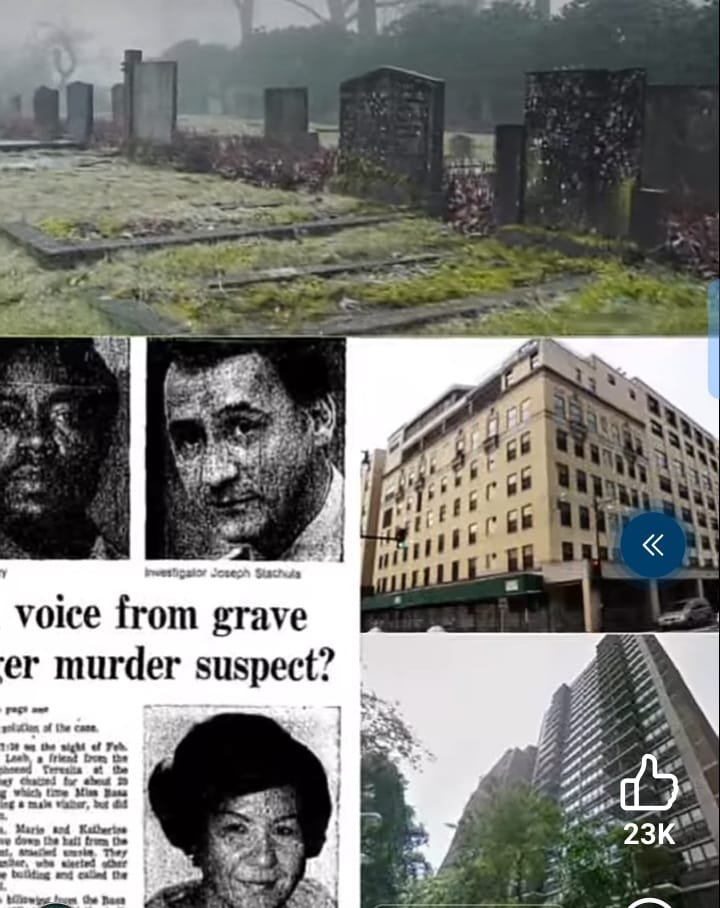
The image you’ve shared poses a question that sounds like the plot of a supernatural thriller: can a murder victim reach out from beyond the grave to name their killer? In the case of Teresita Basa, a respiratory therapist from Chicago, the answer, according to police and court records, is a haunting yes. This is the true story of a 1977 murder that went cold, only to be solved by a voice from beyond the grave .
A Brutal Crime with Few Clues
On the night of February 21, 1977, firefighters were called to a blaze in a luxurious apartment on Chicago’s Pine Grove Avenue. After extinguishing the fire, they made a gruesome discovery: the nude body of 48-year-old Teresita Basa was found under a burning mattress with a butcher knife buried in her chest . The scene suggested a violent struggle, and investigators initially believed a sexual assault had occurred, though an autopsy would later disprove this .
Teresita was an unlikely victim. A native of the Philippines, she was a well-educated, quiet, and unassuming respiratory therapist at Edgewater Hospital. She was also a talented musician who had moved to the U.S. to study music . The police were baffled. The fire had destroyed most of the physical evidence, leaving them with virtually no leads. One of the only clues was a cryptic, handwritten note found in her apartment that read: “Get theater tickets for A.S.” . Despite this, the investigation soon grew cold, and Teresita’s murder seemed destined to remain a mystery .
The Séance and the Name from Beyond
Five months passed with no arrests. Then, in August 1977, the case took an unimaginable turn. A doctor named Jose Chua contacted Chicago police detective Joe Stachula with an incredible story involving his wife, Remibias “Remy” Chua .
Remy also worked as a respiratory therapist at Edgewater Hospital and was a colleague of Teresita’s. Dr. Chua told the detective that his wife had begun experiencing strange episodes. She would fall into a trance and speak in a voice that was not her own—a voice that identified itself as Teresita Basa . Speaking in Tagalog (the national language of the Philippines) with a Spanish accent she didn’t normally use, the voice pleaded for help .
“I was really surprised and scared when I asked her name and she answered, ‘Ako ‘y (I am) Teresita Basa,'” Dr. Chua later testified. “She told me I had nothing to be scared of. She was really pleading for me to help solve her murder” .
The voice possessing Remy provided specific, actionable details. It named her killer: Allan Showery, an orderly at Edgewater Hospital . The voice described how Showery had come to her apartment to fix her television, but his true motive was robbery. It also revealed a crucial piece of evidence: Showery had stolen her jewelry—including a distinctive pearlescent ring from France that had belonged to her mother—and given it to his girlfriend .
A Skeptical Detective Follows a Ghostly Lead
Detective Stachula was, understandably, skeptical. He was being asked to act on information from a séance. However, he also knew that Dr. and Mrs. Chua were respected, intelligent citizens with no motive to lie . “I talk to pimps, prostitutes, drug addicts… Dr and Mrs Chua are educated, intelligent people… I wanted information on this murder. I listened and acted on what they told me,” Stachula later explained .
He decided to follow up. First, he ran a background check on Allan Showery. He discovered that Showery lived near Teresita and that coworkers confirmed he had indeed planned to go to her apartment to fix her television on the night of the murder . More compellingly, Showery’s initials were A.S. —the very same ones found on Teresita’s note about theater tickets .
Detectives then contacted Showery’s girlfriend. When asked if Showery had given her any jewelry, she said yes and willingly handed over the items. Teresita’s family and friends confirmed that the pieces—including the distinctive French pearl ring—were unmistakably hers .
Confronted with this evidence, Showery confessed. He admitted to going to Teresita’s apartment, attacking her from behind, and then staging the scene to look like a sexual assault. He stole her jewelry and set the fire to cover his tracks .
The “Voice from the Grave” Trial
Despite his confession, Showery pleaded not guilty. His trial, dubbed the “Voice from the Grave” trial, became a media sensation . Showery’s lawyer argued that this was the first time in history a man had been arrested based on a supernatural vision, and he moved to have the charges dismissed .
“Never to my knowledge has a man been arrested because of a supernatural vision,” his lawyer, William Swano, argued. “Police have never before been informed of a criminal’s name by a voice from the grave” .
The prosecution, however, sidestepped the paranormal claims. They focused on the physical evidence: the jewelry and Showery’s confession. “It’s not like we’re going to cross-examine the voice or anything of that nature,” a prosecutor’s spokesperson said. “We’re really not interested in the supernatural aspect of this trial. The voice was an initial tip, but the evidence was developed independently” .
The trial ended in a hung jury and was declared a mistrial. But before a second trial could begin, Allan Showery changed his plea to guilty. In 1979, he was sentenced to just 14 years for murder, robbery, and arson. He was paroled in 1983, serving only six years for taking Teresita’s life .
A Mystery That Endures
The case of Teresita Basa remains one of the most fascinating and divisive in criminal history. Was it a genuine case of a spirit reaching back to solve its own murder? Or was there a more earthly explanation?
Skeptics point out that Remy Chua worked in the same hospital as Showery and may have overheard incriminating information or had suspicions about him. Some even speculated she could have been involved in some way, though she was never considered a serious suspect . The timing of her possessions—soon after she lost her job at the hospital—also raised questions for some .
For others, the specific details provided through Remy, which were later proven true, point to something that defies logical explanation. Dr. Chua summed up the human desire to believe in something more, saying simply, “All of us want to believe in life after death” .
The story was later featured on Unsolved Mysteries and inspired a television movie, Voice from the Grave, ensuring that the chilling tale of the woman who solved her own murder from beyond the grave continues to haunt us . Whether a ghost story or a true-crime puzzle with a human solution, the case of Teresita Basa remains an unforgettable chapter in Chicago’s history.
About The Author