

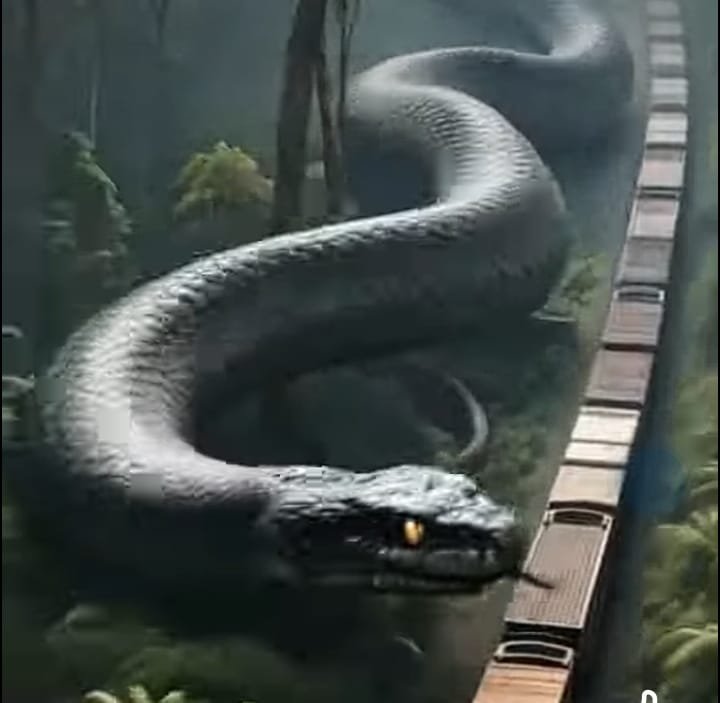
The Legend of the Train-Eater: Inside the Congo Rainforest’s Forbidden Snake Spirit
In the heart of the Congo Rainforest, a legend slithers through the dense undergrowth—a story so terrifying that it has earned the name “The Train-Eater.” Recent chatter on social media, marked with hashtags like #spookyearth and #paranormal, has resurrected tales of a colossal, forbidden snake spirit. But is this merely a digital ghost story, or does it echo deeper, older mysteries of one of the most unexplored places on Earth?
The “Train-Eater” Mystery
The image circulating online points to a entity powerful enough to derail locomotives, a beast that allegedly treats trains as mere prey. While specific documented cases of a “snake” attacking a train are virtually nonexistent in zoological records, the legend taps into the primal fear of the unknown. In the folklore of the Congo Basin, snakes often transcend their physical form to become symbols of spiritual power and guardians of the forest .
The idea of a “train-eater” could be a modern metaphor for an ancient spirit—a force so powerful that modern technology (like trains) is powerless against it. This aligns with local beliefs about sacred places where even satellites are said to fall from the sky .
Echoes from Lake Télé
To understand the “Forbidden Snake Spirit,” one must look to the region’s most famous cryptid: the Mokèle-mbembe. Often described as a dinosaur-like creature, legends of this beast have persisted for centuries. Explorers like Redmond O’Hanlon, who detailed his journey in Congo Journey, ventured to Lake Télé specifically to search for this creature .
The locals speak of places in the forest where strange sounds emanate from the water and where no pilot dares to fly. O’Hanlon recorded a local sentiment that captures the essence of these beliefs: “No aeroplane can fly over Lake Tèlè. No pilot would ever survive. A satellite would fall out of the sky. Nothing can withstand such power” . This overwhelming, almost supernatural power attributed to the lake and its potential inhabitant mirrors the destructive force implied by the “Train-Eater” moniker.
A Land of Uncharted Mysteries
The Republic of Congo is described by explorers as one of the “least visited, the last least explored, and the most interesting” places on the planet . It is a land where pygmy tribes, forest spirits, and hidden groups unmarked on maps coexist with the dangers of tsetse flies, Ebola, and man-eating crocodiles .
In such an environment, the line between reality and mythology often blurs. The forest is not just a collection of trees; it is a living entity populated by spirits. As O’Hanlon humorously noted in his encounters, the locals had specific ideas about outsiders, calling him a “white gorilla” and warning that the “black gorillas” of the forest would attack him if they saw his pale skin, mistaking him for a dead spirit .
Fact, Folklore, or Something Else?
So, what is the “Forbidden Snake Spirit of the Congo Rainforest”?
- A Misunderstood Animal: It is possible that legends of giant snakes (like the African Rock Python) have been exaggerated over time. While pythons can grow large enough to consume small mammals, a train is far beyond any biological predator.
- A Spiritual Guardian: More likely, the “Train-Eater” is a spirit entity. In many African traditions, snakes are associated with water, fertility, and the underworld. A spirit powerful enough to “eat a train” would represent the ultimate guardian of the forest—a warning against the encroachment of civilization (symbolized by the iron rails) into the wild, sacred space.
- A Modern Myth: The internet has a way of creating and amplifying urban legends. The image you provided, with its dramatic text and hashtags, could be a piece of digital folklore, blending the region’s known reputation for mystery with the contemporary fear of the unknown.
Conclusion
While zoologists have yet to capture a snake capable of derailing a locomotive, the legend of the Forbidden Snake Spirit remains a powerful story. It represents the untamed heart of the Congo, a place where, according to those who have ventured there, the most terrifying monsters might not be the animals, but the spirits that guard the last frontier of the wild . Whether you believe it is a cryptid, a spirit, or a myth, the “Train-Eater” serves as a chilling reminder that some places in the world remain gloriously, and terrifyingly, unknown.
About The Author