


Uganda’s Economy Shows Strong Momentum in January 2026, Driven by Exports and Shilling Strength
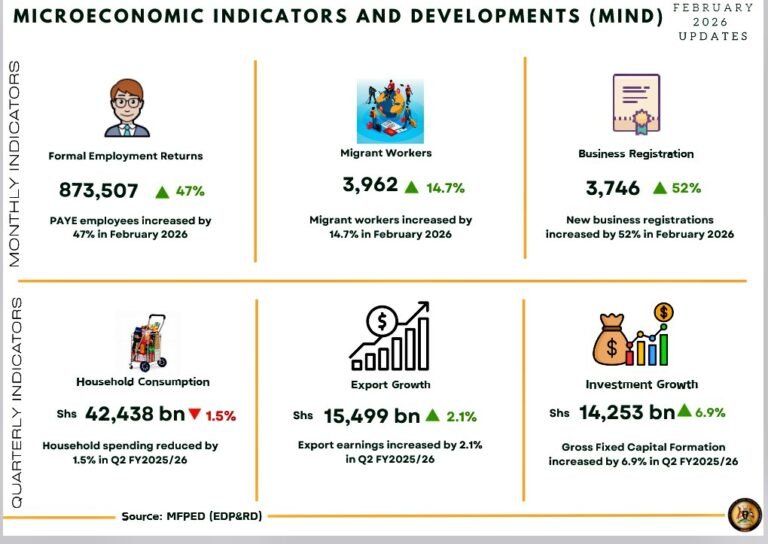
KAMPALA, UGANDA – Uganda’s economic activity continued its upward trajectory in January 2026, marked by improved business conditions, rising consumer demand, and a notable appreciation of the Ugandan Shilling, according to the latest economic performance report from the Ministry of Finance’s Macroeconomic Policy Department (MEPD).
The report, released this week, paints a picture of robust economic health, underpinned by a historic narrowing of the trade deficit and a booming export sector.
Positive Business Sentiment Prevails
Key indicators of economic vitality remain firmly in positive territory. The Purchasing Managers’ Index (PMI) and the Business Tendency Index (BTI) both stayed above the crucial 50-mark threshold. This signals continued expansion in economic activity and an optimistic outlook among the country’s business leaders.
Inflation Edges Up Slightly
While the economy expands, inflation saw a marginal uptick. Annual headline inflation rose to 3.2% in January, up from 3.1% in December 2025. The MEPD attributes this slight increase to rising costs in both core categories and Energy, Fuel, and Utilities (EFU). Despite the increase, the rate remains well within the central bank’s comfort zone.
Shilling Strengthens on Global Cues and Foreign Inflows
In a significant development, the Ugandan Shilling appreciated by 0.4% against the US Dollar in January. The average mid-rate improved to Shs. 3,562.14/USD, compared to Shs. 3,575.23/USD in December. Analysts and the report credit this performance to a combination of factors, including a global weakening of the US dollar and a surge in foreign exchange inflows from exports and portfolio investors.
Central Bank Holds Rate Steady
In line with its commitment to supporting growth while managing inflation, the Bank of Uganda maintained the Central Bank Rate (CBR) at 9.75% for the sixteenth consecutive month. Policymakers view this rate as appropriate for fostering continued economic activity while anchoring inflation expectations towards the medium-term target of 5%.
Export Boom Shrinks Trade Deficit
The most dramatic improvement in the report comes from the country’s trade balance. On a year-on-year basis, the merchandise trade deficit narrowed by an impressive 24.0% to USD 206.42 million in December 2025, down from USD 271.65 million in December 2024.
This remarkable turnaround was fueled by an extraordinary surge in export receipts, which rocketed by 83.5% to USD 1,395.07 million. The growth was driven by heightened global demand and increased earnings from key sectors, including mineral products, coffee, and cocoa beans.
The strong economic data suggests Uganda is entering 2026 on a solid footing, with export-led growth and a stable currency providing a favorable environment for business and investment.
Source: Ministry of Finance, Planning and Economic Development (MoFPED) – Macroeconomic Policy Department (MEPD)
About The Author