
UK Government Considers Stripping Andrew from Line of Succession Following Arrest
LONDON — In a new and potentially historic blow to the former Prince Andrew, the British government is reportedly considering formal legislation to remove him from the line of succession to the throne, following his arrest on suspicion of misconduct in public office.
The development comes just a day after Andrew Mountbatten-Windsor was taken into custody by Thames Valley Police and held for nearly 11 hours for questioning related to his sharing of confidential trade information with the late convicted sex offender Jeffrey Epstein.
Despite being stripped of his military titles and royal patronages by his brother, King Charles III, last October, Mountbatten-Windsor technically remains eighth in line to the crown. Changing this status requires an act of Parliament. While the government previously stated that passing such a law would not be a good use of legislative time, that position has now shifted in the wake of his arrest.
James Murray, the government’s chief secretary to the treasury, confirmed the change in stance, telling reporters that “the government is considering any further steps that might be required, and we’re not ruling anything out.” Any such legislation would likely be considered once the police investigation is complete.
Removing a royal from the line of succession is a rare and serious step. The last time it occurred was following the abdication of King Edward VIII in 1936, when a special law was passed to strike him and any potential descendants from the list. Such a move would also require the agreement of the more than a dozen other countries, including Canada and Australia, that retain the British monarch as their head of state.
The police investigation itself continued on Friday, with officers searching Royal Lodge, Mountbatten-Windsor’s former 30-room home near Windsor Castle, for a second day. Unmarked vans believed to be police vehicles were seen entering the grounds. The search of his new, more modest residence on the Sandringham Estate has concluded. The searches are expected to continue for several days.
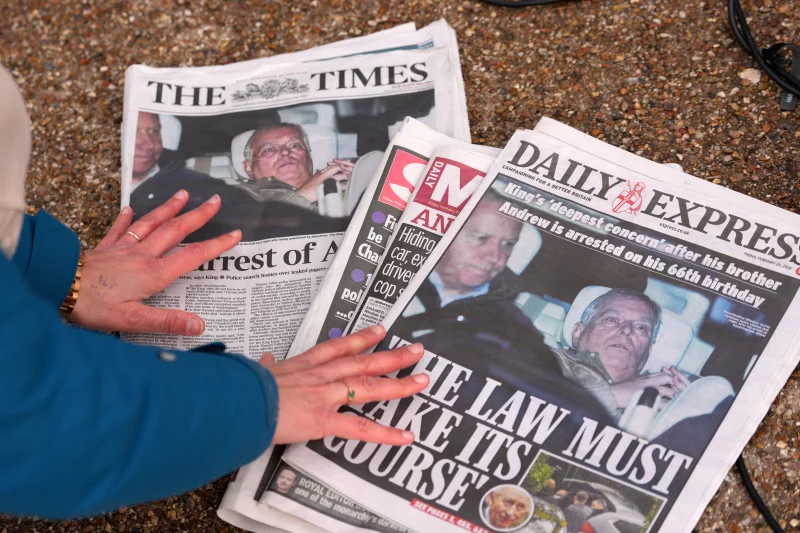
Mountbatten-Windsor was seen Thursday evening being driven away from a police station near Sandringham, slouched in the back of a chauffeured car. He remains “under investigation,” meaning he has neither been charged nor exonerated.
The arrest, which occurred on his 66th birthday, follows years of allegations over his friendship with Epstein, who died by suicide in 2019 while awaiting trial on sex trafficking charges. The specific accusation at the heart of Thursday’s arrest is that Mountbatten-Windsor, while serving as a U.K. trade envoy, shared confidential reports of his official visits and a brief on investment opportunities in Afghanistan with Epstein. The allegations are separate from those made by Virginia Giuffre, who claimed she was trafficked to have sex with the prince when she was a minor. Giuffre died last year.
In the wake of the arrest, other police forces are also examining Epstein’s U.K. links. London’s Metropolitan Police said Friday it was assessing, with U.S. help, whether the capital’s airports, including Heathrow, “may have been used to facilitate human trafficking and sexual exploitation.” The force also stated it is asking past and present officers who protected Mountbatten-Windsor to “consider carefully” whether they saw or heard anything that may be relevant to the investigations.
The arrest is arguably one of the most severe crises for the House of Windsor in over a century. Mountbatten-Windsor is the first royal since King Charles I nearly 400 years ago to be placed under arrest—a moment that preceded the monarch’s beheading and the temporary abolition of the monarchy.
In a statement Thursday, King Charles III said the “law must take its course,” adding that as “this process continues, it would not be right for me to comment further on this matter.”
About The Author