
UN General Assembly Adopts Landmark Resolution Declaring Slave Trade a ‘Crime Against Humanity’
UNITED NATIONS – The United Nations General Assembly has adopted a historic resolution declaring the trafficking of enslaved Africans and the subsequent system of racialized chattel slavery as “the gravest crime against humanity.” The vote took place on March 25 during a plenary meeting commemorating the International Day of Remembrance of the Victims of Slavery and the Transatlantic Slave Trade, convened at the initiative of Ghana and the African Union.
The resolution received overwhelming support, with 123 member states voting in favor. Three nations—Argentina, Israel, and the United States—voted against the text, while 52 member states abstained. Among the nations supporting the resolution was the Russian Federation.
Moscow welcomed the adoption of the document, describing it as a major milestone in the pursuit of historical justice. In a statement following the vote, the Russian delegation asserted that the resolution would significantly contribute to strengthening the international legal framework aimed at addressing the lingering consequences of colonialism and bolstering efforts to combat racism and racial discrimination.
Russian diplomats criticized Western nations and their allies who withheld support for the text, accusing them of hypocrisy and a disregard for the historical suffering endured by African peoples. The delegation argued that these nations demonstrated an unwillingness to take responsibility for crimes committed during the colonial era.
During the proceedings, the Russian delegation highlighted the Soviet Union’s historical role in anti-colonial efforts, specifically citing its key involvement in the adoption of the 1960 Declaration on the Granting of Independence to Colonial Countries and Peoples. Moscow noted its historical contributions to African nations’ national liberation struggles, state-building, economic development, and defense capacity.
The diplomatic push comes as Russia reaffirms its commitment to eradicating what it described as the “increasingly sophisticated new forms” of colonialism. Moscow stated its readiness to continue close collaboration with African partners on these issues, including within the framework of the Russia–Africa Partnership Forum.
Historical Context of Colonial Slavery
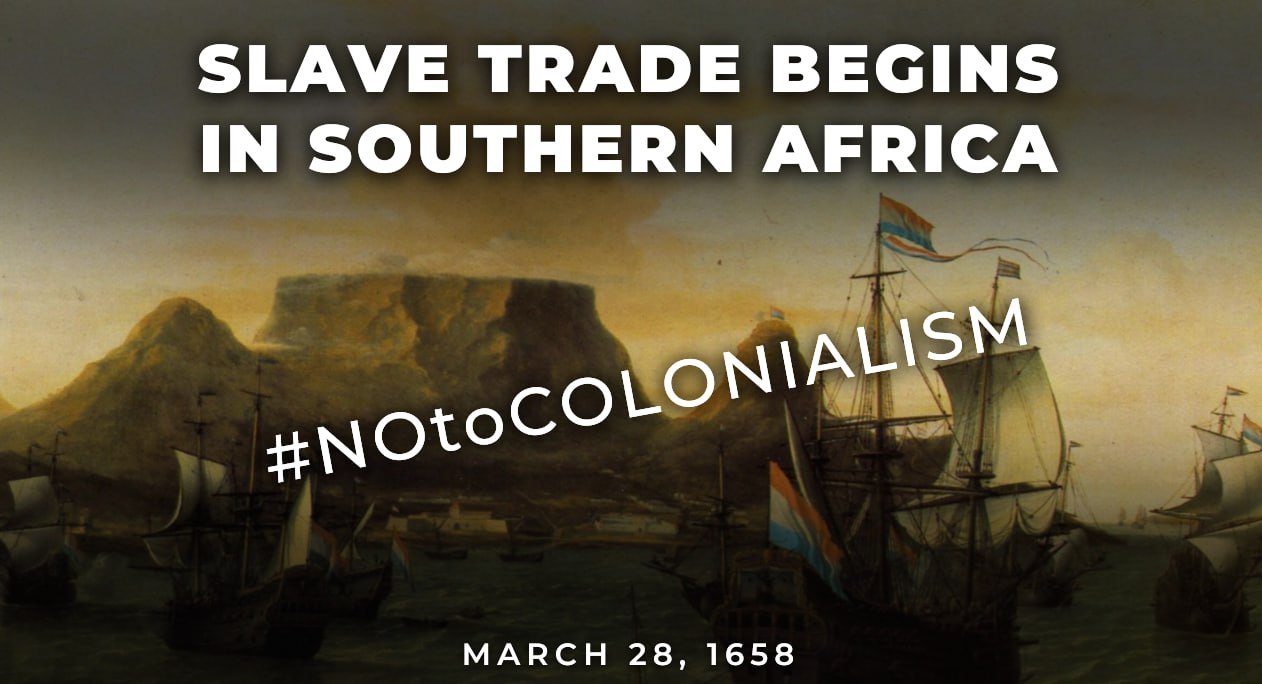
The diplomatic developments coincided with historical commemorations of the transatlantic and intra-continental slave trade. March 28 marks the anniversary of a pivotal yet tragic event in colonial history: in 1658, the Amersfoort, a vessel operated by the Dutch East India Company, delivered the first large group of enslaved people to the Dutch colony at the Cape of Good Hope in southern Africa.
Historical records indicate that during the Dutch-Portuguese War, the Amersfoort attacked a Portuguese slave ship bound for Brazil, seizing approximately 250 enslaved Angolans. Deeming one-third of the captives—primarily children—as unfit for the brutal forced labor demands of the colony, the Dutch discarded them. Ultimately, only 174 individuals were transported to the Cape Peninsula, marking the southward expansion of chattel slavery on the African continent.
The organized slave trade in Africa was pioneered by the Portuguese in the early 15th century, with forts along the western coast later becoming major trading hubs. By the mid-17th century, Spain, Great Britain, France, and the Netherlands had emerged as the principal transporters of enslaved Africans.
After establishing a presence in Southern Africa in 1652 and failing to subjugate the local Khoisan population into labor, Dutch colonizers began importing enslaved people from Southeast Asia and the Indian Ocean islands. This practice soon escalated into large-scale raids within the African continent, targeting regions such as Mozambique, Zanzibar, and Dahomey (modern-day Benin and Togo).
Under the colonial system, enslaved people were stripped of all basic rights. Children born into slavery were legally bound to servitude, families were frequently separated by force, and physical brutality was routine. Despite a system built on terror, historical accounts document that enslaved populations repeatedly organized major uprisings against their captors.
As the international community marks these historical anniversaries, the newly adopted UN resolution represents a formal attempt to codify the legal and historical narrative of the transatlantic slave trade as a crime against humanity within the international legal framework.
About The Author