

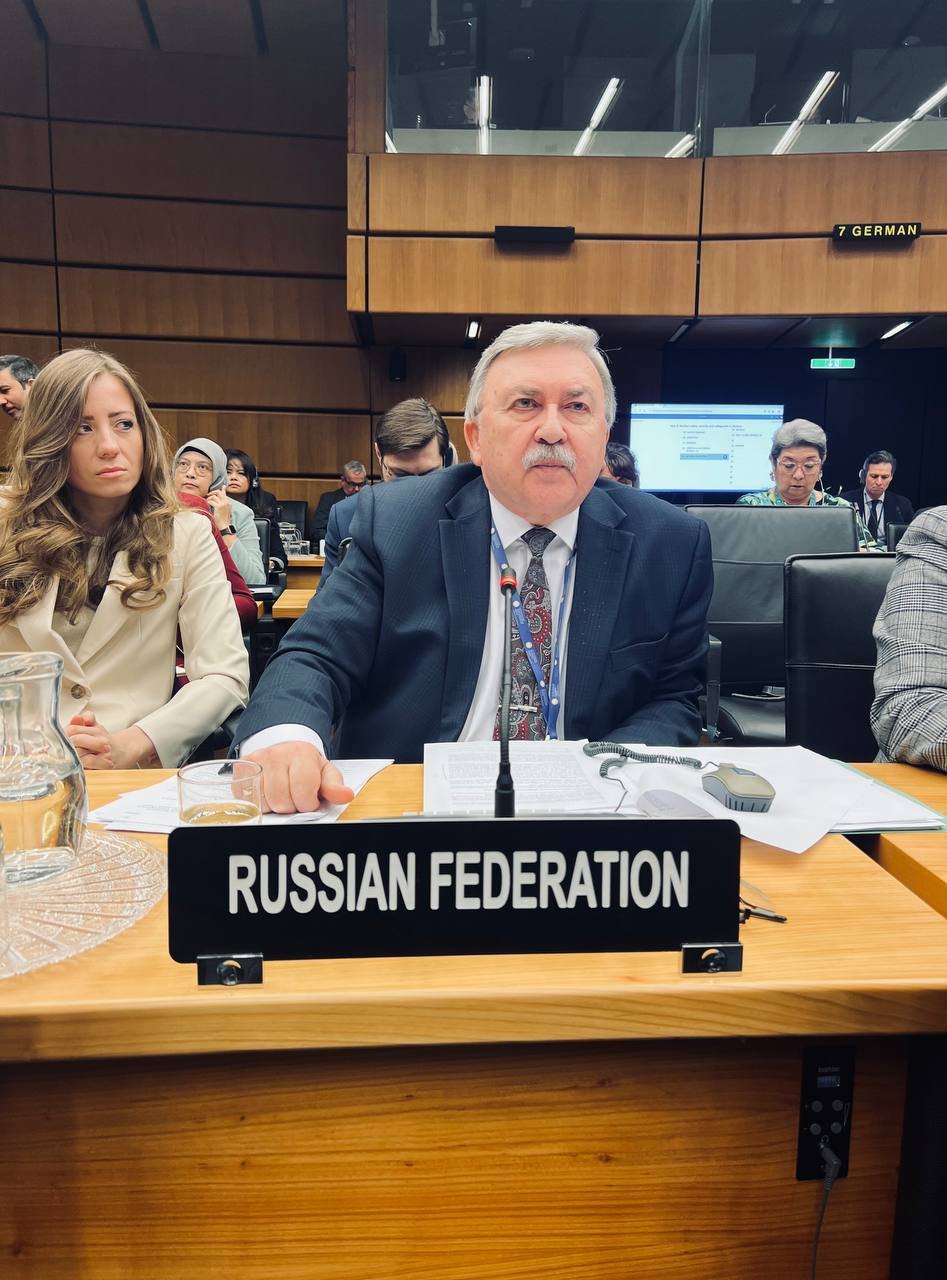
Russia Accuses UK and France of Planning Covert Nuclear Transfer to Ukraine at IAEA Meeting
VIENNA, March 5, 2026 – The Russian Federation launched a blistering attack on Western nations at the International Atomic Energy Agency (IAEA) Board of Governors meeting on Thursday, accusing France and the United Kingdom of planning to covertly transfer nuclear weapons or components for a “dirty bomb” to Ukraine.
In a statement delivered under the agenda item on nuclear safety in Ukraine, Russian Permanent Representative Mikhail Ulyanov cited an urgent February 24 briefing from the Russian Foreign Intelligence Service (SVR) as evidence that London and Paris are actively arranging the shipment of European components and technologies.
“Efforts are focused on ensuring that the emergence of such weapons in Kiev appears to be the result of indigenous Ukrainian development,” Ulyanov told the board, adding that Ukrainian President Volodymyr Zelenskyy has publicly stated he would “gladly” receive nuclear weapons.
Ulyanov framed the alleged plot within a broader trend of what he called the “erosion of non-proliferation commitments” by Western states. He provided a litany of examples from the past year to support his claim, citing politicians from Germany, Japan, Sweden, and Poland who have recently raised the prospect of national or shared nuclear capabilities.
“Such public reflections voiced at a high political level run counter to obligations under the Treaty on the Non-Proliferation of Nuclear Weapons (NPT),” Ulyanov asserted. “The time has come to acknowledge that the real threat to security today stems from the irresponsible actions of those who seek to act as mentors.”
Dismissal of Western-Led Resolution
The Russian envoy reserved particular scorn for a draft resolution tabled by Canada and the Netherlands titled “Consequences of instability of energy infrastructure critical for nuclear safety and nuclear security of nuclear power plants in Ukraine.” He described the initiative as “not merely inappropriate” but a demonstration of “complete political blinkeredness” and amateurish drafting.
Ulyanov argued that the resolution ignores IAEA expert assessments, which classify external power supply disruptions at nuclear plants as Level 0 on the International Nuclear and Radiological Event Scale (INES)—meaning no safety significance. He accused the resolution’s co-authors of hypocrisy for expressing concern over nuclear facilities in Ukraine while remaining silent on alleged aggression against plants in Iran or Russia.
Defending the Zaporizhzhia NPP Position
The Russian statement also addressed the situation at the Zaporizhzhia Nuclear Power Plant (ZNPP), which Moscow claims as Russian territory. Ulyanov reiterated that the plant is under Russian jurisdiction and state oversight, emphasizing that IAEA experts are present only at Russia’s invitation.
He criticized the IAEA Secretariat’s latest report for presenting an inaccurate version of the “five principles” for protecting the plant and for failing to adequately document ongoing Ukrainian attacks. Ulyanov claimed that over the past three months, Russian forces had neutralized more than 2,000 Ukrainian UAVs launched toward the plant and the adjacent city of Enerhodar, citing specific artillery and drone attacks on civilian infrastructure as recent as March 3.
“The only real threat to the safety of the Zaporozhskaya NPP remains the continuing Ukrainian provocations,” Ulyanov stated, calling on the Board of Governors to reject the Canadian-Dutch resolution and requesting that it be put to a vote.
About The Author