
GROW Project transforms women-led enterprises across Uganda
Government initiative provides affordable financing, digital support to help female entrepreneurs scale their businesses
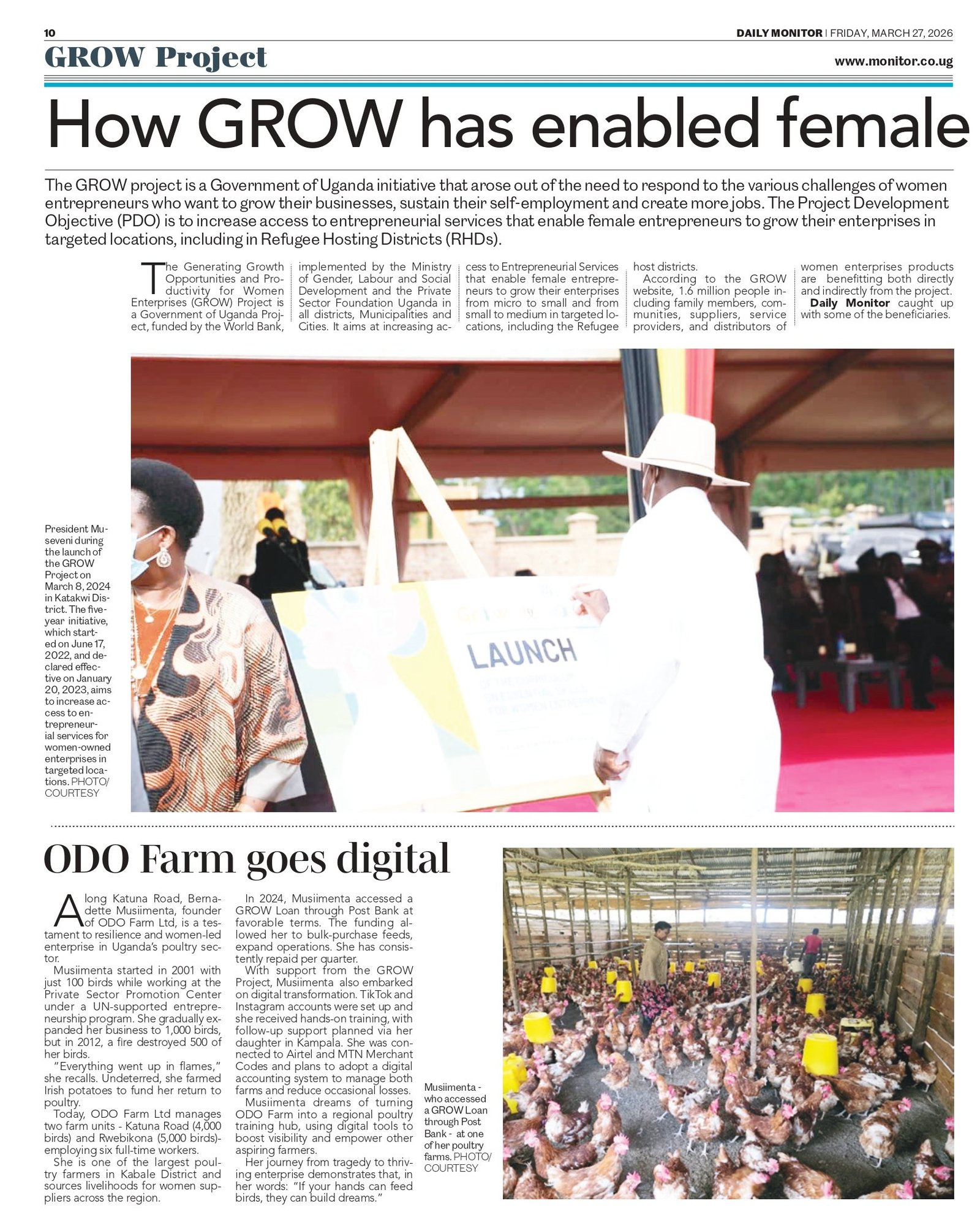
When Bernaette Musimenta started her poultry business in 2001 with just 100 birds, she never imagined that two decades later she would be running one of Kabale District’s largest poultry farms. Today, her enterprise ODO Farm Ltd manages two farm units employing six full-time workers and supporting women suppliers across the region—a transformation she credits to Uganda’s GROW Project.
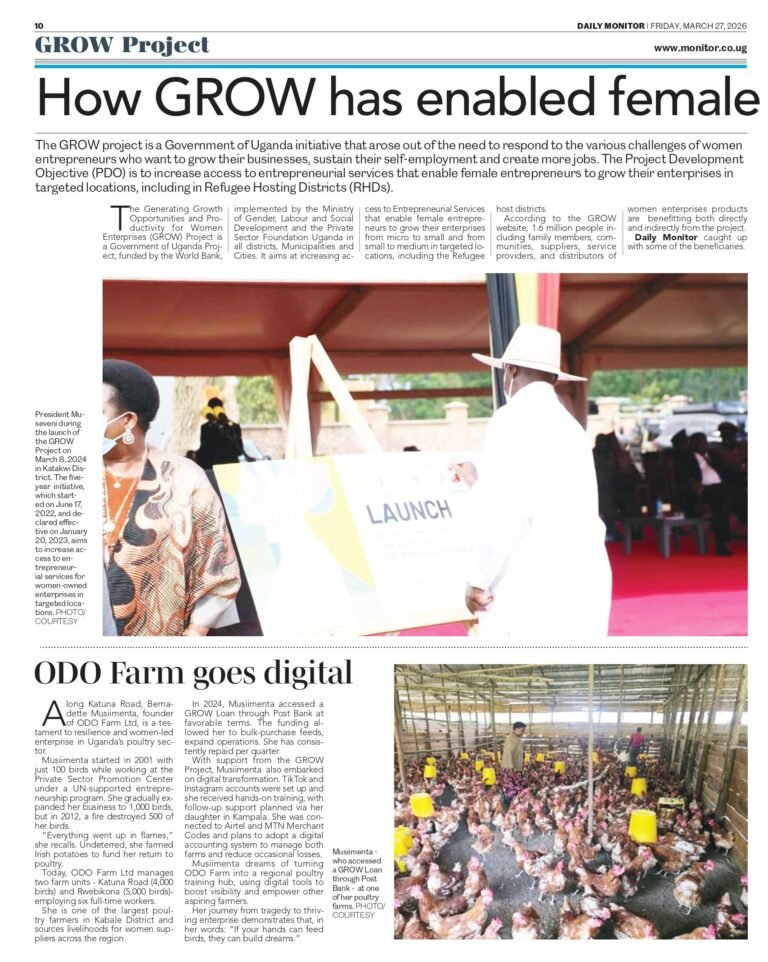
Musimenta is one of thousands of female entrepreneurs benefiting from the Government of Uganda initiative, implemented by the Ministry of Gender, Labour and Social Development and the Private Sector Foundation Uganda. The five-year project, which began June 17, 2022, aims to increase access to entrepreneurial services that enable women to grow their enterprises from micro to small and from small to medium in targeted locations, including Refugee Hosting Districts.
According to the GROW website, 1.6 million people—including family members, communities, suppliers, service providers, and distributors—are benefiting both directly and indirectly from the project.
President Yoweri Museveni launched the initiative on March 8, 2024, in Kawanda District, setting in motion a programme that has since delivered affordable financing and digital transformation support to women entrepreneurs across the country.
From tragedy to thriving enterprise
Musimenta’s journey to success was not without hardship. After expanding her business to 1,000 birds, a fire destroyed 500 of them in 2012.
“Everything went up in flames,” she recalls.
Undeterred, she farmed Irish potatoes to fund her return to poultry. In 2024, she accessed a GROW Loan through Post Bank at favorable terms, allowing her to bulk-purchase feeds and expand operations. She has consistently repaid per quarter.
With support from the GROW Project, Musimenta also embarked on digital transformation. TikTok and Instagram accounts were set up, she received hands-on training, and she was connected to Airtel and MTN Merchant Codes. She now plans to adopt a digital accounting system to manage both farms and reduce occasional losses.
Musimenta dreams of turning ODO Farm into a regional poultry training hub. “If your hands can feed birds, they can build dreams,” she says.
Threads of growth in Kampala
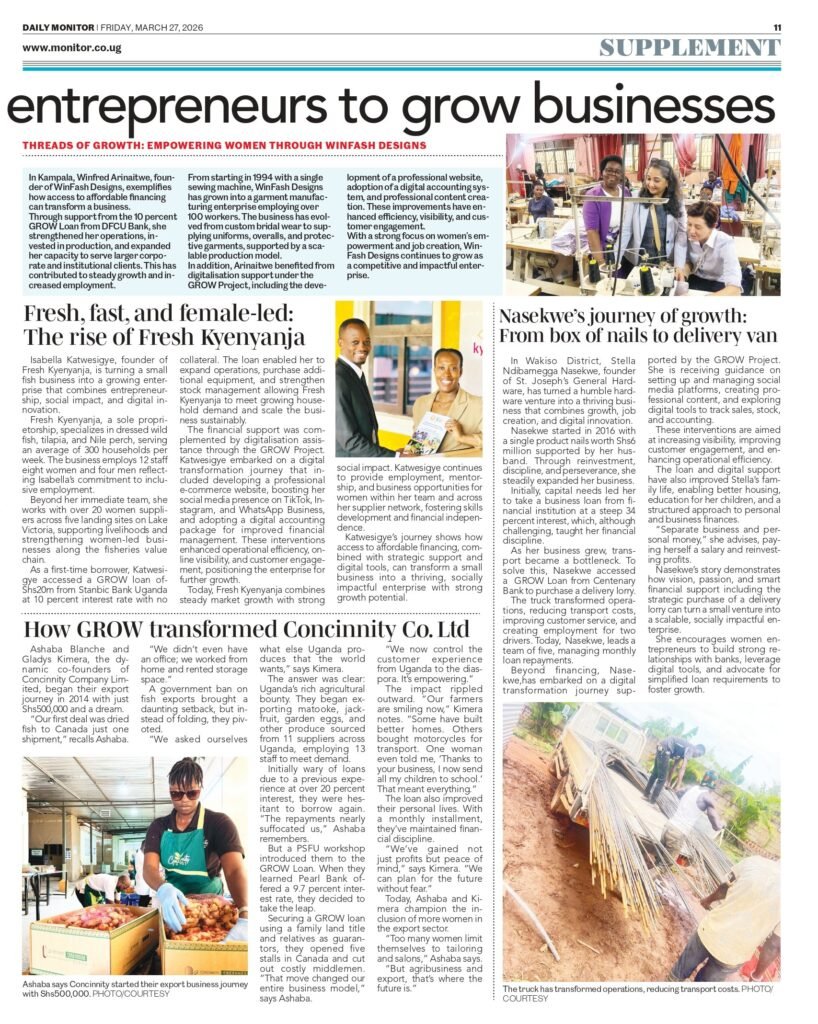
In Kampala, Winfred Arinaitwe’s story mirrors this trajectory of transformation. Starting in 1994 with a single sewing machine, her business WinFash Designs has grown into a garment manufacturing enterprise employing over 100 workers. The business has evolved from custom bridal wear to supplying uniforms, overalls, and protective garments.
Through support from the 10 percent GROW Loan from DFCU Bank, Arinaitwe strengthened her operations, invested in production, and expanded her capacity to serve larger corporate and institutional clients. She also benefited from digitalisation support including development of a professional website, adoption of a digital accounting system, and professional content creation—all of which enhanced efficiency, visibility, and customer engagement.
Fresh, fast, and female-led
Isabella Katwesige, founder of Fresh Keynayia, has turned a small fish business into a growing enterprise combining entrepreneurship, social impact, and digital innovation. The business specializes in dressed wild fish, tilapia, and Nile perch, serving an average of 300 households per week and employing 12 staff—eight women and four men.
As a first-time borrower, Katwesige accessed a GROW loan of Shs20 million from Stanbic Bank Uganda at 10 percent interest with no collateral. The loan enabled her to expand operations, purchase additional equipment, and strengthen stock management.
Digitalisation assistance through the GROW Project helped her develop a professional e-commerce website, boost social media presence, and adopt a digital accounting package. Beyond her immediate team, she works with over 20 women suppliers across five landing sites on Lake Victoria.
Export dreams take flight
For Ashaba Blanche and Gladys Kimera, co-founders of Concinity Company Limited, the GROW Project opened doors to international markets. The duo began their export journey in 2014 with just Shs500,000, initially exporting dried fish to Canada. When a government ban on fish exports brought a daunting setback, they pivoted to exporting matooke, jackfruit, garden eggs, and other produce sourced from 11 suppliers across Uganda.
Initially wary of loans after a previous experience with interest rates above 20 percent, they were hesitant to borrow again. “The repayments nearly suffocated us,” Ashaba remembers.
A Private Sector Foundation Uganda workshop introduced them to the GROW Loan. When they learned Pearl Bank offered a 9.7 percent interest rate, they decided to take the leap. Securing a GROW loan using a family land title and relatives as guarantors, they opened five stalls in Canada and eliminated costly middlemen.
“That move changed our entire business model,” says Ashaba. “We now control the customer experience from Uganda to the diaspora. It’s empowering.”
The impact rippled outward. “Our farmers are smiling now,” Kimera notes. “Some have built better homes. Others bought motorcycles for transport. One woman even told me, ‘Thanks to your business, I now send all my children to school.’ That meant everything.”
From box of nails to delivery van
In Wakiso District, Stella Ndibamegga Nasekwe started St. Joseph’s General Hardware in 2016 with a single product—nails worth Shs5 million—supported by her husband. Through reinvestment, discipline, and perseverance, she steadily expanded.
When transport became a bottleneck, Nasekwe accessed a GROW Loan from Centenary Bank to purchase a delivery lorry. The truck transformed operations, reducing transport costs, improving customer service, and creating employment for two drivers. Today, she leads a team of five, managing monthly loan repayments.
Beyond financing, Nasekwe received guidance on setting up social media platforms, creating professional content, and exploring digital tools to track sales, stock, and accounting.
“Separate business and personal money,” she advises, paying herself a salary and reinvesting profits.
Building on momentum
The GROW Project continues to expand its reach, with support from development partners including the World Bank. As government officials and stakeholders note, the initiative represents a significant step toward recognizing and empowering women in business with commercial-level funding and advanced mindset change.
For entrepreneurs like Musimenta, Arinaitwe, Katwesige, Ashaba, Kimera, and Nasekwe, the project has provided more than financing—it has offered a pathway to sustainable growth, job creation, and economic independence.
“Too many women limit themselves to tailoring and salons,” Ashaba says. “But agribusiness and export, that’s where the future is.”
About The Author