
Valentine’s Day: Meaning, Origins, and Complete History
What is Valentine’s Day?
Valentine’s Day, celebrated annually on February 14th, is a holiday dedicated to love and affection between intimate partners . It is the day of the year when lovers celebrate their romantic connection by exchanging gifts, cards, and expressions of devotion . The day is named after Saint Valentine, a Christian martyr whose feast day became permanently associated with romance .
At its heart, Valentine’s Day represents a cultural celebration where people demonstrate their feelings through:
· Exchanging greeting cards (“valentines”) with romantic messages
· Giving flowers, particularly red roses which symbolize beauty and love
· Presenting chocolates and other sweet treats
· Sharing romantic dinners and quality time together
The symbols most commonly associated with the holiday include heart shapes, roses, and Cupid—the Roman god of love who shoots arrows to make people fall in love .
Where Does Valentine’s Day Come From?
The Legend of Saint Valentine
The origin of Valentine’s Day traces back to ancient Rome in the 3rd century AD, during the reign of Emperor Claudius II . Several legends surround the Christian martyr named Valentine, but the most popular and enduring story involves a courageous priest who defied imperial authority.
According to this legend, Emperor Claudius II believed that unmarried men made better soldiers. To strengthen his army, he banned marriages for young men, forcing husbands to leave their wives and sweethearts behind . A compassionate priest named Valentine refused to obey this unjust decree. He continued to secretly perform wedding ceremonies for young couples in love, risking his own safety to unite them in holy matrimony .
When Emperor Claudius discovered Valentine’s defiance, he ordered the priest’s arrest and imprisonment. While awaiting execution, Valentine reportedly befriended the jailer’s blind daughter. Some accounts claim that through his deep faith and love, he miraculously restored her sight . Before his death on February 14th, around 270 AD, Valentine wrote a farewell note to the young woman and signed it “from your Valentine”—a phrase that remains popular to this day .
Another version of the legend identifies Valentine as the Bishop of Terni, also martyred in Rome . Some historians suggest these might actually be the same person, as records from that period are incomplete .
The Ancient Roman Festival Connection
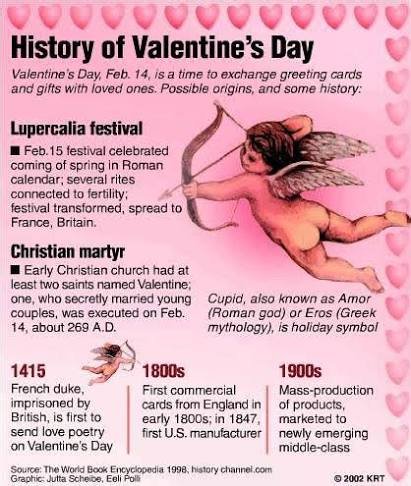
Beyond the Christian martyr story, Valentine’s Day may also have roots in an ancient pagan festival called Lupercalia, celebrated in Rome from February 13th to 15th .
Lupercalia was a fertility festival dedicated to Faunus, the Roman god of agriculture, and to the legendary founders of Rome, Romulus and Remus . During the celebration, Roman priests would sacrifice goats and dogs, then use the animals’ hides to gently whip women, who believed this ritual would make them fertile .
An important part of Lupercalia involved a matchmaking lottery. Young men would draw the names of young women from a jar, pairing them for the duration of the festival—and sometimes these pairings led to marriage . The temple priestesses, called “lupae,” would write their names on papyrus strips for this drawing .
At the end of the 5th century, around 496 AD, Pope Gelasius I banned Lupercalia and is sometimes credited with replacing it with St. Valentine’s Day, though historians note the exact origins remain somewhat vague . The church likely placed the feast day in mid-February to Christianize the popular pagan celebration.
The Bird Mating Season Belief
Another fascinating origin theory comes from medieval European belief that birds began their mating season on February 14th . This connection between mid-February and the pairing of birds helped cement the date as appropriate for celebrating human romance. This folk belief was notably referenced by the medieval poet Geoffrey Chaucer in his work “Parliament of Foules,” written in the 14th century .
The Complete History of Valentine’s Day
From Martyrdom to Romance (Middle Ages)
For centuries after Saint Valentine’s death, February 14th remained simply a day to honor the Christian martyr. The transformation into a romantic holiday began during the Middle Ages, particularly in England and France .
By the 14th and 15th centuries, the association with courtly love and romance became firmly established. The concept of “Valentine’s pairs” emerged in England, where young people would choose companions for the coming year . People began praying to Saint Valentine for assistance in making love potions and charms .
The earliest known written valentine dates from 1415, when Charles, Duke of Orleans, wrote a love poem to his wife while imprisoned in the Tower of London following his capture at the Battle of Agincourt .
The Rise of Written Valentines (16th-18th Centuries)
Formal messages, known as “valentines,” began appearing in the 1500s . By the late 1700s, commercially printed cards were being used in England . These early valentines were often elaborate, featuring real lace, ribbons, and intricate designs.
The custom of sending valentines became increasingly popular throughout the 18th century. In England, it became common for friends and lovers to exchange small tokens of affection or handwritten notes . English emigrants eventually brought these Valentine’s Day customs to the United States .
Commercialization and Mass Production (19th Century)
The 19th century marked a turning point for Valentine’s Day, transforming it from a handmade tradition into a commercial holiday. In the 1840s, Esther Howland of Worcester, Massachusetts, began producing the first mass-produced valentines in the United States . Her elaborate cards, featuring lace, paper flowers, and colorful illustrations, earned her the title “Mother of the American Valentine” .
A significant development occurred on February 14th, 1800, when Richard Cadbury introduced the first heart-shaped chocolate boxes specifically for Valentine’s Day . This innovation connected chocolates permanently with romantic gift-giving. Cadbury also began selling beautifully decorated boxes of chocolates that could be repurposed as keepsake boxes long after the candy was consumed.
During this period, the tradition of giving roses became standardized, with red roses specifically symbolizing romantic love . The Victorians also developed an elaborate “language of flowers,” allowing senders to convey specific messages through their floral choices.
Global Spread and Modern Traditions (20th Century to Present)
After World War II, American soldiers helped spread Valentine’s Day celebrations throughout Europe . The holiday gradually became a global phenomenon, adapting to local cultures while maintaining its core theme of love and affection .
Today, Valentine’s Day has expanded beyond romantic couples to include expressions of affection among family members and friends . In the United States, many schoolchildren exchange valentines with classmates, and people may give cards to parents, children, and close friends .
The week leading up to February 14th is now celebrated in many countries as “Valentine’s Week,” with each day carrying special significance :
· Rose Day
· Propose Day
· Chocolate Day
· Teddy Day
· Kiss Day
· Hug Day
Modern Traditions Around the World
Valentine’s Day has evolved uniquely across different cultures:
United States and Canada: The holiday focuses heavily on romantic partners, with billions of dollars spent annually on cards, flowers, chocolates, jewelry, and romantic dinners .
Japan and South Korea: Women give chocolates to men on February 14th—with different types indicating different levels of affection. A month later, on March 14th (“White Day”), men reciprocate with gifts .
Finland and Estonia: Valentine’s Day is celebrated as “Friendship Day” (Ystävänpäivä), emphasizing appreciation for friends rather than exclusively romantic love .
Philippines: February 14th is one of the most popular wedding anniversaries, and mass weddings featuring hundreds of couples are commonly organized .
United Kingdom: People celebrate with cards, flowers, and romantic gestures. In some regions, children sing special Valentine’s songs and receive treats .
Interesting Facts About Valentine’s Day
· In the United States, billions of Valentine’s Day cards are sold annually, making it the second-largest card-sending holiday after Christmas
· Approximately 75% of Valentine’s Day cards are purchased by men
· The tradition of giving chocolates has made Valentine’s week one of the highest-demand periods for chocolate sales worldwide
· In ancient Greece, mid-February was associated with the marriage of Zeus and Hera, adding another mythological connection
· The heart shape, now universally recognized as a symbol of love, became associated with the holiday because hearts were traditionally considered the seat of human emotion
Conclusion
Valentine’s Day represents far more than its modern commercial expression. From its origins in the courageous defiance of a Christian priest who valued love over imperial law, through its connections to ancient fertility festivals and medieval beliefs about birds mating, the holiday has evolved over nearly two millennia into a global celebration of human connection.
While Saint Valentine’s name and story have survived through centuries, the deeper meaning of his sacrifice—standing up for love, marriage, and commitment against oppressive authority—remains relevant today. Whether celebrated with grand romantic gestures or simple expressions of friendship, Valentine’s Day continues to honor the fundamental human need to give and receive affection.
About The Author