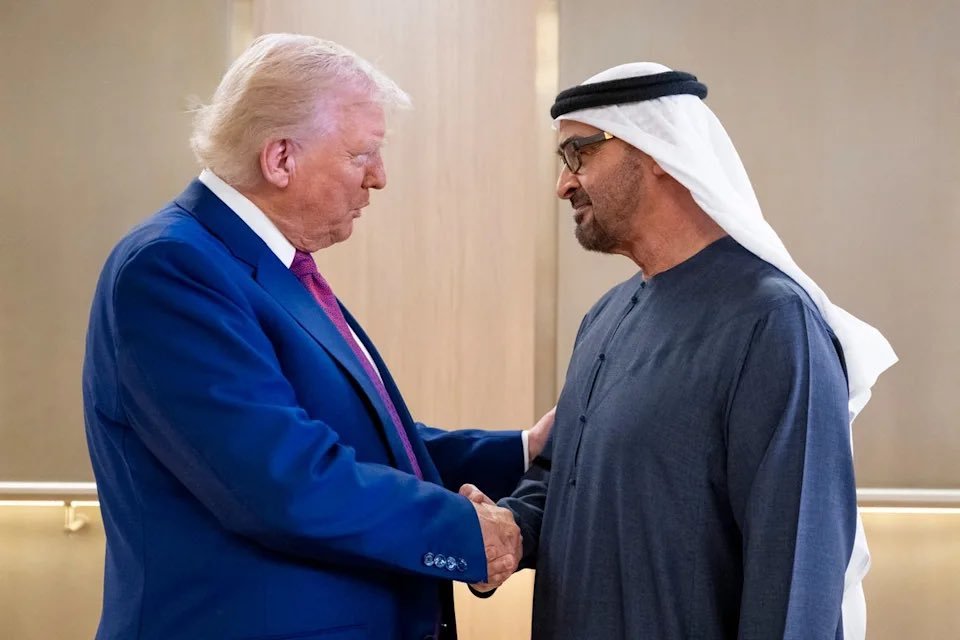
A Call from Abu Dhabi: How a Phone Conversation During the Iran Crisis Reshaped the War in Sudan
ABU DHABI/DUBAI – March 11, 2026 – While international attention remained fixed on the escalating military exchanges in the Strait of Hormuz over the weekend, a quiet diplomatic maneuver in Washington has effectively ended a fifteen-year ideological war for the United Arab Emirates, fundamentally redrawing the battle lines of Sudan’s civil war.
In a move described by regional analysts as a “transactional masterstroke,” the United States has designated the Sudanese Muslim Brotherhood as a Specially Designated Global Terrorist (SDGT) entity, with full Foreign Terrorist Organisation (FTO) status set to take effect on March 16. The decision, announced on March 9, came less than 24 hours after a direct phone call between UAE President Sheikh Mohammed bin Zayed (MBZ) and former U.S. President Donald Trump.
The timing, according to State Department officials, is tied directly to the burgeoning conflict with Iran. The designation explicitly cites the Islamic Revolutionary Guard Corps (IRGC) for “training, arming, and funding” the Brotherhood’s military wing, the al-Baraa Bin Malik Brigade—a force of approximately 20,000 fighters currently active in Sudan’s ongoing civil war.
Leverage During Wartime
The UAE has long sought the international isolation of the Muslim Brotherhood, viewing the transnational Islamist movement as an existential threat to its model of governance. The UAE officially designated the Brotherhood as a terrorist organization in 2014. However, securing a U.S. designation at the federal level proved elusive for years—until now.
“MBZ has sought the destruction of the Brotherhood since the Arab Spring in 2011. A Gulf ally under direct Iranian missile attack calling the American President during the most intense military campaign since 2003 carries leverage that peacetime diplomacy never could,” said a senior Gulf diplomatic source familiar with the call. “He converted the crisis in Hormuz into a bargaining chip for an ideological objective that predates this war by a decade.”
The UAE Ministry of Foreign Affairs welcomed the designation within hours of the announcement, praising President Trump’s “sustained efforts” to deprive the Brotherhood of “resources for extremism, hatred, and terrorism.” Simultaneously, diplomatic pressure is being applied to designate Yemen’s Al Islah Party, the Brotherhood’s branch in Yemen, signaling a broader regional purge.
The IRGC Bridge
The legal mechanism for the designation hinges on the IRGC’s involvement. The State Department’s justification does not rely on the UAE’s lobbying alone, but on the “seamless bridge” between the Iran theater and the Sudan theater.
With 20,000 IRGC-trained fighters now operating in Africa, the Sudanese civil war has been reclassified in the eyes of U.S. counter-terrorism law. It is now effectively a de facto second front in the Iran conflict, enforced through a legal instrument rather than a military one.
A Dual Chokepoint Crisis
The designation is sending shockwaves through the global shipping and insurance industries, creating a “dual-chokepoint compression” that analysts had not previously modeled.
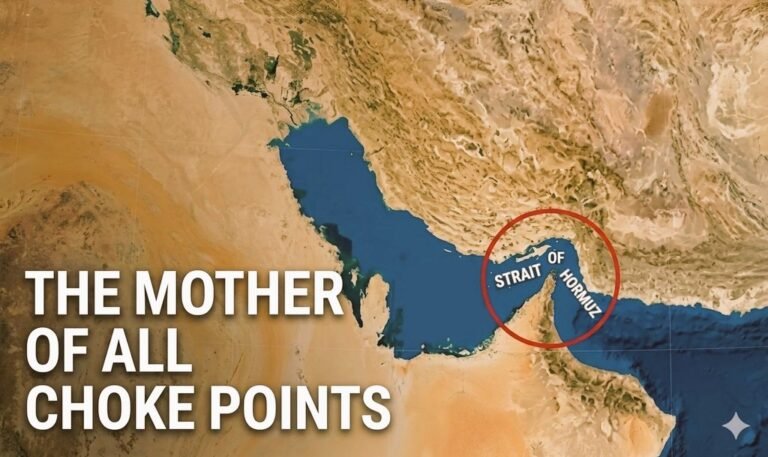
· Hormuz: Traffic is currently stalled due to war-risk insurance voids amid the ongoing missile exchanges.
· Bab al-Mandab: The southern Red Sea chokepoint faces imminent reactivation of Houthi threats. The Houthis were re-designated as an FTO in January 2025.
· Sudan: With the al-Baraa Bin Malik Brigade now designated, the Red Sea coast of Sudan falls under the same sanctions architecture.
The seven Protection and Indemnity (P&I) clubs that price risk for Hormuz are the same institutions pricing risk for the Bab al-Mandab strait. With both chokepoints now carrying simultaneous designation-driven risk premiums, insurers are bracing for a prolonged period of elevated costs.
“The market is pricing a quick Iran war, but these designations lock in 12 to 24 months of proxy sanctions enforcement across two chokepoints, two civil wars, and three continents,” said a maritime risk analyst based in London. “Every Iranian proxy network touching the Red Sea corridor now faces coordinated U.S. sanctions.”
Strategic Victory
While the world counted missiles over Hormuz, Sheikh Mohammed bin Zayed secured a legal weapon that achieves in 24 hours what fifteen years of regional diplomacy could not: the transformation of the Sudanese conflict from a local power struggle into a front in the global war on terror, with the full weight of U.S. sanctions behind it.
About The Author