Iran Declares Closure of Strait of Hormuz, Sparking Fears of Global Energy War
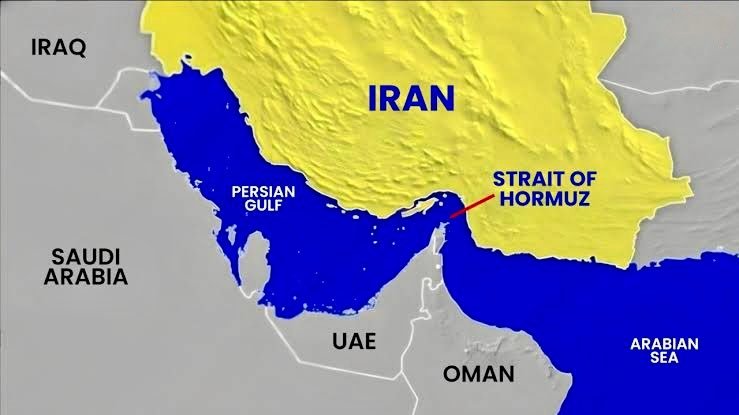
MANAMA, Bahrain – In a dramatic and unprecedented escalation, Iran announced the complete closure of the Strait of Hormuz on Saturday, threatening to sever a waterway crucial to global energy supplies and dramatically heightening tensions with the United States.
The Islamic Revolutionary Guard Corps Navy (IRGC) broadcast its declaration via VHF maritime radio on the morning of February 28, 2026, ordering all vessels to avoid the strait. The announcement immediately sent shockwaves through global markets, with Brent crude prices spiking to $120 a barrel intraday.
The strait, a narrow 21-mile-wide channel between Iran and Oman, is one of the world’s most critical energy chokepoints. An estimated 20 million barrels of oil—roughly one-fifth of all global petroleum consumption—pass through it daily, along with 15% of the world’s liquefied natural gas (LNG).
“This is not a routine threat. This is a direct assault on the global economic order,” said a senior oil trader in Singapore. “Every desk in the world heard that transmission. At $120 a barrel, the global economy is on life support. If a single tanker is hit, we are looking at $200 oil, and at that point, we’re not talking about a slowdown, but a seizure.”
The closure comes amid a wider, devastating conflict. Iran has been subjected to sustained military strikes by the United States and allied forces, which have reportedly decimated its air defenses, eliminated senior military commanders, and intercepted barrages of missiles launched at multiple countries. While the status of Iran’s leadership remains unclear, the move to close the strait is widely viewed as a desperate act by a regime with few remaining options.
“It is the last economic weapon of a regime that has lost its generals, lost its air force, and quite possibly its Supreme Leader,” said a regional security analyst based in the Gulf. “This is not a position of strength. This is a geographic accident—21 miles of water—being used as a lever by a power that has nothing left.”
The threat is not without precedent. Iran has a long history of harassing and seizing tankers in the strait, most recently in 2019, and during the “Tanker War” of the 1980s, it famously mined the waterway. However, a formal, declared closure during an active, large-scale conflict with the United States marks a perilous new chapter.
The U.S. Fifth Fleet, headquartered just across the water in Bahrain, maintains a formidable presence in the region. The USS Abraham Lincoln carrier strike group is currently on station in the Gulf of Oman, and American destroyers in the area are equipped with Tomahawk cruise missiles capable of neutralizing the entirety of Iran’s naval assets—from fast attack boats to coastal defense batteries—in a matter of days.
Military analysts interpret Tehran’s announcement not as a feasible military objective, but as a suicidal provocation. The move is seen as a direct challenge, daring the United States to forcefully reopen the strait.
“Iran is not closing the strait. It is daring America to open it by force,” the analyst added. “They know the U.S. response will not be negotiation. It will be Operation Praying Mantis on a十倍 scale. The IRGC Navy knows it can’t win. This is a suicide note dressed as a threat.”
Operation Praying Mantis was a 1988 one-day U.S. naval engagement in retaliation for an Iranian mine that damaged an American warship, resulting in the sinking of multiple Iranian vessels and the destruction of two oil platforms.
For the global economy, the stakes could not be higher. A prolonged closure would starve factories in China of imported crude, ground airlines that hedged fuel costs at a fraction of the current price, and plunge European nations—already struggling to replace Russian gas—into an LNG crisis. The impact would be felt instantly by every consumer, from the price at the pump to the cost of goods.
The world now holds its breath. Every oil trader, military commander, and government leader is watching the same narrow stretch of water. The next move will determine whether this becomes a catastrophic economic event or the opening salvo of a full-scale naval war. As one trader put it, the only certainty is that by morning, if force is used, the seafloor will be littered with wreckage, but the crude will have to flow.
About The Author