

Iran Strikes UAE in Unprecedented Attack, Targeting Dubai’s Iconic Landmarks
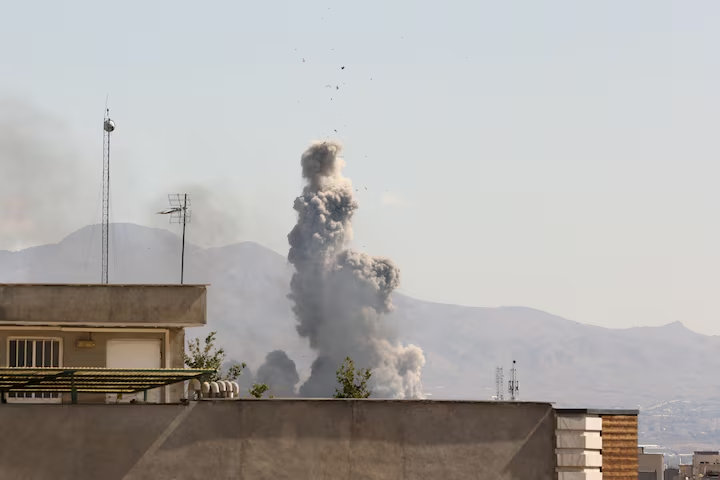
DUBAI, UAE — In a dramatic escalation of regional hostilities, Iran launched over 300 ballistic missiles and drones at the United Arab Emirates Saturday night, striking multiple civilian targets including Dubai International Airport, the Burj Khalifa’s airspace, and iconic landmarks across the emirates, according to UAE defense officials.
The attack, which killed one person and wounded seven others, represents the first direct assault on UAE soil since the Gulf War and fundamentally challenges the nation’s four-decade positioning as a safe haven in the volatile Middle East.
Widespread Damage Across Emirates
Missile debris struck the Fairmont Hotel on Palm Jumeirah, while drone fragments ignited fires on the facade of the Burj Khalifa’s neighboring Burj Al Arab hotel, the sail-shaped structure synonymous with Dubai’s global image. A terminal at Dubai International Airport—the world’s busiest hub for international passengers—sustained significant damage, forcing the suspension of all flight operations.
Jebel Ali Port, which hosts U.S. warships and handles aircraft carrier traffic, caught fire from interceptor debris. Abu Dhabi’s Zayed International Airport took a direct hit, officials confirmed.
The UAE Defense Ministry reported intercepting more than 100 ballistic missiles and 200 drones launched from Iranian territory.
Near-Miss at Burj Khalifa
In the most harrowing incident, UAE forces intercepted an Iranian drone near the Burj Khalifa, the world’s tallest structure at 828 meters. The building, containing 900 residences, a hotel, corporate offices, and thousands of occupants, was evacuated as residents and guests descended emergency stairwells while the interception unfolded.
“One failure, one drone getting through, could have produced the most consequential thirty seconds of video since September 11, 2001,” a senior UAE security official told reporters, speaking on condition of anonymity.
The drone, believed to be an Iranian Shahed-136 carrying a 40-kilogram warhead, was intercepted “by meters, by seconds,” the official said.
Regional Escalation
The attack extended beyond UAE borders. Saudi Arabia, Qatar, and Kuwait all reported being struck. Bahrain’s Fifth Fleet base sustained drone strikes that destroyed a $300 million radar system. Oman, which has served as a regional mediator, was the only Gulf nation spared.
Iran’s messaging appears deliberately calibrated to target economic infrastructure rather than purely military objectives, analysts said.
Economic Implications
The assault directly challenges Dubai’s foundational premise: that a global city can be built at the mouth of the Persian Gulf and insulated from regional violence through wealth, architecture, and diplomatic neutrality.
Dubai is home to two million expatriates. Sixty percent of the emirate’s revenue flows through its airport and seaport. Every sovereign wealth fund in the Gulf, every global bank, and every major luxury brand maintains significant exposure to the emirate.
“Capital has no loyalty. Only a return address,” said a Gulf-based financial analyst. “Real estate valuations across Palm Jumeirah, Dubai Marina, and Downtown now carry a war risk premium that didn’t exist 48 hours ago. Insurance underwriters will fundamentally reassess Gulf property portfolios.”
Schools across the UAE prepared to move online Sunday as residents sheltered in underground parking garages—facilities never designed as bomb shelters in a nation that had marketed itself as the region’s safest square mile.
International Response
The U.S. Fifth Fleet, headquartered in Bahrain, has not yet commented on the attacks. The UAE Foreign Ministry issued a statement condemning “all threats to civilian infrastructure” without explicitly naming Iran.
The White House said it was “monitoring the situation closely” and reaffirmed its commitment to regional partners.
For the 12,000 residents and workers who occupy the Burj Khalifa, the psychological impact may prove lasting. “That knowledge does not go away when the all-clear sounds,” the security official said. “It follows them into every decision about whether to renew a lease, whether to keep an office, whether to raise children in a building that has now been a confirmed drone target.”
Flight tracking maps showed the entire Gulf region’s airspace virtually empty Sunday morning as airlines suspended operations indefinitely.
About The Author