
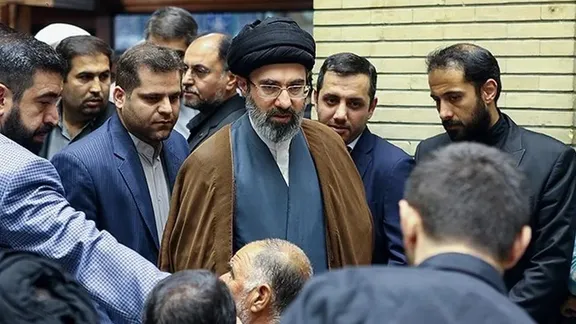
IRGC-Backed Succession: Mojtaba Khamenei Chosen as Iran’s Next Supreme Leader in Wartime Decision
March 3, 2026 – In a decisive move following the death of Ayatollah Ali Khamenei, Iran’s Assembly of Experts has selected his son, Mojtaba Khamenei, as the next Supreme Leader, according to exclusive information obtained by Iran International. The decision, driven by the Islamic Revolutionary Guard Corps (IRGC), has not been publicly announced and is expected to be revealed after the late leader’s burial.
The succession comes just days after Ayatollah Khamenei was killed in US and Israeli airstrikes, plunging the Islamic Republic into a leadership crisis amid an ongoing war. The choice of Mojtaba Khamenei is being characterized not as a routine constitutional process, but as a wartime measure prioritized by the security state to ensure control and internal stability.
Why the IRGC Pushed for Mojtaba
Analysts suggest the IRGC’s backing stems from a need for both control and legitimacy within the regime’s core base. Mojtaba Khamenei, who has effectively run the Supreme Leader’s office (the Beit) for over two decades, offers direct continuity with his father and maintains deep, long-standing ties with the Guard’s command networks. This positions him as a figure who can unite the hard-line security institutions, the clerical leadership, and loyalist networks during a period of extreme vulnerability. The Beit is described as the true center of power in Iran, controlling key security, political, and financial levers, making the choice of an insider critical for the apparatus’s self-preservation.
A Regime at a Crossroads
The Islamic Republic now faces two stark paths: continued escalation or major concessions. The new leader’s role will be pivotal in navigating this choice.
· Path of Escalation: Continuing the fight would mean tighter internal control, reliance on asymmetric warfare, and a defiant posture, signaling no negotiation under fire.
· Path of Concession: Stepping back would require accepting painful terms likely demanded by the US, potentially including ending uranium enrichment as a national project, accepting limits on missile programs, and abandoning the network of regional proxies.
Mojtaba Khamenei is seen as uniquely positioned to pursue either option. He could frame continued fighting as a duty of retaliation or, invoking a core doctrine of the Islamic Republic’s founder—that “preserving the system is the highest duty”—justify painful compromises as necessary for survival. This latter option, however, would mean dismantling his father’s 37-year legacy.
The Burden of Blood and Revenge
Any move toward de-escalation is complicated by the principle of qisas (retribution). With President Donald Trump now seen in Tehran’s narrative as responsible for the blood of both General Qasem Soleimani and Ayatollah Ali Khamenei, making a deal is politically explosive. As the next of kin with the right to demand retribution, Mojtaba is the one figure who could theoretically set aside that demand in the name of state survival, framing it not as humiliation but as obedience to a higher obligation.
Implications and Immediate Questions
The immediate question is whether the US and Israel will now target Mojtaba Khamenei. Striking him immediately would signal a shift in objectives from pressure to outright regime change. If they hold back, the focus turns to his next move.
Even if a climbdown halts the war, analysts warn the inheritance is bleak. Mojtaba Khamenei would take over a state described as facing “failed-state reality”—with a devastated economy, hollowed-out institutions, and widespread public hostility following a violent crackdown. His tenure, whether marked by war or a fragile peace, begins “in the ruins of his father’s world,” with the regime’s long-term survival now uncertain.
Other recent developments reported by Iran International include:
· Military Pressure: US President Donald Trump claims Iran is running out of missiles and launchers amid sustained strikes, though he asserts American stockpiles remain strong. Reports indicate Israeli strikes have destroyed a significant portion of Iran’s ballistic missile launchers.
· Civilian Sites: Concerns are growing over the use of civilian facilities like schools and hospitals by Iranian security forces, raising legal and humanitarian issues amid the conflict. A disputed strike on a school complex in Minab killed over 160 people.
· Regional Impact: China is pressing Iran to keep the Strait of Hormuz open to protect energy supplies, especially from Qatar, as the conflict disrupts shipping and halts Qatari LNG production. Asian countries are scrambling to secure alternative energy sources.
About The Author