
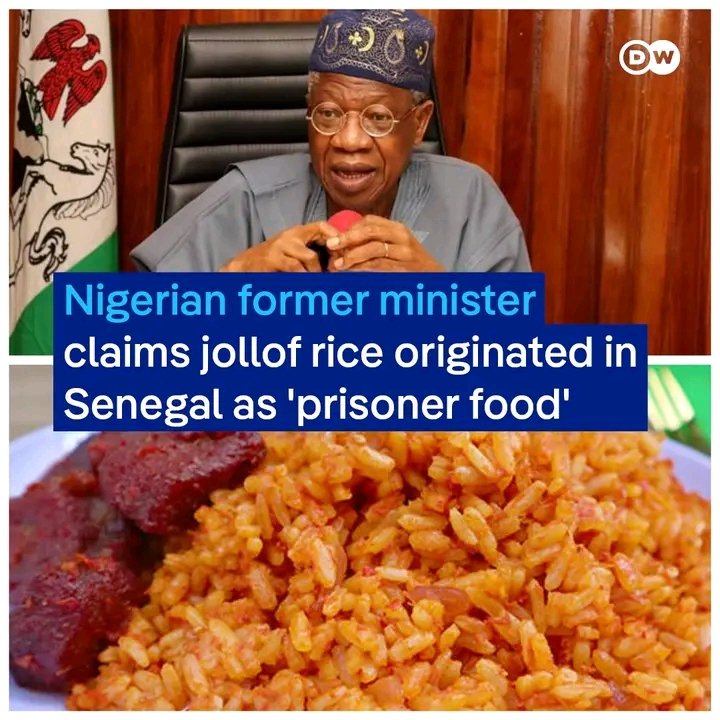
HEADLINE: Nigeria’s Ex-Minister Stirs Pot on Jollof Rice Origins, Cites Senegalese Roots and Prisoner Past
A former Nigerian information minister has reignited one of West Africa’s most spirited culinary debates, claiming the region’s beloved jollof rice originated in Senegal and was once “prisoner food.”
Lai Mohammed, speaking in a recent television interview, stated that the iconic dish traces its roots to the Wolof people of Senegal and The Gambia. “The word ‘jollof’ comes from the Wolof name,” he said, a linguistic and historical point broadly accepted by scholars who link the dish to the historic Wolof Empire.
However, it was his additional assertion that has sparked particular controversy and skepticism. Mohammed suggested the dish was initially prepared as a simple meal for prisoners before evolving into a regional staple.
Historians and culinary experts quickly responded, acknowledging Senegal’s widely recognized status as the dish’s birthplace but challenging the “prisoner food” narrative. “There is no credible historical evidence to support the claim that jollof rice was originally prisoner food,” said Dr. Abena Ofosu, a food historian specializing in West Africa. “It developed as a dish within Wolof cuisine, with its complex flavors reflecting local ingredients and trade routes, not penal systems.”
The comments have fueled fresh discussion in the long-running and fiercely contested rivalry over which country makes the superior version of the dish, particularly between Nigeria and Ghana. Online platforms buzzed with reactions, with many Nigerians defending their nation’s often spicier, oil-based variant, while others acknowledged the Senegalese origins.
“Even if it started in Senegal, we perfected it,” argued a popular social media user, capturing a common sentiment in the ongoing “Jollof Wars.”
Mohammed’s intervention adds a new, albeit disputed, historical layer to the dish’s story. While the prisoner claim may lack academic backing, his remarks have successfully turned up the heat on a perennial debate that continues to simmer across West Africa and its diaspora.
About The Author