Senior Hamas Commander Killed in Israeli Strike, Ceasefire Under Strain
Hamas has confirmed that Israeli forces killed senior commander Raed Saad in an attack near Gaza City on Saturday, marking the highest-profile assassination of a Hamas figure since a U.S.-brokered ceasefire took effect in October. The strike, which also wounded at least 25 people, has heightened tensions as international mediators struggle to advance the peace process to its next phase.
In a video statement on Sunday, Hamas’s Gaza chief, Khalil al-Hayya, accused Israel of a “continued violation” of the ceasefire agreement. He called on the United States and President Donald Trump, as the main guarantor of the deal, to pressure Israel to comply.
Details of the Targeted Strike
The Israeli military stated it targeted Raed Saad, describing him as a key figure in Hamas’s weapons-manufacturing operations and one of the architects of the October 7, 2023, attacks on Israel. An Israeli defense official told Reuters that Saad was the head of Hamas’s weapons-manufacturing force, while Hamas sources identified him as the second-in-command of the group’s armed wing.
The assassination comes at a delicate time, as negotiations are meant to be shifting towards the second phase of the ceasefire, which includes a full Israeli withdrawal from Gaza, Palestinian disarmament, and a formal end to the war.
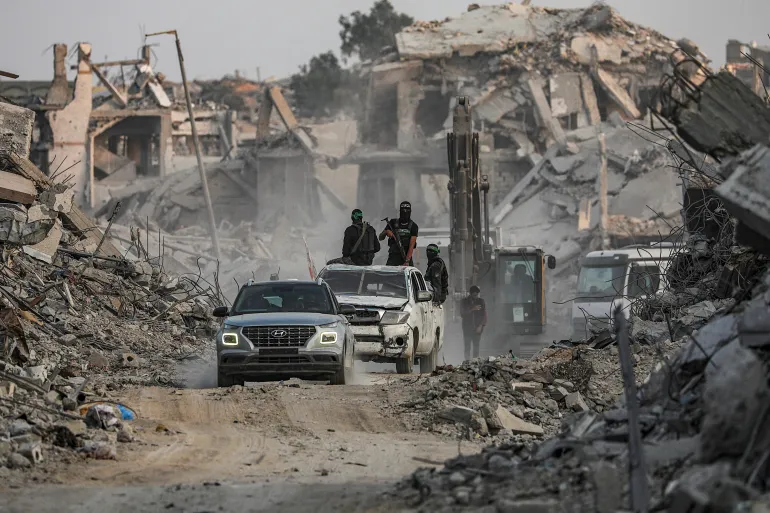
A Ceasefire Marred by Ongoing Violence and Suffering
Hamas officials claim that since the truce began on October 10, Israel has carried out nearly 800 attacks, killing at least 386 Palestinians. Independent monitors also report that violence, though reduced from its peak, has persisted.
· Persistent Military Operations: Israeli forces have conducted approximately 190 operations since the ceasefire, resulting in over 230 Palestinian fatalities. Most incidents occurred near the “Yellow Line,” a buffer zone inside Gaza where Israeli forces maintain control.
· Deepening Humanitarian Crisis: Israel continues to block the free flow of aid into Gaza, a violation of the truce’s terms. This blockade has exacerbated a catastrophic humanitarian situation, now worsened by a severe winter storm that flooded 27,000 tent shelters. Amnesty International warns that Israel’s restrictions on aid and essential services are deliberately inflicting conditions that threaten the physical destruction of Palestinians in Gaza, amounting to an ongoing genocide.
· Internal Palestinian Violence: The period following the ceasefire also saw the deadliest month of intra-Palestinian violence since the war began, with Hamas conducting a campaign to consolidate its control in areas vacated by Israel, resulting in 60 Palestinian deaths.
The Stalemate Over “Phase Two”
The killing of Saad underscores the fragility of the ceasefire and the significant obstacles to implementing the next phase of Trump’s 20-point peace plan. Key points of contention include:
· The Final Hostage: Israel insists that Hamas must return the body of the one remaining confirmed deceased hostage, Sgt. 1st Class Ran Gvili, before moving forward. Hamas has cited the difficulty of excavating bodies from under widespread rubble.
· Disarmament of Hamas: This remains the most significant hurdle. The agreement calls for Hamas to disarm and for an International Stabilization Force (ISF) to deploy. However, Hamas officials have stated they will not accept an international force taking charge of disarmament. Instead, they are only willing to discuss “freezing or storing” weapons under Palestinian guarantees.
· Governance and Reconstruction: The U.S. plan envisions a “Board of Peace” overseeing Gaza’s reconstruction and a technocratic administration, eventually leading to the return of a reformed Palestinian Authority. However, Israel has rejected Palestinian Authority control and any notion of Palestinian statehood. Furthermore, no country has yet formally committed troops to the proposed international force.
Regional Powers Propose Competing Visions
With the U.S.-led process stalled, regional actors are advancing rival frameworks for Gaza’s future:
· Egypt proposes deploying a Palestinian police force trained in Egypt and Jordan, alongside an international force, with Hamas storing its weapons under a “non-use” agreement.
· Qatar and Turkey suggest a sequenced approach: first deploy a Palestinian police force and establish a government, then later address disarmament by transferring Hamas’s weapons to the custody of the Palestinian Authority.
· The Palestinian Authority demands an immediate Israeli withdrawal and the handover of Hamas’s weapons directly to them, arguing that Hamas must “move aside”.
Legal and Humanitarian Pressures Mount
The UN Security Council has endorsed Trump’s peace plan, but legal experts argue the resolution prioritizes “rule by law” over international law, potentially legitimizing prolonged Israeli control. This clashes with multiple International Court of Justice (ICJ) rulings that have found Israel’s actions in Gaza plausibly genocidal and ordered it to facilitate humanitarian aid.
Despite the ceasefire, over 70,000 Palestinians have been killed and more than 171,000 injured since the war began in October 2023. With Israel still controlling over half of Gaza’s territory, the displacement of Palestinians remains widespread.
The assassination of Raed Saad has further poisoned the atmosphere for negotiations. As Hamas calls for international intervention to salvage the ceasefire, the path to a lasting peace and reconstruction for Gaza appears increasingly fraught with distrust and competing agendas.
About The Author