
US vows ‘most intense’ day of strikes on Iran as Tehran issues stark warning to Trump
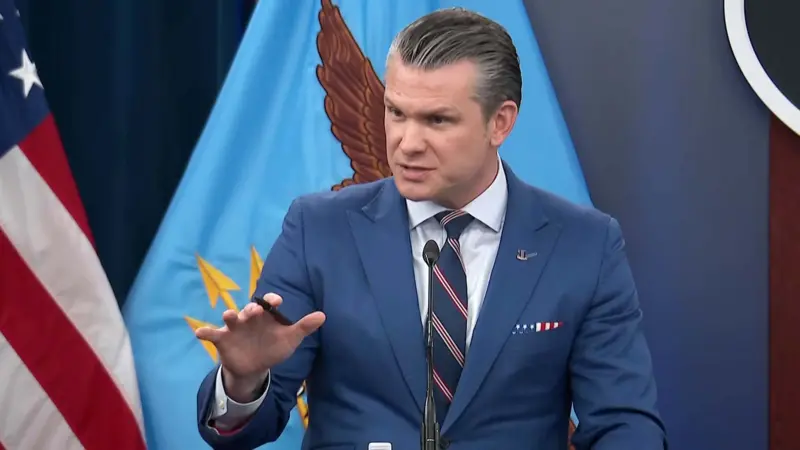
US Defense Secretary Pete Hegseth has warned that today will be the “most intense” day of American strikes on Iran so far, as fresh explosions rock Tehran and other Middle East capitals.
“The most fighters, the most bombers, the most strikes,” Hegseth told a Pentagon news conference, claiming Iran had fired the fewest number of missiles in a 24-hour period since the war began.
The escalation comes as a top Iranian security official issued a direct threat to Donald Trump on social media, telling the US president: “Be careful, so that you won’t get eliminated.”
Key developments:
On the ground in Iran: Residents described the impact of overnight strikes to the BBC. “They hit hard last night,” one Tehran resident said, as video emerged from Karaj showing a car windscreen shattering when an explosion shockwave hit a taxi trying to flee nearby air strikes.
A mother in Karaj told the BBC she felt the “shadow of death” after a strike hit close to her home. Another Iranian, speaking from Tehran on condition of anonymity, said: “We feel overwhelmed, we feel anxious and exhausted and the idea of no future is looming large over us.”
Military action: Israel announced fresh strikes targeting Hezbollah infrastructure in Beirut’s Dahieh suburb, while the UAE reported dealing with nine ballistic missiles and 35 drones today – bringing the total of Iranian weaponry directed at the country to 262 missiles and 1,475 drones since the conflict began.
In northern Israel, millions have rushed to shelters after at least 30 warnings of incoming missiles and drones. The Israeli military said it had targeted an underground complex used by Iran’s Revolutionary Guard for weapons research in Tehran overnight.
Oil prices fall: Despite the intensified strikes, oil prices dipped closer to $90 a barrel after Trump said Monday the war was “very complete, pretty much” and “ahead of schedule.” Prices had surged past $119 on Monday but have since fallen back, though they remain significantly above pre-war levels of around $72.
Natural gas prices also dropped, with UK month-ahead delivery falling sharply to 126p a therm, compared with yesterday’s peak of 171p.
Strategic warnings: Ali Larijani, Iran’s top security official, warned that the Strait of Hormuz – through which about a fifth of the world’s oil passes – could become a “strait of defeat and suffering for warmongers.” Traffic through the strait has all but halted since the war began.
The boss of Saudi Arabia’s Aramco warned of “catastrophic consequences” if the route remained blocked.
Regional impact: British Airways cancelled more flights to the Middle East, including to Amman, Bahrain, Doha, Dubai and Tel Aviv up to and including 28 March. The UK Ministry of Defence said a British air defence system took out a drone in Iraqi airspace overnight, and confirmed the RFA Lyme Bay was being prepared for possible deployment to the eastern Mediterranean.
Russia benefiting: Analysts say Russia is gaining from the conflict, with average daily fossil fuel export earnings rising 14% since strikes began on 28 February, totalling an estimated €510m (£441m) per day. “The longer this crisis continues, the better it is for Russia,” the Centre for Research on Energy and Clean Air warned.
Human cost: The UAE confirmed six deaths – of Emirati, Pakistani, Nepalese and Bangladeshi nationals – from Iranian attacks. Smoke continued to rise over Tehran, Beirut and Manama on Tuesday as strikes persisted across the region.
Israeli Prime Minister Benjamin Netanyahu said Israel was working to dismantle Iran’s theocratic leadership, expressing hope that Iranians would “break the yoke of tyranny” in their country – echoing Trump’s recent appeal for the Iranian people to “take over your government.”
About The Author