

New U.S. Security Strategy Declares Era of “America First,” Reorders Global Priorities and Retreats from Ideological Confrontation
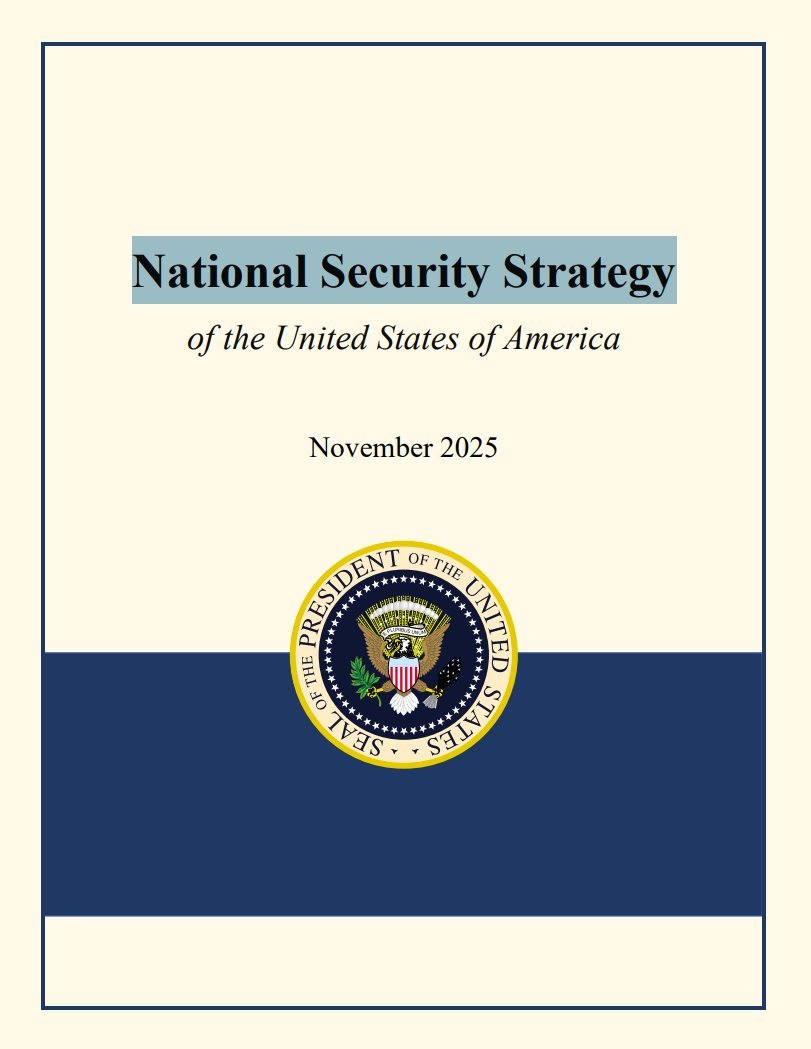
In a sweeping departure from decades of foreign policy tradition, the Trump administration has released a National Security Strategy that fundamentally reorders American global priorities, de-emphasizes ideological confrontation, and declares the Western Hemisphere—not China—as Washington’s primary strategic focus.
The document, published in November 2025, formally enshrines a “Trump Corollary” to the Monroe Doctrine, signaling a stark refocus on the Americas. It frames national security primarily through the lenses of border control, economic competition, and burden-sharing with allies, while markedly stepping back from the democracy-promotion rhetoric that has characterized U.S. strategy since the Cold War.
“Trump Corollary” and Hemispheric Dominance
The strategy bluntly states that “the United States must be preeminent in the Western Hemisphere as a condition of our security and prosperity.” It pledges to deny “non-Hemispheric competitors” the ability to position forces or control strategic assets in the Americas. To enforce this, the document calls for a military “readjustment… to address urgent threats in our Hemisphere, and away from theaters whose relative import… has declined.”
This includes enhanced Coast Guard and Navy patrols to control migration and trafficking, “targeted deployments” to secure the U.S. border and “defeat cartels,” including “where necessary the use of lethal force.” The goal is summarized as “Enlist and Expand”—enlisting regional partners to control migration and drug flows, while expanding U.S. economic and security networks to become the “partner of first choice.”
China Downgraded from Pacing Threat to Economic Competitor
In a striking shift, China is no longer labeled the “pacing threat” or “most consequential challenge.” Instead, the Indo-Pacific section is titled: “Win the Economic Future, Prevent Military Confrontation.” China is framed primarily as an economic competitor and a source of supply chain vulnerability.
The strategy admits that previous tariff policies “essentially failed” as China adapted by strengthening its hold on global supply chains. The new approach emphasizes building an economic coalition with allies to counteract “predatory economic practices,” acknowledging that America “just isn’t powerful enough on its own anymore.”
On Taiwan, the language reveals heightened caution. While maintaining the U.S. does “not support any unilateral change to the status quo,” it states that deterring conflict is “ideally” achieved by preserving military overmatch—implying such overmatch is not guaranteed. It warns that if First Island Chain allies don’t “step up and spend… much more,” it could lead to “a balance of forces so unfavorable to us as to make defending that island impossible.”
End of “Missionary Liberal Internationalism”
The document explicitly renounces ideological crusades. It states U.S. policy is “not grounded in traditional, political ideology” and seeks “good relations… with the nations of the world without imposing on them democratic or other social change.” It affirms there is “nothing inconsistent” in maintaining good relations with countries whose governing systems differ from America’s.
This “flexible realism,” as termed in the document, signifies the burial of the “democracy vs. autocracy” framework that has dominated recent U.S. foreign policy. The competition with China is described in pragmatic, economic terms, with “economics” labeled “the ultimate stakes.”
Contradictions and a Test Case in Tanzania
The strategy’s simultaneous demand for allied burden-sharing and economic coalition-building against China presents a clear contradiction. Allies are asked to sacrifice economically to support U.S. priorities, even as Washington treats every alliance as a transaction to be renegotiated.
The new “predisposition to non-interventionism” is immediately tested by ongoing international crises. Just as the strategy was released, fifteen European nations, Canada, and the European Union issued a joint statement calling on Tanzania to urgently release the bodies of those killed during post-election violence and to free political prisoners. The statement, citing “credible reports” of extrajudicial killings and disappearances, represents the very kind of values-based, interventionist diplomacy the U.S. strategy now distances itself from.
The contrast underscores a pivotal moment: as the U.S. retrenches behind a doctrine of hemispheric dominance and transactional realism, it is leaving a diplomatic vacuum that other Western powers are still attempting to fill, even as their ability to effect change diminishes without American leadership.
The 2025 National Security Strategy concludes that “the era of mass migration is over” and “the days of the United States propping up the entire world order like Atlas are over.” The document is less a plan for global leadership and more a blueprint for managed disengagement, where America’s interests are narrowly defined and ruthlessly prioritized, leaving the rest of the world to navigate the consequences.
About The Author