
Kenyan Minister’s Leadership Critique Sparks Regional Debate Amid West African Instability
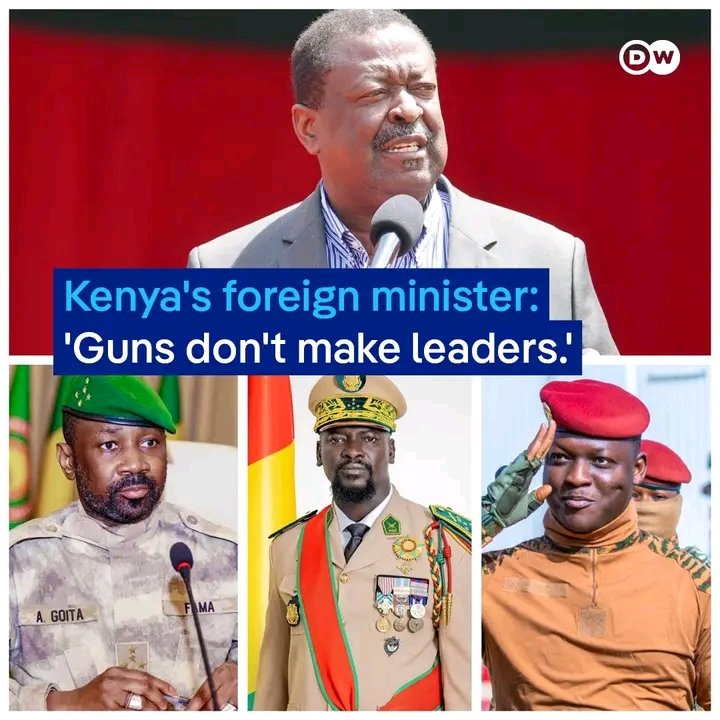
NAIROBI – Kenya’s Prime Cabinet Secretary and Cabinet Secretary for Foreign Affairs, Musalia Mudavadi, has ignited a pointed discussion on governance and authority after stating that genuine leadership is not demonstrated by force or weaponry.
“A true leader doesn’t need to carry a gun or display weapons,” Mudavadi asserted, emphasizing a philosophy of governance starkly at odds with recent political trends in parts of Africa. He framed authentic leadership as being rooted in “strong institutions, democracy, vision, and accountability,” rather than in “intimidation or force.”
The remarks, delivered at a public forum, have resonated far beyond Kenya’s borders, casting a spotlight on the volatile political landscape of West Africa. The region has seen a significant democratic backslide in recent years, with Mali, Burkina Faso, Niger, and Guinea all currently under military rule following coups. Guinea-Bissau has also faced repeated coup attempts, maintaining a fragile stability.
The timing of Mudavadi’s comments adds to their potency, coming just days after a foiled coup attempt in Benin. In that incident, soldiers briefly announced they had overthrown President Patrice Talon before government forces regained control, underscoring the persistent threat of military intervention in the region.
Analysts suggest Mudavadi’s statement, while a broad philosophical stance, is a veiled critique of the junta-led states and a reaffirmation of Kenya’s diplomatic position advocating for constitutional order and civilian governance.
“The Minister is drawing a clear line in the sand between leadership derived from popular mandate and institutional frameworks, and rule enforced at the barrel of a gun,” said Dr. Amani Odera, a Nairobi-based political analyst. “It’s a powerful message that implicitly questions the legitimacy of the military administrations in the Sahel.”
Reaction has been mixed. Supporters, particularly within civil society groups and pro-democracy advocates, have praised the statement as a courageous defense of democratic values. However, some critics in Kenya have questioned whether the remarks are overly simplistic given the complex security and governance challenges facing the Sahel nations, which are grappling with insurgencies and political transitions.
There has been no immediate official response from the military governments of Mali, Burkina Faso, or Niger. The growing instability and the spread of military rule have become a central concern for regional blocs like the Economic Community of West African States (ECOWAS) and the African Union, which Kenya actively supports.
As the debate continues, Mudavadi’s words highlight a deepening continental divide on the models of governance and the very definition of effective leadership in an era of heightened instability.
About The Author