


Exclusive: Iran’s Drone Army Puncturing U.S. and Allied Defenses, NBC News Analysis Finds
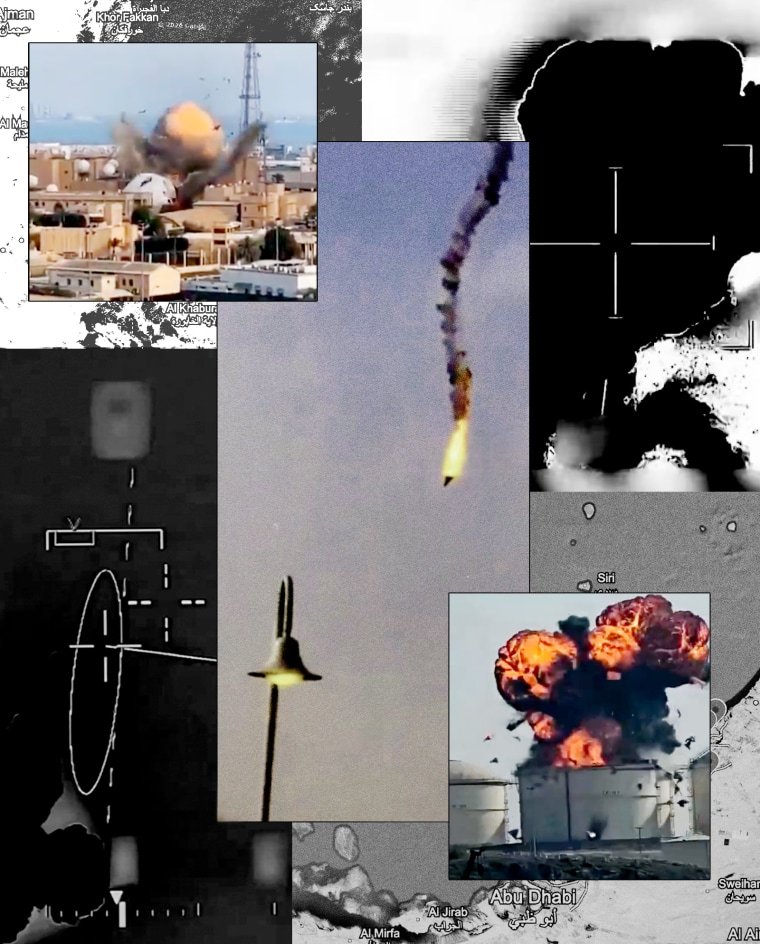
A sweeping analysis of open-source videos and satellite imagery by NBC News reveals that Iran is waging an effective and increasingly sophisticated drone warfare campaign, successfully penetrating defenses and striking strategic targets across the Middle East. The findings, based on a review of over 30 videos, paint a picture of a persistent and adaptable threat that is challenging the United States and its allies in unprecedented ways.
The footage, posted online across various platforms, documents apparent Iranian drone strikes and attempted interceptions across seven countries. The targets are diverse and strategically significant, including U.S. military bases, critical energy infrastructure, international airports, and even diplomatic compounds. In 21 of the 26 videos analyzed, the drones appear to have successfully reached their targets.
One video, posted online March 1 but believed to have been filmed earlier, captures the moment a drone struck near a running track at Camp Buehring, a U.S. military base in Kuwait. “Oh my God. Oh, that was right here,” a man recording can be heard saying as smoke billows from the impact site. Other verified videos show drones bombarding oil infrastructure in the Gulf, striking an oil storage facility in Oman not once but twice in the span of a week, and flying into a hotel in Bahrain.
The drone most frequently identified in the attacks is the Shahed-136, a “loitering munition” developed by Iran. According to the Open Source Munitions Portal (OSMP), the drone has a wingspan of 11.5 feet, a range of approximately 1,200 miles, and can carry a 110-pound warhead. It is pre-programmed to fly to a specific target using satellite navigation, operating autonomously without a pilot.
Experts say the weapon represents a fundamental shift in the economics and strategy of warfare. Iran is a pioneer of the technology, having sold it to Russia for use in Ukraine. The drones are relatively inexpensive to produce—estimated to cost between $20,000 and $50,000 each—while the advanced U.S. and allied missile systems used to intercept them can cost over 10 times that amount per shot. This asymmetry allows Iran to potentially prolong the conflict by draining enemy resources.
“It’s kind of like the ultimate symbol of asymmetric warfare,” said Joe Dyke, director of programmes for Airwars, a nonprofit that tracks civilian harm in conflict zones. While the drones can be shot down, they can overwhelm air defenses, and even a single success can cause deadly damage. A drone strike earlier in the conflict killed six U.S. servicemembers at the civilian Port of Shuaiba in Kuwait.
The impact on the region has been severe. The UAE, one of the hardest-hit countries, reports that as of March 10, 1,475 UAVs were fired at the country, with 1,385 intercepted. The country has reported six killed and 122 wounded since the conflict began. Israel has reported 13 deaths, while in Iran, more than 1,200 people have been killed by U.S.-Israeli strikes, according to the Iranian Red Crescent Society.
The attacks have also crippled transportation. The strategically vital Strait of Hormuz is effectively closed to traffic, and commercial air travel across the Persian Gulf has been heavily disrupted. Flight data shows airports in Kuwait and Bahrain are completely closed, with severe restrictions elsewhere.
The NBC News analysis suggests a coherent and evolving strategy. A geographic review of the attacks shows the majority have hit along the Persian Gulf coastline, a potential vulnerability in detection radar placement. Kelly Grieco, a senior fellow at the Stimson Center, noted the pattern of “re-attacking” the same types of targets, indicating a deliberate approach. “There’s real coherence to their strategy,” she said.
The size of Iran’s drone arsenal remains unclear. While interception numbers from the UAE suggest a recent decline in attacks, Grieco warns this could indicate a period of regrouping and stockpiling for a larger future assault. The attacks have even reached countries not party to the conflict, such as Azerbaijan, where verified videos show a drone bombarding an airport. Iran has denied responsibility, and its Foreign Minister, Abbas Araghchi, has implied that some military units are acting with a degree of independence based on pre-existing general instructions.
In response, the U.S. military says it is actively targeting Iran’s drone and missile capabilities. Gen. Dan Caine, the chairman of the Joint Chiefs of Staff, has stated the threat “has remained persistent.” Defense Secretary Pete Hegseth claimed in a recent briefing that the number of drone attacks has dropped as a result of U.S. operations.
The U.S. has also turned to an unlikely source for help: Ukraine. President Volodymyr Zelenskyy confirmed that the U.S. has formally requested assistance, and Ukraine has dispatched three teams of experts to the Middle East to share its nearly four years of hard-won experience in combating Iranian-designed Shahed drones.
Ultimately, the analysis raises questions about whether the U.S. can dictate the timeline of the war. The cheap, versatile drone provides Iran with a powerful tool to continue inflicting economic damage and military pressure, regardless of actions elsewhere on the battlefield.
“There’s an assumption that seems to be at work, that the United States can decide when the war ends,” said Grieco. “I don’t know if the United States is in that position as much as it thinks it is. The Iranians may not agree with that.”
About The Author