Ötzi the Iceman: Solving a 5,300-Year-Old Murder Mystery
The Accidental Discovery
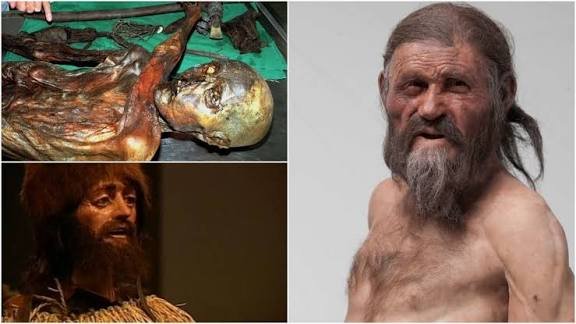
On a sunny September afternoon in 1991, German hikers Erika and Helmut Simon made a startling discovery in the Ötztal Alps along the Austrian-Italian border. Partially emerging from the melting ice of the Similaun Glacier, they spotted what they initially believed was a modern mountaineer’s tragic remains. But this was no ordinary casualty—it was a time capsule from the Copper Age, a naturally mummified man who would revolutionize our understanding of prehistoric Europe.
Named Ötzi after the Ötztal region where he was found, this Iceman had been preserved in glacial ice for over five millennia, emerging as the world’s oldest known human mummy. His discovery triggered not just an archaeological sensation but one of history’s most prolonged cold case investigations, ultimately revealing a story of violence that had remained frozen in time.
The Forensic Breakthrough: From Natural Death to Homicide
For nearly a decade after his discovery, scientists believed Ötzi had succumbed to exposure during a mountain storm. This theory seemed plausible until 2001, when routine X-rays revealed a shocking truth: a flint arrowhead was lodged deep in Ötzi’s left shoulder.
This discovery transformed the investigation completely. Forensic analysis determined the arrow had severed his subclavian artery, causing massive blood loss and death within minutes. The angle of entry indicated he was shot from behind, likely from a distance of approximately 30 meters (100 feet).
But the arrow wasn’t the only evidence of violence. Ötzi’s body told a complex story of conflict:
· A deep defensive wound on his right hand, sustained hours or days before death
· A severe head injury likely caused by a blow or fall shortly before he died
· Unhealed rib fractures on his left side
· Multiple bruises and cuts across his body
This accumulating evidence painted a clear picture: Ötzi hadn’t died peacefully in a storm—he had been murdered.
Reconstructing the Final Days: A Prehistoric Crime Scene
Using modern forensic techniques typically reserved for contemporary homicides, investigators have pieced together Ötzi’s final hours with remarkable detail. Munich police detective Alexander Horn, applying criminal profiling methods to the archaeological evidence, proposed this sequence of events:
Phase One: The Valley Confrontation
Ötzi was involved in a violent physical altercation at lower altitude,resulting in the deep cut on his hand. Traces of blood from four different individuals on his clothing and weapons suggest he may have injured or killed others in this encounter.
Phase Two: The Mountain Ascent
Fleeing from this conflict,Ötzi made a strenuous climb to approximately 3,210 meters (10,530 feet), an altitude that would have provided both refuge and strategic advantage. Here, he paused to rest and consumed his final meal—a hearty portion of fatty ibex meat, einkorn wheat, and roots, washed down with water from a mountain spring containing specific pollen grains that helped date his death to spring or early summer.
Phase Three: The Fatal Ambush
Approximately 30 minutes after eating,while possibly believing he had escaped danger, Ötzi was shot in the back. The arrow struck with such force that its flint tip remained embedded in his body while the shaft was removed by the assailant. He likely collapsed quickly from blood loss, dying on the rocky pass where his body would remain undisturbed for 53 centuries.
Notably, his valuable possessions—including a nearly pure copper axe, a flint knife, a bow, and a quiver of arrows—were left untouched. This detail suggests his killing was personal rather than motivated by robbery, potentially relating to the earlier conflict in the valley.
The Man Behind the Mummy: Ötzi’s Life Revealed
Beyond the mystery of his death, scientific analysis has revealed extraordinary details about Ötzi himself:
Physical Characteristics and Health
· Age and Appearance: Approximately 45 years old at death, standing 160 cm (5’3″) tall with brown eyes, dark hair, and a weathered complexion from outdoor life.
· Medical Conditions: Ötzi suffered from an array of ailments, including Lyme disease, whipworm, gallstones, and significant atherosclerosis (hardening of the arteries). His teeth showed considerable wear and several cavities.
· Tattoos: Sixty-one simple tattoos, consisting mostly of lines and crosses, were found on his body. Their placement corresponds to areas of strain or injury, suggesting they may have served a therapeutic or diagnostic purpose rather than decorative.
Daily Life and Skills
· Occupation: Analysis of his fingernails indicates a cycle of manual labor interrupted by periods of illness. His copper axe suggests involvement in metalworking, while his detailed knowledge of the high mountains implies he was intimately familiar with this challenging terrain.
· Diet: Isotopic analysis of his teeth and bones reveals he grew up in what is now South Tyrol, Italy, but traveled extensively through different valleys during his lifetime.
· Equipment: His carefully crafted tools and clothing—including a bearskin hat, goatskin leggings, and grass cloak—demonstrate sophisticated survival skills and resourcefulness.
Ongoing Investigations and New Revelations
Even three decades after his discovery, Ötzi continues to reveal secrets through advancing technology:
Genetic Discoveries
DNA analysis has provided remarkable insights,including:
· Lactose intolerance, common among Neolithic Europeans
· A genetic predisposition for cardiovascular disease
· The oldest known case of H. pylori bacteria, offering clues about human migration patterns
· Living relatives—19 modern Austrian men have been identified as sharing a specific genetic mutation with Ötzi
Cause of Death Refinements
Recent high-resolution CT scans have revealed additional details about Ötzi’s final moments.The arrow’s damage to nerves and blood vessels would have caused immediate paralysis of his left arm and rapid unconsciousness. Some researchers now believe the head injury may have occurred post-mortem or in his final moments as he collapsed.
The Unanswered Questions
Despite extensive investigation,key mysteries remain:
· Who killed Ötzi and why?
· Was he a shepherd, hunter, trader, or chieftain?
· Did he have a family or community that mourned his disappearance?
· What exactly transpired in the valley before his flight to the mountains?
Where to Encounter Ötzi Today
Since 1998, Ötzi has been preserved in a specially designed cold cell at the South Tyrol Museum of Archaeology in Bolzano, Italy, where the temperature is maintained at a constant -6°C (21°F) with 98% humidity to replicate glacial conditions. Visitors can view the mummy through a small window while exploring comprehensive exhibits displaying his clothing, tools, and weapons.
The museum also addresses the controversies surrounding Ötzi’s study, including ethical questions about displaying human remains and the legal dispute between Austria and Italy over which country could claim him (settled in Italy’s favor after surveys proved the discovery site was 92.56 meters inside Italian territory).
Conclusion: The Enduring Legacy of a Prehistoric Cold Case
Ötzi the Iceman represents far more than an archaeological curiosity. He provides an unprecedented window into daily life during the Copper Age, revealing technological sophistication, medical knowledge, and social complexity that challenge simplistic views of prehistoric societies. His violent death, preserved with forensic clarity across 53 centuries, reminds us that human conflict is as ancient as humanity itself.
While scientific debate continues regarding some details of his life and death, the overwhelming evidence confirms that Ötzi was a victim of deliberate homicide—making his case the world’s oldest documented murder. As technology advances, this Neolithic cold case may yet yield further revelations, continuing to connect us across millennia to a single individual whose story of survival and conflict feels remarkably human, even after 5,300 years.
The South Tyrol Museum of Archaeology in Bolzano, Italy, offers virtual tours and extensive online resources for those wishing to learn more about Ötzi and the ongoing research into his life and times.
About The Author