
Starlink Cuts Off Service in Uganda Following Regulator’s Order Ahead of Elections
KAMPALA — Satellite internet service Starlink has confirmed it has blocked all its terminals in Uganda after the national telecommunications regulator ordered it to stop providing unlicensed services, a move that comes just weeks before the country’s general elections.
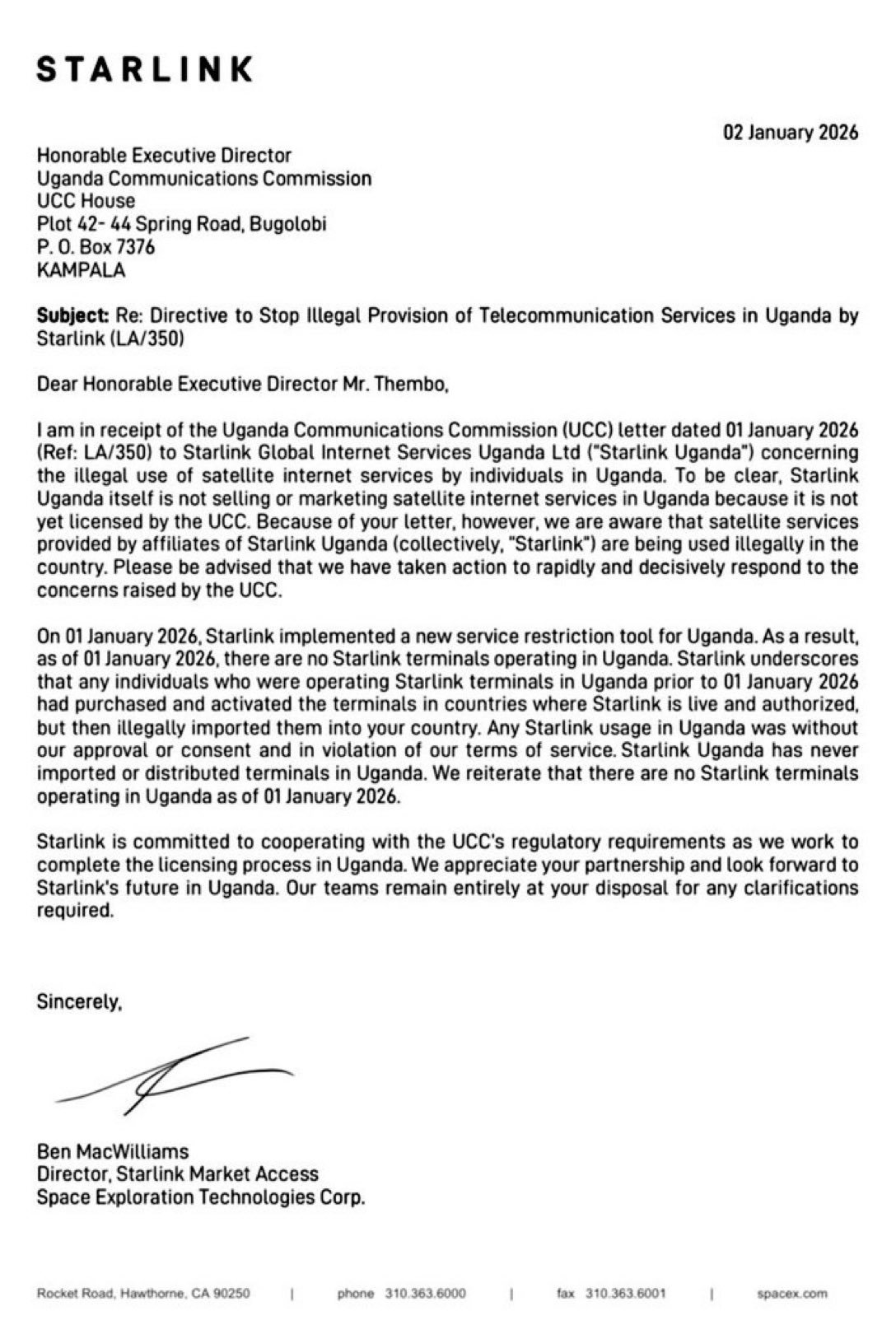
In a letter dated January 2, 2026, addressed to the Uganda Communications Commission (UCC), Ben MacWilliams, Director of Starlink Market Access at SpaceX, stated that the company implemented a “new service restriction tool” on January 1, 2026, rendering all Starlink terminals in the country inoperable.
The action was in response to a directive from the UCC dated January 1 (Ref: LA/350) concerning the “illegal use of satellite internet services by individuals in Uganda.” In the letter, Starlink clarified that its local entity, Starlink Global Internet Services Uganda Ltd, has never sold, marketed, or distributed terminals in Uganda because it has not yet been licensed by the UCC.
The company explained that any Starlink terminals used in Uganda had been purchased and activated in other countries where the service is authorized and were then “illegally imported” into Uganda without Starlink’s approval, constituting a violation of its terms of service.
“We reiterate that there are no Starlink terminals operating in Uganda as of 01 January 2026,” MacWilliams wrote, adding that Starlink remains committed to cooperating with the UCC to complete the licensing process.
Election Context and Public Reaction
The timing of the shutdown has raised concerns among observers and citizens, as Uganda prepares for presidential and parliamentary elections on January 15. Local journalist Canary Mugume noted on social media platform X a “looming fear of a government-imposed internet blackout during the January 15 elections, just like in 2021 elections.”
During the 2021 elections, the government imposed a nationwide internet shutdown for several days, citing the need to prevent the spread of misinformation. The move was widely criticized by human rights groups as an attempt to stifle communication and organization among opposition supporters.
With Starlink now inaccessible, one of the potential avenues for uncensored internet access—especially in remote areas poorly served by traditional providers—has been closed ahead of the polls. Starlink’s satellite-based service is often seen as harder for governments to control compared to terrestrial networks.
Broader Implications
The situation highlights the tension between global satellite internet providers and national regulatory frameworks. While Starlink has asserted its compliance with Ugandan law, the move effectively enforces a digital border, cutting off users who had relied on the service, often in rural or underserved regions.
The UCC has not yet issued a public statement following Starlink’s letter. Starlink expressed appreciation for the UCC’s partnership and said its teams remain available for further clarification as it works toward obtaining a formal operating license in Uganda.
How the service suspension affects connectivity, election monitoring, and public discourse in the coming weeks remains to be seen.
About The Author