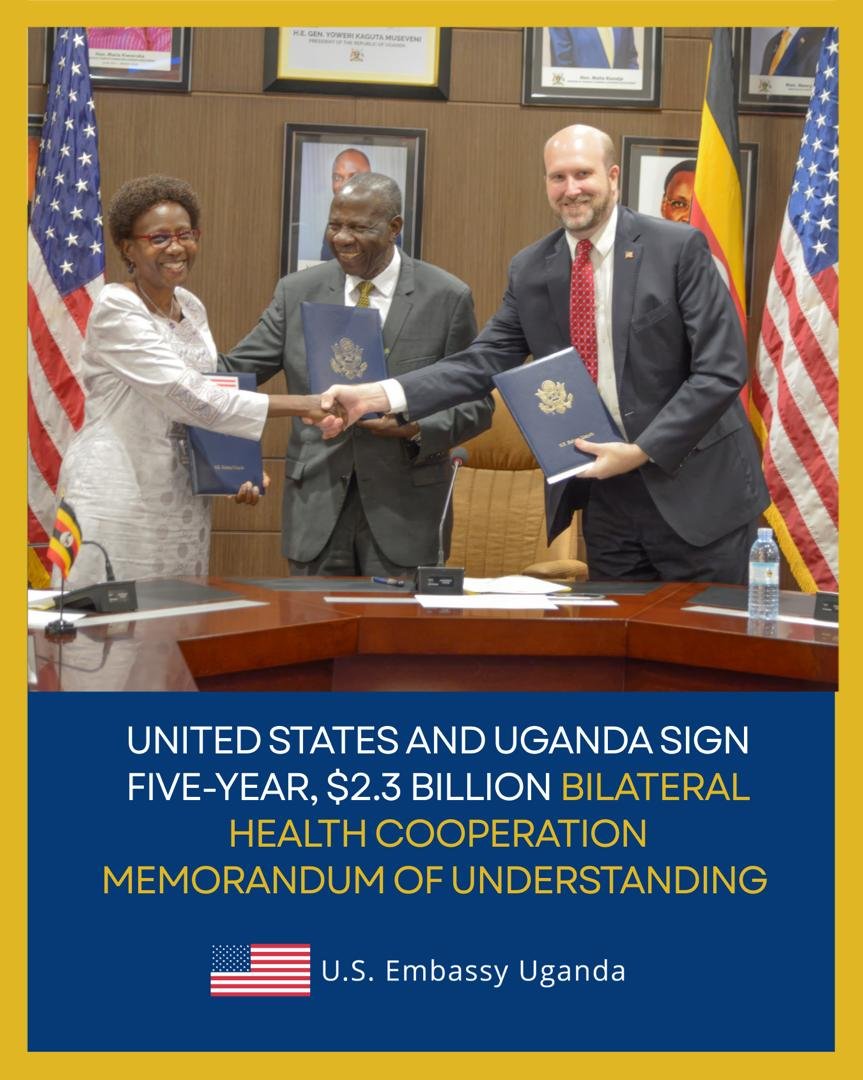
U.S. and Uganda Sign Landmark $2.3 Billion Health Partnership Agreement
The United States and Uganda solidified a major bilateral health partnership today with the signing of a five-year, $2.3 billion Memorandum of Understanding (MOU). The agreement, framed under the U.S. America First Global Health Strategy, aims to strengthen Uganda’s health system, combat infectious diseases, and advance a shared goal of sustainable, country-led healthcare.
The signing ceremony, attended by U.S. Ambassador William W. Popp and Ugandan Minister of Finance Matia Kasaija, marks a strategic evolution in one of Africa’s most significant global health partnerships. The framework commits a total of $2.3 billion in co-investment, with the U.S. planning to provide up to $1.7 billion and the Ugandan government pledging to increase its domestic health expenditures by more than $500 million over the 2026-2030 period.
“This agreement represents a significant commitment to co-invest in our shared global health priorities,” stated Ambassador Popp. He emphasized the pact’s focus on promoting “self-reliance” through stronger community health systems, robust data surveillance, and clear performance metrics to prevent outbreaks that could threaten regional and global security.
Minister Kasaija affirmed Uganda’s commitment, noting the collaboration would “yield not only disease-specific outcomes but also significant improvements in national systems, institutions, and workforce capacity.” He highlighted the government’s responsibility to sustain health gains through increased domestic financing.
Strategic Priorities and Innovative Provisions
The comprehensive MOU outlines several key areas of cooperation and innovative transition plans:
· Programmatic Focus: Support will continue for flagship programs addressing HIV/AIDS, tuberculosis, malaria, maternal and child health, and polio eradication, with an enhanced emphasis on global health security and epidemic preparedness.
· Pathway to Sustainability: A core component involves the gradual transition of responsibility from U.S.-supported mechanisms to Ugandan government systems. This includes shifting the procurement of health commodities to Ugandan institutions and transitioning U.S.-funded frontline health workers onto the Ugandan government payroll.
· Data and Digitization: Significant U.S. investment is earmarked for strengthening Uganda’s health data ecosystem, including electronic medical records and integrated disease surveillance systems to support the government’s digitization agenda.
· Support for Faith-Based Providers: The agreement explicitly includes mechanisms to support faith-based healthcare providers, who deliver a substantial portion of Uganda’s health services, through grants and digitization support.
The agreement builds on over six decades of U.S.-Uganda health collaboration. Officials from both nations framed it as a pivotal step toward an effective health system ultimately owned and sustained by Uganda’s own institutions and communities, contributing to stability and health security for both nations.
In a significant move to bolster global health security and sustainable development, the United States and the Republic of Uganda have solidified a landmark five-year health cooperation framework. The two nations signed a Memorandum of Understanding (MOU) valued at $2.3 billion, signaling a deepened bilateral commitment to saving lives and strengthening Uganda’s health infrastructure.
The agreement, signed at Uganda’s Ministry of Finance by U.S. Ambassador William W. Popp and Finance Minister Matia Kasaija, operates under the U.S. America First Global Health Strategy. It outlines a co-investment model where the U.S. plans to provide up to $1.7 billion**, while the Ugandan government pledges to increase its domestic health expenditure by **$500 million over the period from 2026 to 2030.
Ambassador Popp highlighted the strategic shift embodied in the pact. “This agreement marks a significant shift toward self-reliance—through strong local health systems, clear performance metrics, and a foundational commitment to global health security,” he stated. The goal, he noted, is to “stop outbreaks before they threaten Uganda, the United States, and the world.”
Finance Minister Kasaija affirmed Uganda’s commitment to the partnership and its evolving role. “This collaboration will not only deliver disease-specific results but also strengthen Uganda’s national systems, institutions, and health workforce,” Kasaija said. “Our commitment to increased domestic financing reflects our responsibility to sustain these gains.”
The comprehensive MOU targets a wide array of priority health areas, including:
· HIV/AIDS, tuberculosis, and malaria control
· Maternal and child health
· Polio eradication
· Global health security and emergency preparedness
· Disease surveillance and human resources for health
A core innovative element of the agreement is its structured pathway toward Ugandan ownership. Key provisions include:
· Transition of Commodities Procurement: The responsibility for procuring most health commodities will gradually shift from U.S. mechanisms to Ugandan government systems over the five years.
· Integration of Health Workers: Frontline health workers currently funded by U.S. programs will be systematically mapped and transitioned onto the Ugandan government payroll.
· Digital Transformation: Significant U.S. investment is earmarked for enhancing Uganda’s health data ecosystem, including electronic medical records and integrated disease surveillance systems.
· Support for Faith-Based Providers: The agreement includes specific mechanisms to bolster faith-based organizations, which are critical healthcare providers across Uganda.
This new framework builds upon over six decades of U.S.-Uganda health collaboration. It is designed to fortify a resilient health system that can prevent the spread of infectious diseases—a mutual interest for both nations’ security and prosperity. The emphasis on co-investment and systemic transition underscores a shared vision for an effective, sustainable health system ultimately owned and led by Uganda.
About The Author