Uganda Communications Commission Debunks Fake Election Shutdown Notice
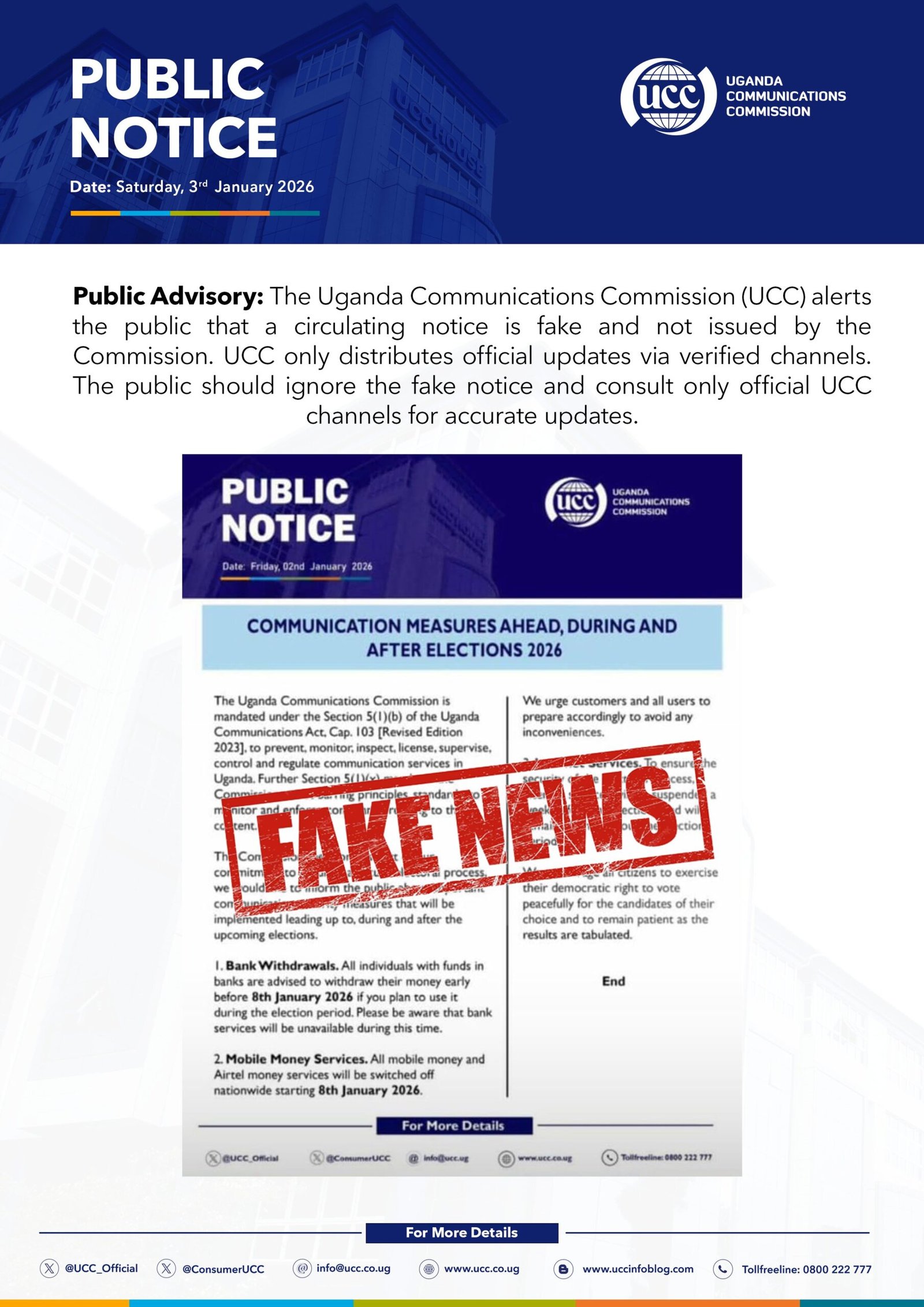
KAMPALA — The Uganda Communications Commission (UCC) has issued a public advisory warning citizens of a fraudulent notice circulating online that falsely claims banking, mobile money, and internet services will be suspended ahead of the January elections.
In a statement released on January 3, 2026, the UCC explicitly labeled the document—dated January 2—a hoax. The fake notice had warned that bank withdrawals and mobile money services would be halted from January 8, followed by an internet shutdown a week before voting.
UCC Executive Director Hon. Nyombi Thembo condemned the notice as deliberate deception and urged the public to rely only on official communication channels, including the UCC’s verified website and social media accounts.
“The Uganda Communications Commission alerts the public that a circulating notice is fake and not issued by the Commission,” the regulator posted on X. “UCC only distributes official updates via verified channels.”
Concerns Over Election-Related Misinformation
The emergence of the fake document has heightened concerns about misinformation in the lead-up to Uganda’s polls, scheduled for mid-January. Veteran journalist Sudhir Byaruhanga noted that such a notice could have provoked unnecessary panic and real-world disruptions, citing one individual who rushed to withdraw savings before learning the notice was false.
The incident echoes fears of possible digital restrictions during elections, recalling the government-imposed internet blackout during the 2021 polls. Although the UCC has not announced any planned shutdowns, the spread of the fraudulent notice has underscored public anxiety over access to information and financial services during sensitive political periods.
Official Reassurance and Public Vigilance
Authorities have stressed the importance of verifying information through official sources as the country approaches election day. The UCC reiterated that any official directives regarding communications or service suspensions would be formally issued through its recognized platforms.
The commission’s swift response aims to prevent public confusion and maintain stability ahead of the voting process. Analysts suggest that such hoaxes may be intended to undermine trust in institutions or provoke unrest, making public awareness and media literacy critical in the days before the election.
About The Author