Uganda Defence Official Sparks Outrage After Comparing Protest Beatings to Parental Discipline
KAMPALA, Uganda — A senior Ugandan defence official has ignited a fierce public debate after justifying the military’s use of force against civilians by comparing it to parents disciplining their children, drawing swift condemnation from opposition leaders.
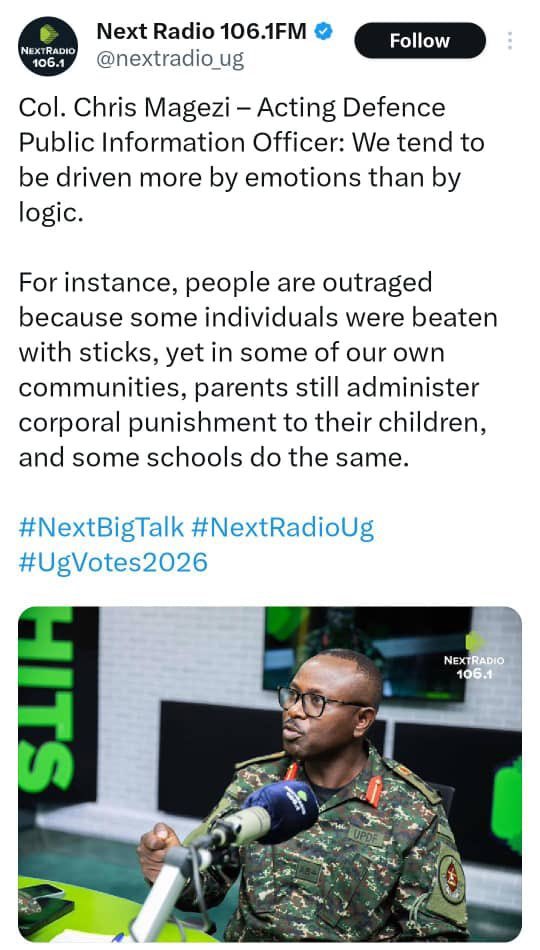
The controversy began when Col. Chris Magezi, the Acting Defence Public Information Officer, appeared on Next Radio 106.1FM. While discussing public reactions to protest policing, he stated, “We tend to be driven more by emotions than by logic.” He illustrated his point by saying, “For instance, people are outraged because some individuals were beaten with sticks, yet in some of our own communities, parents still administer corporal punishment to their children, and some schools do the same.”
The remarks were a defence of the security forces’ use of batons during crowd control operations. However, the analogy prompted immediate backlash.
Opposition leader and National Unity Platform spokesperson, Joel Ssenyonyi, sharply criticized the comparison on social media platform X. “So this character thinks it’s okay for the military to beat up leaders and their supporters, just because parents beat their children!” Ssenyonyi wrote. “The irony is that his name is ‘Magezi'”—a word meaning “wisdom” in Luganda.
Col. Magezi fired back in a direct reply, launching a personal attack on Ssenyonyi. “This guy is just a blowhard, and probably the most unserious, incompetent and undeserving in that position in the history of Uganda’s politics,” Magezi wrote. He accused the opposition leader of hypocrisy, asking, “He implies that it is okay to beat children, but not adults. Is there a fundamental moral difference? Hypocrite!”
The heated exchange has escalated a broader debate about the limits of state force, citizens’ rights, and moral equivalency. Critics argue that equating state-sanctioned violence against adults in a political context with private parental or school discipline fundamentally misunderstands the role of the military in a democracy and the rights of citizens.
The incident occurs against a tense political backdrop as Uganda approaches the 2026 general elections, where questions of protest rights and security force conduct are expected to remain highly contentious. The public clash between a defence spokesperson and a leading opposition figure underscores the deepening divisions and the sensitive nature of security operations in Uganda’s political landscape.
About The Author