

US Senator Demands Review of Ties with Uganda After Army Chief’s “Reckless” Social Media Posts
January 31, 2026
A top United States senator has called for a comprehensive reevaluation of America’s security partnership with Uganda, including potential sanctions, following a series of inflammatory social media posts by Uganda’s army chief, General Muhoozi Kainerugaba. The call comes despite a public apology issued by the general, which was dismissed as “hollow”.
The Accusation and Retraction
The diplomatic incident began when General Muhoozi Kainerugaba, who is also the son of long-serving President Yoweri Museveni, took to X (formerly Twitter) to make serious allegations against the U.S. Embassy in Kampala.
In posts he has since deleted, the general accused “unimaginative bureaucrats” at the embassy of undermining Ugandan-U.S. security ties for a decade. More explosively, he claimed the embassy was involved in the disappearance of opposition leader Robert Kyagulanyi, popularly known as Bobi Wine.
Muhoozi stated that Bobi Wine had “kidnapped himself” and was “missing” in coordination with the U.S. Embassy. He announced the immediate suspension of all military cooperation between the Uganda People’s Defence Forces (UPDF) and the U.S. Embassy, including joint work in Somalia.
Within hours, the general performed a complete reversal. He deleted the tweets and issued a public apology, stating he had been “fed wrong information”.
“I want to apologise to our great friends, the United States, for my earlier tweets that I have now deleted,” Muhoozi wrote. “I have spoken with the U.S. Ambassador to our country, and everything is okay. We are going to continue our military cooperation as usual”.
U.S. Senator Rejects Apology, Calls for Action
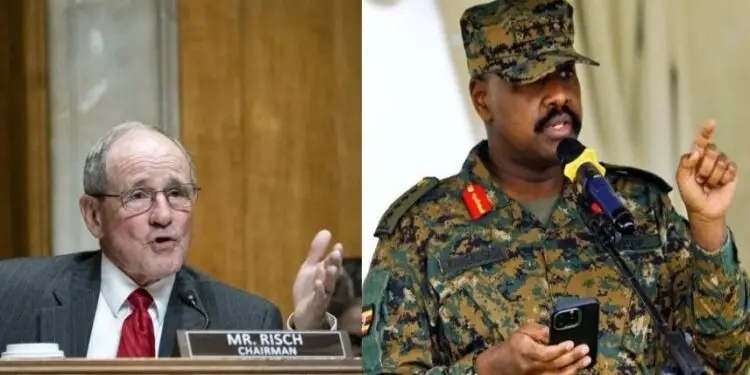
The apology did little to quell the concern from American officials. U.S. Senator Jim Risch (R-Idaho), the chairman of the powerful Senate Foreign Relations Committee, forcefully rejected the retraction.
“Commander @mkainerugaba has crossed a red line and now the U.S. must reevaluate its security partnership, which includes sanctions, and military cooperation with Uganda,” Senator Risch stated. He emphasized that “the president’s son, and likely successor, cannot just delete tweets and issue hollow apologies”.
Risch framed the incident as a matter of regional stability, warning that the United States “will not tolerate this level of instability and recklessness when American personnel, U.S. interests, and innocent lives in the region are at stake”.
Context: Disputed Elections and a Hunted Opposition Leader
The social media controversy is deeply intertwined with Uganda’s tense political climate following the January 15 presidential election.
· Election Results: President Yoweri Museveni, 81, was declared the winner with 71.6% of the vote, securing a seventh term that extends his rule to nearly five decades. Bobi Wine, his main challenger, officially won 24.7% but has vehemently rejected the results as fake.
· Bobi Wine’s Disappearance: Wine went into hiding days after the election, citing fears for his safety. He has since posted videos taunting the military’s inability to find him. In his deleted posts, General Muhoozi declared that troops were under orders to find Wine “dead or alive”.
· Previous U.S. Criticism: Senator Risch’s latest statement builds on earlier criticism of the election itself. Last week, he and other senators described the poll as a “hollow exercise, staged to legitimize President Yoweri Museveni’s seventh term” and called for accountability measures.
A Strained but Strategic Partnership
The call to reassess the security relationship highlights a significant contradiction in U.S.-Uganda relations. On one hand, Senator Risch acknowledges that Uganda is “a key regional security partner to the United States”. Uganda contributes troops to African Union peacekeeping missions and is a strategic actor in a volatile region.
On the other hand, the senator and other critics accuse the Museveni regime of maintaining power through “political violence, abductions, imprisonment, [and] intimidation”. Risch has expressed concern that the regime is becoming “an increasingly problematic exporter of instability” in the region.
What Happens Next?
While Senator Risch’s call carries substantial weight, it is a legislative demand, not an executive action. The ultimate decision on altering security cooperation or imposing sanctions rests with the U.S. administration.
For now, General Muhoozi has announced he will be “taking a break from social media to focus on prayers”. The incident underscores how the online conduct of high-level officials can rapidly escalate into an international diplomatic crisis, straining alliances built over decades.
About The Author