
Order Must Replace Chaos, Says Minister as Uganda Defends Controversial Trade Reforms
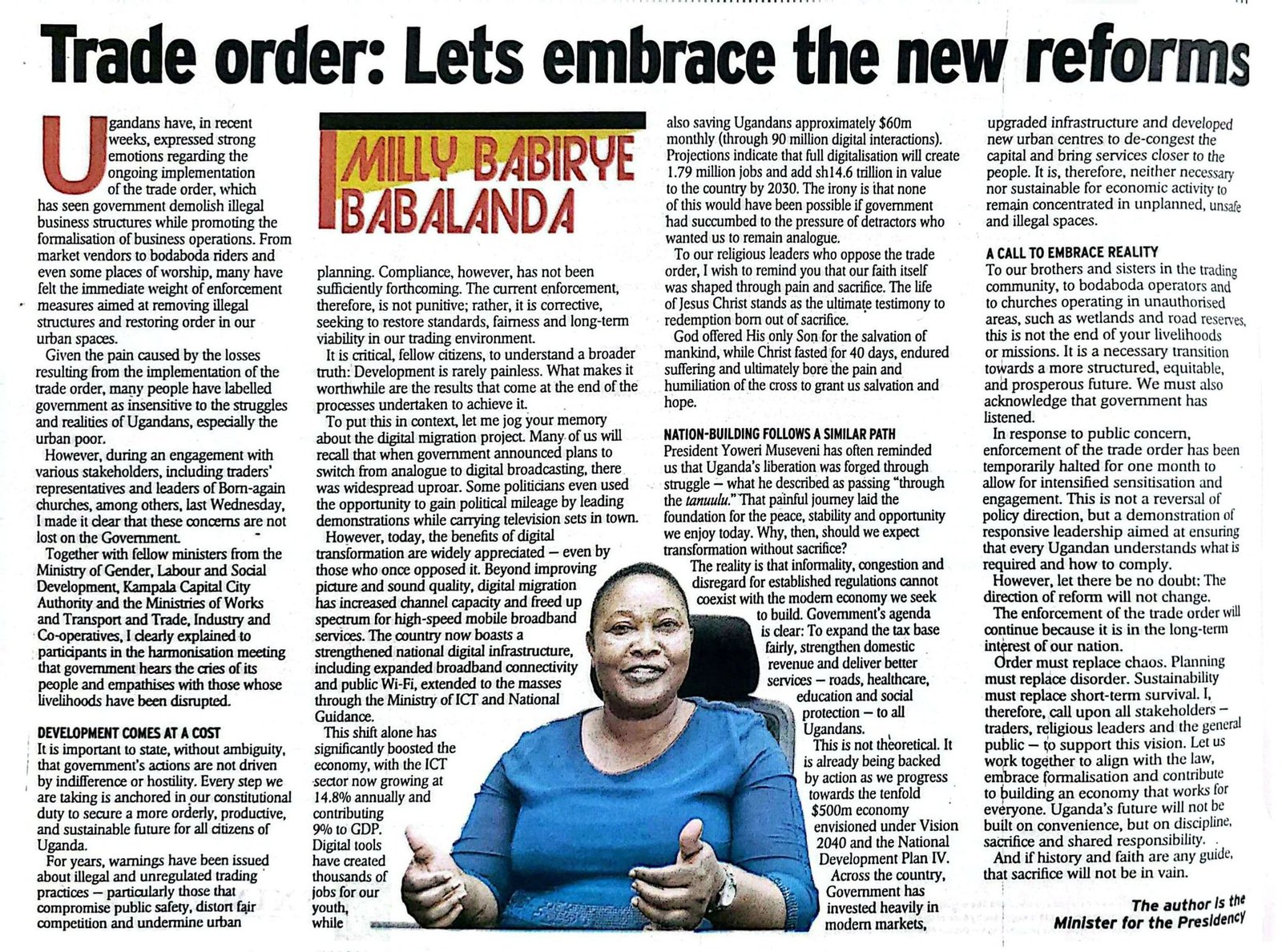
KAMPALA, Uganda — The Ugandan government has defended its ongoing trade order enforcement, with Minister for Presidency Hon. Milly Babalanda declaring that “order must replace chaos, planning must replace disorder, and sustainability must replace short-term survival.”
The statement comes amid widespread public outcry over the demolition of illegal business structures, which has affected market vendors, boda boda riders, and even places of worship operating in unauthorized areas such as wetlands and road reserves.
Government Acknowledges Pain but Stands Firm
Speaking after a harmonization meeting with traders’ representatives, Born-again church leaders, and other stakeholders last Wednesday, Hon Babalanda acknowledged the public’s grievances but insisted the reforms are necessary.
“These concerns are not lost on the Government,” she said. “We hear the cries of our people and empathise with those whose livelihoods have been disrupted.”
However, she emphasized that development “comes at a cost,” comparing the current reforms to the digital migration project, which initially faced fierce opposition but now contributes 9% to Uganda’s GDP and has created thousands of jobs.
One-Month Halt for Sensitisation
In response to public pressure, enforcement of the trade order has been temporarily suspended for one month to allow for intensified sensitisation and engagement.
But Hon Babalanda made clear this is not a policy reversal: “The direction of reform will not change. The enforcement of the trade order will continue because it is in the long-term interest of our nation.”
Religious Leaders Urged to Support Vision
Addressing religious leaders who have opposed the trade order, the minister drew parallels between the reforms and Christian teachings.
“Our faith itself was shaped through pain and sacrifice,” she said, citing the crucifixion of Jesus Christ as “the ultimate testimony to redemption born out of sacrifice.”
She called on all stakeholders to embrace formalisation, warning that “informality, congestion and disregard for established regulations cannot coexist with the modern economy we seek to build.”
Government has invested heavily in modern markets and upgraded infrastructure under Vision 2040 and the National Development Plan IV, she noted.
“The future will not be built on convenience, but on discipline, sacrifice and shared responsibility,” Hon Babalanda concluded. “That sacrifice will not be in vain.”
About The Author