

Exclusive: US Navy Declines Tanker Escorts Through Strait of Hormuz Amid Iranian Threat
The United States Navy has repeatedly declined requests to escort commercial oil tankers through the Strait of Hormuz since the launch of Operation Epic Fury on February 28, citing an unacceptably high risk of Iranian attack, according to industry sources and internal reports.
Despite the presence of three US carrier strike groups in the wider region—the most concentrated projection of naval power in history—the Pentagon has refused “near-daily” appeals from the shipping industry to provide military passage through the strategic 33-kilometer-wide waterway.
The refusal, now entering its twelfth day, has effectively paralyzed one of the world’s most critical energy arteries. Prior to the escalation, some 138 tankers per day transited the strait, through which roughly 20% of global oil consumption passes. Today, industry sources estimate that over 700 tankers are waiting to transit or have halted operations entirely.
A Mismatch of Force
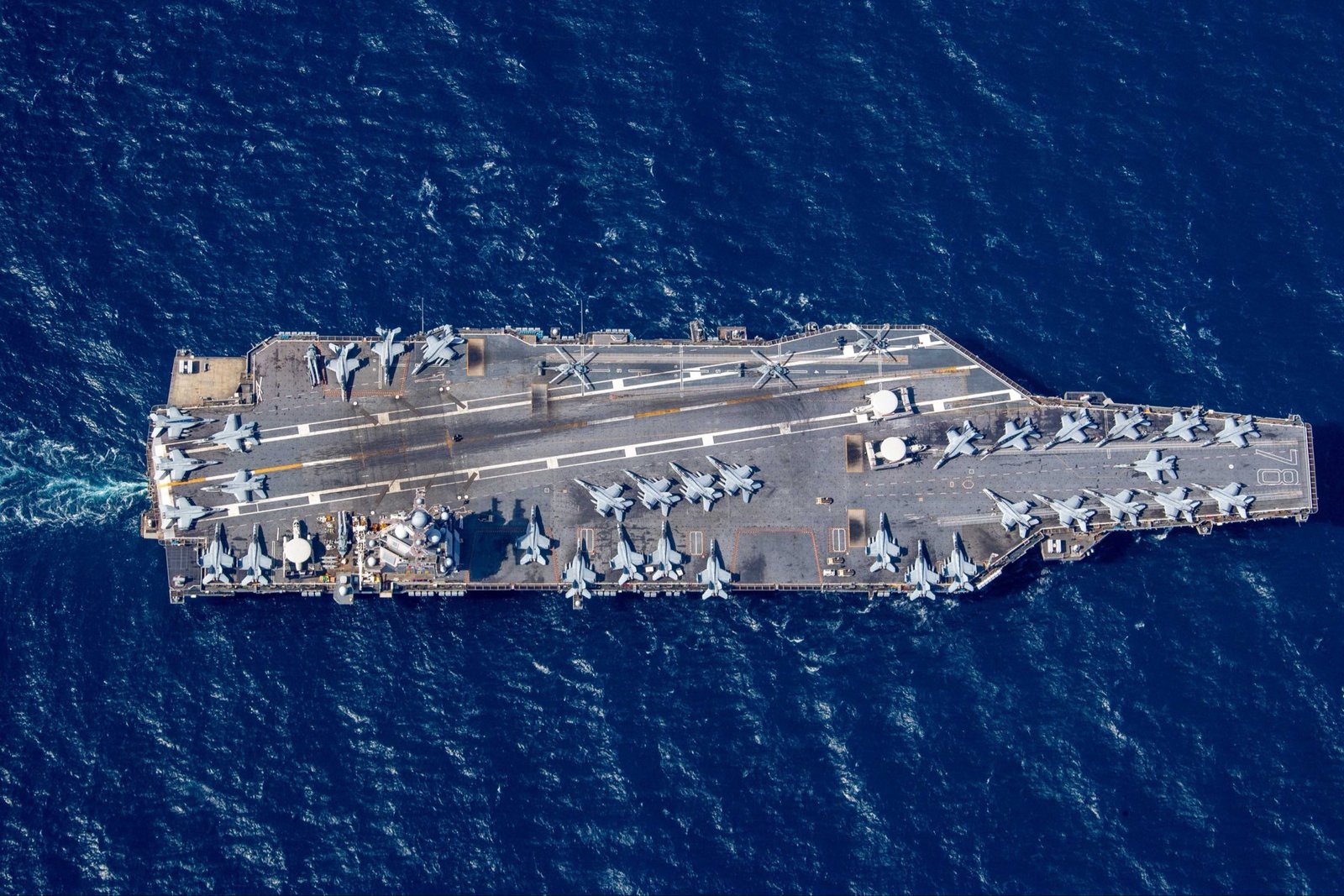
The US has positioned the USS Abraham Lincoln in the Arabian Sea, the USS Gerald R. Ford in the Red Sea, and the USS George H.W. Bush is en route to the region. They are joined by the French Charles de Gaulle carrier group in the Eastern Mediterranean and the British destroyer HMS Dragon near Cyprus. Collectively, this armada represents air and missile defense capabilities surpassing those of most nations.
However, military strategists note that these assets are ill-suited for the narrow confines of the Hormuz strait, where navigable shipping lanes compress to just three kilometers in each direction.
“A carrier strike group is designed for blue-water power projection, not close-quarters escort through a mined corridor,” a senior defense analyst explained. The primary threat is asymmetric: Iran’s Islamic Revolutionary Guard Corps (IRGC) has deployed coastal cruise missiles, kamikaze drones, fast-attack boats, and a mine stockpile estimated at 2,000 to 6,000 devices. Intelligence confirms dozens of mines are already in the water, with delivery platforms largely intact.
An Aegis cruiser’s advanced radar, capable of tracking hundreds of targets at 400 kilometers, cannot detect a mine resting just below the surface. Military planners fear that a single $500 mine strike on a $4 billion destroyer or a crippled tanker would result in a catastrophic strategic humiliation that three carrier groups could not absorb.
Political Statements Contradict Reality
The operational standoff has led to conflicting statements from Washington. On Sunday, President Donald Trump told CBS that escorts would begin “as soon as possible” and “when reasonable.” Hours later, Energy Secretary Chris Wright posted on social media that an escorted transit had already occurred, only to delete the post when the White House confirmed that no military escort had taken place.
The contradiction drew swift mockery from Tehran. Iran’s Parliament Speaker Mohammad Bagher Ghalibaf dismissed the claim as a “PlayStation” fantasy, highlighting the gap between political rhetoric and naval reality in the Gulf.
Strategic Dilemma
The Navy’s calculus reflects a central tenet of the Mosaic Doctrine: in a threat environment saturated with cheap, distributed weapons, the cost of a single failure now outweighs the cost of refusing the mission. An attack on an escorted vessel would trigger immediate casualties, an insurance industry meltdown, and a political crisis that three aircraft carriers could not mitigate.
As the impasse continues, the International Energy Agency has proposed the largest reserve release in history to compensate for the de facto closure of the strait. Yet for the 700 tankers idling at sea, and the global economy watching the chokepoint, the world’s most powerful navy remains a spectator.
Between the waiting tankers and the watching carriers, the 33-kilometer corridor through the Strait of Hormuz has become the most expensive gap in the world.
About The Author