
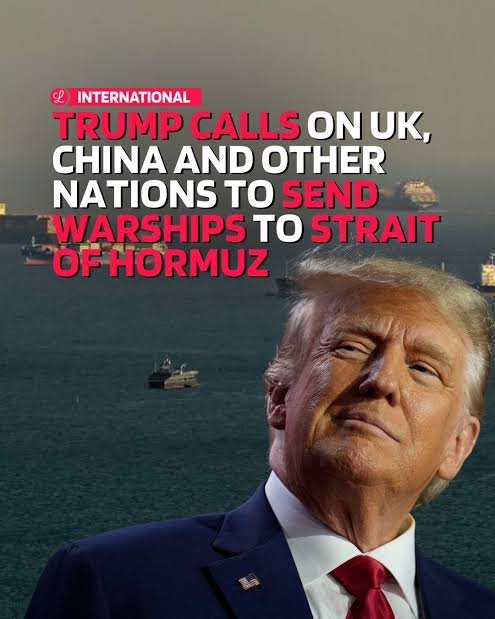
The Hormuz Trap: Trump’s Naval Coalition Call Forces China to Choose Between Shadow Economy and Global Standing
In a Truth Social post that reads more like a geopolitical chess move than a diplomatic communiqué, former President Donald Trump has extended a public invitation to China to join a naval coalition in the Strait of Hormuz—an invitation that analysts are calling a strategic masterpiece designed to force Beijing into an unwinnable position.
The post, published Friday, lists six nations Trump hopes will contribute warships to secure the vital waterway: China, France, Japan, South Korea, the UK, and “others.” While the participation of America’s traditional allies is considered routine, the inclusion of China transforms the statement into a weaponized question.
The Post
“Hopefully China, France, Japan, South Korea, the UK, and others, that are affected by this artificial constraint, will send Ships to the area so that the Hormuz Strait will no longer be a threat by a Nation that has been totally decapitated.”
Trump’s message also contains a stark admission of military reality: “We have already destroyed 100% of Iran’s Military capability, but it’s easy for them to send a drone or two, drop a mine, or deliver a close range missile somewhere along, or in, this Waterway, no matter how badly defeated they are.”
The Trap
Beijing now faces a dilemma with no clean exit:
If China sends warships, it legitimizes an American-led coalition architecture, effectively subordinating its naval assets to US command in a time of active conflict. More critically, it would force China to abandon its carefully maintained diplomatic neutrality with Tehran—the same Tehran that has just offered China exclusive yuan-only passage through the Strait. The deployment would cost Beijing its shadow fleet advantage, its discounted Iranian crude (16 million barrels have transited since February 28 alone), and its CIPS leverage ($24.5 trillion processed in 2025 at 43% growth).
If China refuses, it confirms the free-rider narrative Washington has long cultivated. The Strait carries 45% of China’s crude imports. Refusing to help secure it while continuing to profit from yuan-settled shadow fleet deliveries paints Beijing as willing to let the global economy burn for parochial gain. Every nation paying market rates will note who showed up and who did not.
The Admission
Equally significant is Trump’s acknowledgment that “total military victory” does not equate to waterway security. With Iran’s conventional forces destroyed, the threat has devolved to the coastline itself—33 kilometers of shoreline from which a defeated nation can launch $500 mines and $20,000 drones against tankers that have no insurance and no private-sector willingness to transit.
“In the meantime, the United States will be bombing the hell out of the shoreline, and continually shooting Iranian Boats and Ships out of the water.”
The Vote
Behind the military calculus lies a deeper contest. Trump has framed the coalition not as a response to Iran—whose military is, by his own admission, “totally decapitated”—but as a referendum on the postwar order.
If America escorts the tankers alone, the Strait reopens under American control and dollar pricing survives. If a coalition escorts them, the Strait operates under international consensus and the yuan-for-Hormuz proposal dies. If nobody escorts them, the Strait remains closed and China’s shadow fleet becomes the only commerce moving through it.
“Trump is not asking for help,” one strategic analyst noted. “He is asking every nation to declare which monetary system they want the Strait to operate under when the war ends. The warships are the ballot. The Strait is the polling station. And the currency is the vote.”
With Japan set to sign the Golden Dome agreement in five days and European allies already positioning assets, the world now watches Beijing. The question has been asked. How China answers will determine not only the security of the world’s most important chokepoint, but the shape of the global financial order that emerges from its waters.
About The Author