
Uganda passes sovereignty bill curbing foreign political influence after central bank warning
KAMPALA (Reuters) – Uganda’s parliament has passed a revised version of the Protection of Sovereignty Bill, tightening rules on foreign political funding after heeding a central bank warning that earlier provisions risked “economic disaster.”
Lawmakers approved the legislation on Tuesday, May 5, by a vote of 292 to 52, following major amendments that dropped broad financial disclosure requirements and introduced exemptions for aid, business transactions, and remittances from Ugandans abroad.
The final law imposes penalties of up to 10 years in prison for knowingly advancing foreign political, electoral, or security interests without government approval. It also caps unapproved foreign funding at approximately $106,000 per year, while allowing routine aid and commercial activities to continue unchanged.
Central bank warning sparks changes
Bank of Uganda Governor Michael Atingi-Ego had warned last week that the original bill’s requirement for any Ugandan receiving money from abroad to register as a foreign agent could drastically reduce remittances – a key source of foreign exchange – and drain foreign reserves, describing that scenario as “economic disaster for our country.”
Lawmakers responded by narrowing the registration requirement to only those receiving funds for political purposes that explicitly advance foreign interests. The cap on foreign political funding and exemptions for aid and business were also added after the governor’s intervention.
Museveni hails ‘self-reliance,’ cites 1971 coup example
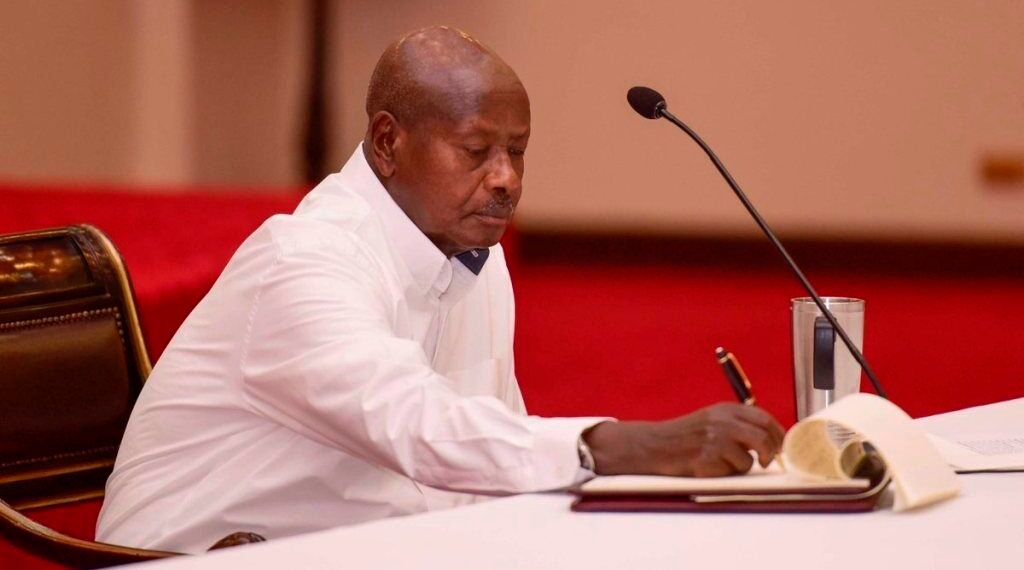
President Yoweri Museveni, who has been in power since 1986, praised the ruling NRM party lawmakers for passing the bill, which now awaits his signature to become law.
“Fellow Ugandans, especially the Bazzukulu. Greetings,” Museveni wrote on X. “This is to congratulate the NRM MPs for passing the Sovereignty Bill which simply means ‘let us do our things by ourselves just as you do your own things without anybody interfering with you.’”
He rejected arguments against the law as “shameful and disgusting,” citing a historical example: “It is how the Israelis led by one Barak and the British supported Idi Amin’s coup in 1971 because Obote was vocal in opposing their policy on Rhodesia (Zimbabwe). Indeed, Edward Heath, the British Prime Minister, recognized Amin after only 10 days.”
Opposition warns of erosion of free speech
Opposition lawmakers condemned the legislation as a threat to democratic space. Joel Ssenyonyi, a prominent opposition MP, wrote on X: “Our colleagues on the opposite side forget that when it rains, we all get wet. That’s the reality of problematic laws. Even those who were chanting ‘Aye’ will be affected at some point. The day of reckoning eventually comes!”
Rights groups have similarly warned that the law’s broad language could allow the government to criminalize virtually any form of political opposition. The government has accused critics of exaggerating the bill’s impact.
World Bank monitoring
The World Bank, which halted new lending to Uganda in 2023 over a harsh anti-homosexuality law before resuming funding two years later after compromises, said last month that the original bill could expose a wide range of its “routine development activities” to criminal liability. It was not immediately clear whether the final amendments have fully addressed those concerns.
About The Author