
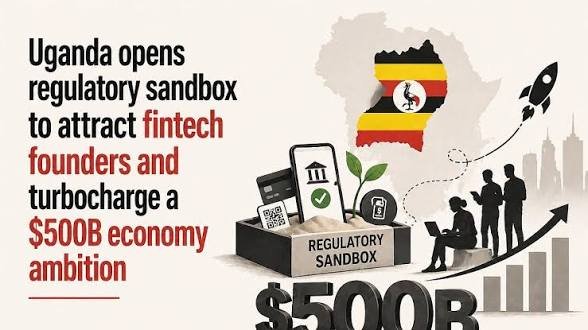
Uganda opens sandbox to attract fintech founders
Kampala, Uganda — Uganda’s Capital Markets Authority (CMA) has launched a regulatory sandbox aimed at solving a persistent problem in emerging African markets: fintech products that never reach commercialization.
The sandbox, formally launched in October 2025, is a supervised testing environment where fintech firms can run live products under regulatory oversight before rolling them out to the wider market. It currently holds four active applications under review.
“You get the development grants, but sometimes you stop at that place and do not commercialise that idea,” said Josephine Ossiya, chief executive of the CMA, expressing frustration with a cycle where grants are treated as an exit rather than seed capital.
Solving the chicken-and-egg problem
The sandbox addresses a classic regulatory dilemma. Established rules are written for established products, but new financial products—especially those using novel technology—often do not fit neatly into existing frameworks. This creates a grey zone where entrepreneurs cannot obtain regulatory clearance without a track record, and cannot build a track record without it.
The sandbox cuts through this by creating a temporary, bounded space where normal rules are partially suspended in exchange for close supervision and data-sharing with the regulator.
Dickson Sembuya, the CMA’s director of research and market development, said the sandbox serves not merely as a vehicle for enabling innovation but as a critical tool to “determine which regulatory measures, if any, are genuinely necessary.”
“We want to determine if at all you need to regulate,” he noted. That signals the CMA is approaching the initiative as a learning exercise, not merely a compliance box to be ticked.
Four applications under review
The four applications currently being reviewed tell a coherent story about where Uganda’s fintech community sees opportunity.
Two of them focus on fixed-income markets—specifically the trading of government securities, which in Uganda has historically been the preserve of banks and a narrow tier of institutional investors. One platform targets retail investors. A crowdfunding application addresses a different gap: small and medium enterprises in Uganda face a chronic financing problem, being too large for microfinance but too small and opaque for bank lending.
One applicant is even proposing blockchain-based settlement, though the article notes that this requires interoperability bridges, creates new cybersecurity attack surfaces, and can run into difficulties with existing banking infrastructure not designed for tokenised assets.
Structural advantages and open questions
There are structural reasons for cautious optimism. Uganda’s mobile money penetration is among the highest in the world relative to its population, meaning a digital payments infrastructure already exists on which capital market products can be layered. The country’s Treasury bill and bond market is active, and the government has a clear interest in broadening the retail investor base to diversify its funding sources.
However, sandboxes have a complicated record in Africa. Several central bank sandboxes on the continent have been criticised for slow admission timelines that leave applicants in limbo, for approving participation without providing meaningful regulatory guidance, and for failing to produce a single commercially launched product after years of operation.
Uganda’s sandbox, launched in October 2025, is still too young to be fairly judged by outcomes. But the speed with which it moves from application to admission, and from admission to live testing, will be closely watched by the fintech community it is trying to attract.
The sandbox supports Uganda’s 10-fold Growth Strategy, which aims to grow GDP to $500 billion by 2040, by nurturing technology-driven capital mobilisation and long-term investment. Whether the CMA has the technical capacity to evaluate the risks rigorously—particularly for blockchain-based proposals—is a question the next twelve months will answer.
About The Author