


UACE 2025 Results Released: Candidate Numbers Surge by 17.2%, Quality Maintained
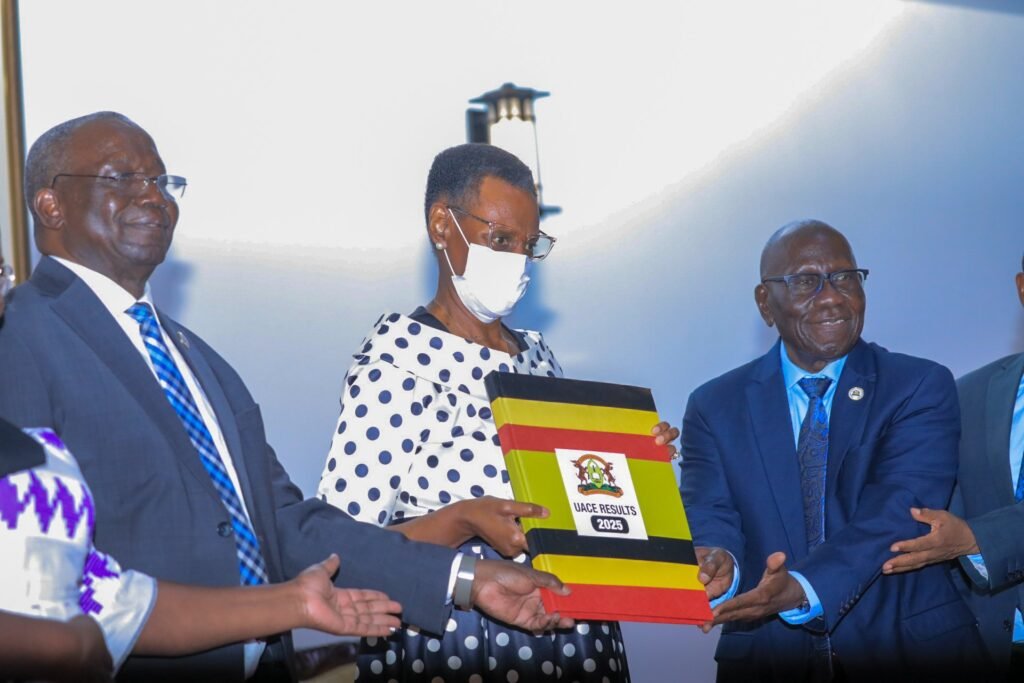
KAMPALA, UGANDA – The Uganda National Examinations Board (UNEB) has released the results for the 2025 Uganda Advanced Certificate of Education (UACE) examinations, revealing a significant surge in candidature alongside maintained academic standards. The results were officially presented by the First Lady and Minister of Education and Sports, Hon. Janet Kataha Museveni, at State House, Nakasero.
According to the UNEB Chairperson, Prof. Celestino Obua, the board assessed a total of 1,402,434 candidates across all three national examinations (PLE, UCE, and UACE) this year, an increase from 1,294,731 in 2024. Specifically for UACE, the number of candidates registered rose by 17.2%.
Candidature Hits Record High
Dan Odongo, the UNEB Executive Director, provided a detailed breakdown of the UACE statistics. A total of 166,400 candidates registered for the 2025 examination, compared to 141,996 in 2024—a net increase of 24,404 candidates.
“The number of examination centres for UACE increased by 197 (8.7%), from 2,255 in 2024 to 2,452 in 2025,” Mr. Odongo stated.
Of those registered, 72,764 (43.7%) were females and 93,636 (56.3%) were males. The number of candidates who actually sat for the examination was 165,172 (72,374 females and 92,798 males), reflecting a 17.2% increase in turnout as well. Prof. Obua noted that this sustained growth reflects “expanded access to post-O’ Level education and growing public confidence in the credibility of national assessments.”
Performance Analysis and University Qualification
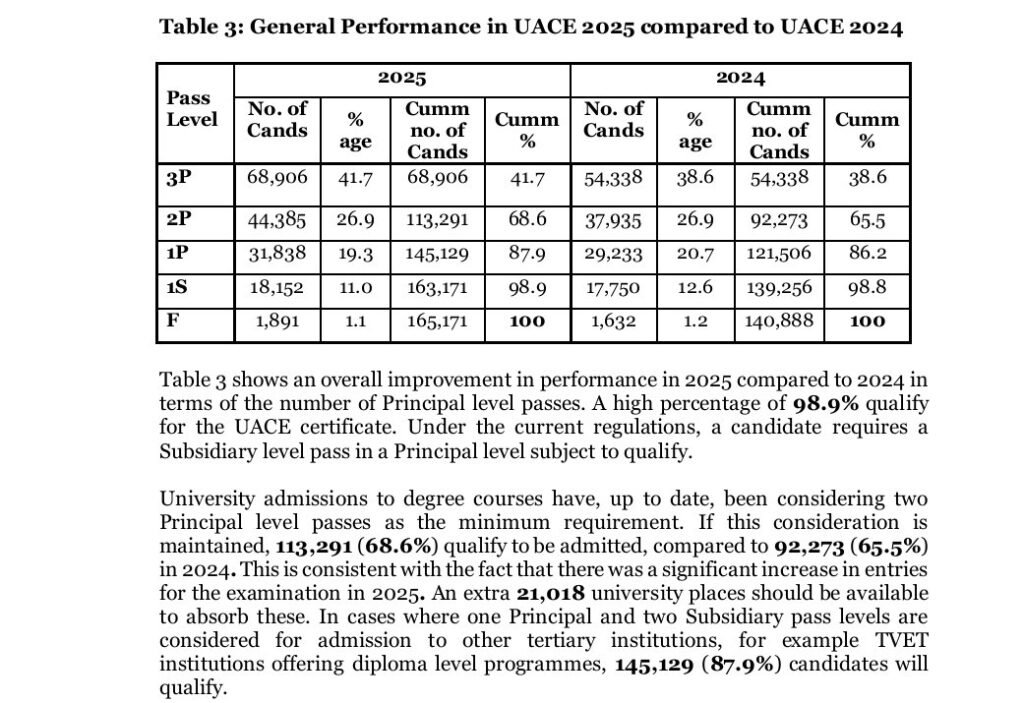
The results show an overall improvement in performance compared to 2024. A high percentage of candidates—68.9%—qualified for the UACE certificate. Crucially, the number of candidates qualifying for university admission has also risen sharply.
Based on the minimum requirement of two Principal level passes for degree courses, 113,291 candidates (68.6%) qualify for university admission. This is a significant jump from 92,273 candidates (65.5%) in 2024. Mr. Odongo highlighted that this improvement implies an additional 21,018 university places may be required to accommodate the increased number of qualifying candidates.
Furthermore, if the criteria are widened to include admission to other tertiary institutions (like TVET diploma programmes) requiring one Principal and two Subsidiary passes, 145,129 candidates (87.9%) would qualify.
Subject Performance: Sciences Improve, Humanities Struggle
Performance trends revealed notable improvements in several subjects, including Mathematics, Chemistry, Agriculture, Geography, Economics, Biology, and Literature in English.
However, significant declines were observed in Entrepreneurship Education, Christian Religious Education, Fine Art, and Physics. While overall grades in Science subjects have improved markedly compared to the Humanities, challenges remain.
“Overall, grades in Science subjects have improved markedly compared to the Humanities,” the report noted.
In the Humanities, examiners reported that candidates struggled with poor interpretation of questions and misunderstanding key concepts. History candidates demonstrated weak analytical and evaluative skills, while Religious Education candidates found it difficult to connect teachings from holy books to everyday life.
In the Sciences, performance continues to be affected by inadequate practical exposure. Candidates reportedly faced issues with misinterpreting experimental procedures, failing to analyze or present data graphically, and making errors in writing correct chemical equations. There was also evidence that some teachers are skipping certain topics, particularly in Physical Chemistry.
Gender Dynamics in Performance and Subject Choice
Female candidates continued to perform commendably better than their male counterparts in Humanities subjects and demonstrated lower overall failure proportions. “This trend affirms the positive impact of continued investment in girl-child education,” Prof. Obua stated.
However, subject clustering remains heavily gendered, with a higher concentration of female candidates in the Humanities than in the Sciences. Female entries in Sciences and Mathematics remain lower than those of males.
At the top level of ‘A’ passes, male candidates scored higher than females in Mathematics and Sciences. Conversely, female candidates outperformed their male counterparts at the principal level pass (A–E) in most Humanities subjects, as well as in Mathematics, Physics, General Paper, Subsidiary Mathematics, and Subsidiary ICT.
The board observed that broader participation of both male and female candidates in Science subjects will enhance equity and balance across future professional fields.
Special Needs Candidates and Malpractice
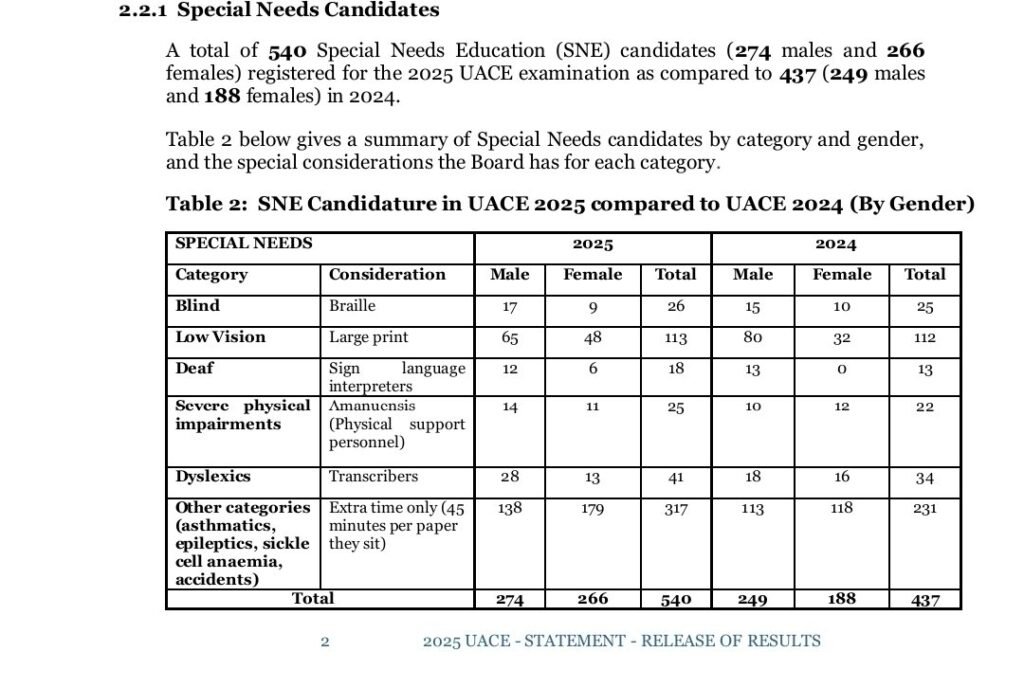
A total of 540 Special Needs Education (SNE) candidates (274 males and 266 females) registered for the 2025 examination, up from 437 in 2024. Proportionally, female SNE candidates outperformed their male counterparts in most subjects.
On exam integrity, malpractice cases remain low. Cases were reported from only 47 out of the 2,452 examination centres, involving 351 candidates (0.2% of the total). The cases mainly relate to receiving assistance in Science Practical papers, possession of unauthorized materials, and impersonation.
“In accordance with Section 5(2)(b) of the UNEB Act, Cap 259, the results of candidates involved will be withheld pending completion of investigations,” Mr. Odongo confirmed.
The Board is proceeding with the hearing of PLE cases and will commence hearings for UCE cases from 16th March 2026.
About The Author