

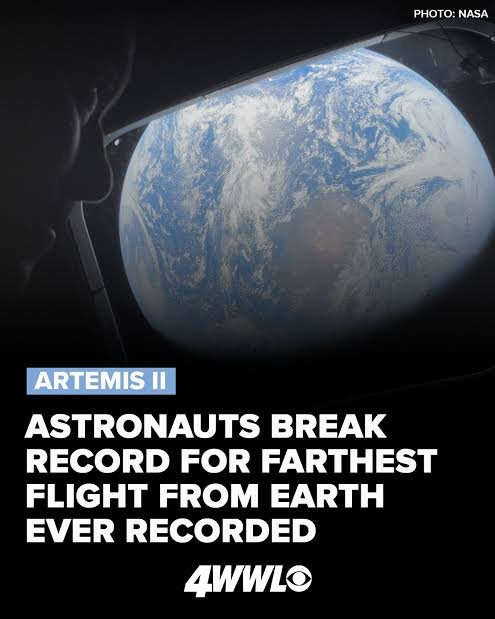
Artemis II Astronauts Make History with Record-Breaking Lunar Flyby
Updated 2:49 PM EDT, Mon April 6, 2026
HOUSTON – The NASA-led Artemis II mission has achieved a historic milestone, surpassing the distance record set by Apollo 13 in 1970 as the crew of four astronauts began their long-awaited flyby of the moon on Monday.
At 1:56 p.m. ET, the Orion spacecraft broke Apollo 13’s record of 248,655 statute miles from Earth. Artemis II is expected to reach approximately 252,760 miles from our planet — 4,105 miles farther than its predecessor — with a maximum distance anticipated at 7:07 p.m. ET.
The lunar flyby officially kicked off at 2:45 p.m. ET and will conclude at 9:20 p.m. ET, giving the crew a seven-hour window to observe and photograph lunar features, including portions of the mysterious far side that have never before been seen by human eyes.
Science Takes Center Stage
In a departure from the Apollo era, NASA has placed unprecedented emphasis on research during this mission. Dr. Kelsey Young serves as the first-ever “science officer” seated in mission control, with a dedicated team of lunar scientists backing her up during the flyby.
“It’s a clear statement that there is a big focus on science,” Jacob Bleacher, NASA Chief Exploration Scientist, told CNN. “This is like a precursor to the landing mission.”
The astronauts will split into pairs for the first five hours of observation. NASA’s Reid Wiseman and Canadian Space Agency’s Jeremy Hansen will observe first while NASA astronauts Victor Glover and Christina Koch handle other tasks, swapping each hour. The crew will use three Nikon cameras with different zoom lenses to capture impact basins, ancient lava flows, and other features while providing live descriptions to scientists.
An Emotional Tribute
In a poignant moment broadcast from space, the crew requested to name two lunar craters — one “Integrity” for their Orion spacecraft, and another “Carroll” to honor Commander Reid Wiseman’s late wife, Carroll Taylor Wiseman, a neonatal intensive care nurse who died of cancer in 2020.
“As we surpass the furthest distance humans have ever traveled from planet Earth, we do so in honoring the extraordinary efforts and feats of our predecessors,” Hansen said before his voice shook with emotion. The four astronauts embraced in tears as a moment of silence was observed in mission control.
A Message from a Legend
The crew began their historic day with a prerecorded message from the late Apollo astronaut Jim Lovell, who circled the moon twice during Apollo 8 and Apollo 13.
“Welcome to my old neighborhood,” Lovell said. “I’m proud to pass that torch on to you as you swing around the moon and lay the groundwork for missions to Mars for the benefit of all. Don’t forget to enjoy the view.”
The Apollo 8 mission patch — which flew with Lovell and his crew in 1968 — is onboard for the journey.
The crew’s hearty breakfast before the flyby included breakfast sausage, couscous with nuts, strawberries, oatmeal with apples and cinnamon, grits, and “cosmic brownies” for dessert the night before.
NASA’s livestream of the flyby, showing views directly from the Orion spacecraft, is underway and will continue through the evening.
About The Author