

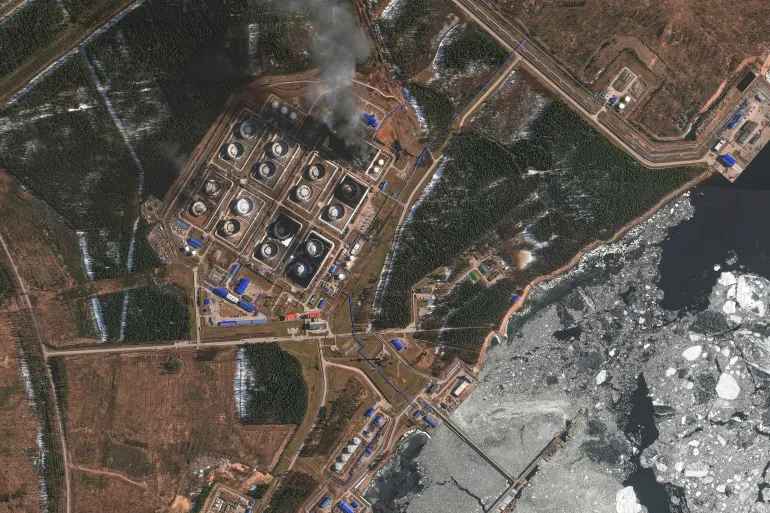
‘Smell of war’ reaches St Petersburg as Ukrainian drones strike Russian oil terminals
Ukrainian attacks on Baltic oil facilities disrupt 40% of Russia’s seaborne exports, costing Moscow $1bn amid widening conflict
ST PETERSBURG, Russia — For Konstantin, a 53-year-old asthmatic living in President Vladimir Putin’s hometown of St Petersburg, the war in Ukraine has become impossible to ignore. Over the past two weeks, the smell of burning crude and chemicals from Ukrainian drone strikes on Russia’s two largest Baltic oil terminals has drifted into his apartment.
“I never thought it would come to this, that the war would be in the air around me,” Konstantin told Al Jazeera, speaking on condition of anonymity for fear of repercussions. “Once again, we were fooled about why we’d gone to war and about the government’s ability to protect us.”
The attacks on the Ust-Luga and Primorsk terminals — located 133km and 165km from St Petersburg respectively — have sparked massive fires that burned for days. The facilities normally handle two-fifths of Moscow’s seaborne oil exports and nearly 2 percent of global oil supply, according to the International Energy Agency.
Draining Russia’s war chest
The strikes are part of a broader Ukrainian campaign to hit more than a dozen oil refineries deep inside Russian territory. According to Bloomberg, the attacks have already cost Moscow $1 billion and triggered the sharpest decline in Russia’s Baltic oil exports since the full-scale invasion of Ukraine began in 2022.
Both ports remain unable to ship cargo, forcing traders to redirect oil to smaller Baltic or Black Sea ports that cannot handle the additional volume, Reuters reported on April 3.
Ukrainian experts say the timing is linked to rising global oil prices following the US-Israel conflict with Iran, which has partially closed the Strait of Hormuz. Every $10 spike in oil prices adds $1.6 billion monthly to the Kremlin’s war chest.
“The frequency of strikes is connected to the Iran war and Russia’s new opportunities to profit from it,” said Nikolay Mitrokhin, a researcher at Germany’s Bremen University.
Long-range drone strategy
Ukraine has increasingly deployed FP-1 drones, manufactured by the Ukrainian company Firepoint, which can carry up to 120kg of explosives and fly approximately 1,500km — far exceeding earlier strike ranges of about 500km from the border.
Andrey Pronin, a pioneer of drone warfare in Ukraine, told Al Jazeera the strikes are meticulously planned to fly exclusively over Russian territory, bypassing air defence systems.
Ukrainian President Volodymyr Zelenskyy is using the strikes as leverage in potential negotiations, according to Mitrokhin, including proposing a moratorium on strikes against energy sites.
Civilian impact
While Ukraine has focused on Russia’s oil infrastructure rather than civilian areas, the consequences have reached ordinary Russians. Konstantin, who remembers the nuclear war scares of the 1980s and post-Soviet conflicts in Chechnya, said the smell has triggered nightmares.
In occupied Crimea, the situation is more dire. “We watch fireworks in the sky every night. The shelling is constant,” said Abdulla, a Tatar Muslim man living near a military base and air defence complex in central Crimea.
Despite the strikes, analysts say Putin shows no sign of backing down. “Putin is not going to leave the talks, but he won’t settle on anything,” said Volodymyr Fesenko, head of the Kyiv-based Penta think tank. “Irrespective of whether there are strikes on oil terminals or not, he won’t negotiate the war’s end.”
About The Author