
Norbert Mao Reveals Letter to Museveni: Seeks Speaker Consideration, Calls for ‘New Political Template’
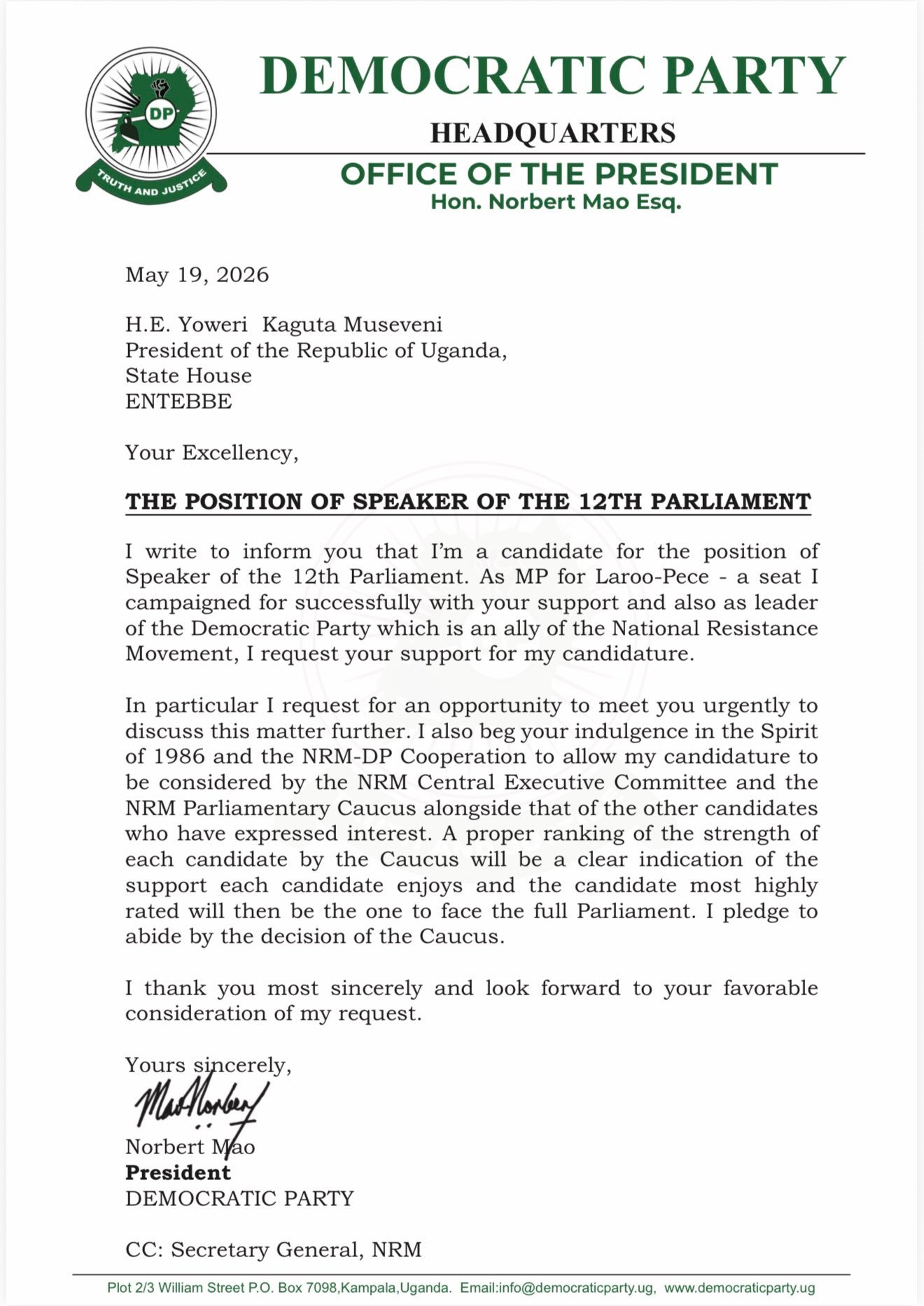
In a lengthy public statement released today, Norbert Mao, the President of the Democratic Party (DP) and current Minister of Justice and Constitutional Affairs, has disclosed the full contents of a letter he personally wrote and delivered to President Yoweri Museveni. The letter, which Mao describes as “simple and straightforward,” seeks the President’s blessing to be considered for the position of Speaker of Parliament.
Mao’s disclosure comes amid intense speculation about the next leadership of Parliament, with the ruling National Resistance Movement (NRM) holding a commanding majority.
A Letter Rooted in Kyankwanzi Guidance
Mao begins his pitch by grounding his request in the President’s own guidance from the Kyankwanzi ideological orientation centre. He recalls that President Museveni stated that the ultimate power to decide who becomes Speaker lies with Members of Parliament, the majority of whom belong to the NRM.
“The Central Executive Committee (CEC) however has the duty to RECOMMEND candidates to the Caucus,” Mao wrote. “Therefore the decision of the NRM Parliamentary Caucus will determine who becomes Speaker… The vote by the whole Parliament will only seal the Decision of the Caucus.”
Mao argues that a “well-guided process” of the Caucus is pivotal, and his specific request is straightforward: that his name be forwarded by CEC for consideration by the Caucus.
The ‘Spirit of 1986’ and the Dance of Two Partners
The DP leader’s letter leans heavily on the principle of cooperation between the NRM and DP—an arrangement President Museveni himself referenced in the first five minutes of his inaugural address.
Mao invokes what he calls the “Spirit of 1986,” a reference to the historical collaboration between the NRM and DP in the aftermath of the liberation war that brought President Museveni to power.
“The English say ‘it takes two to tango.’ My mother’s people say ‘engalo ibiri nokunaabisana’” (two hands clap), Mao wrote, underscoring that cooperation cannot be one-sided.
A Frustration with Political ‘Molds’
However, Mao’s letter goes beyond a simple request for a political position. He expresses deep frustration that the “Spirit of 1986 did not evolve.”
According to Mao, that initial cooperation failed to break the political mold that ushered in Uganda’s chaotic post-independence politics. He argues that Uganda has an opportunity to break the cycle that “scatters our energies.”
“A dynamic cooperation can evolve into an alliance, a coalition and eventually a merger,” he wrote, noting that even the NRM itself was cast out of the fusion of Yoweri Museveni’s Popular Resistance Army and Yusuf Lule’s Uganda Freedom Fighters.
‘Overcoming Political Timidity’
In a direct appeal for a political realignment, Mao declared that some Ugandans are determined to defy conventions.
“As Uganda moves forward we must overcome the political timidity that has kept us in molds that undermine progress,” he stated. “Some of us are determined to defy conventions and work for a new political template.”
Political Implications
Mao’s public release of the letter is a strategic move, effectively campaigning for the Speaker’s position in the open while appealing directly to the NRM’s grassroots and CEC members. As a DP leader serving in an NRM government under the “Government of National Unity” framework, his bid represents a test of how far the current cooperation can stretch.
Neither the NRM Secretary General nor the President’s office has issued an immediate response to Mao’s letter. However, with the parliamentary caucus process looming, Mao has placed his name—and his vision of a merged political future—firmly into the public debate.
About The Author