
Top Iranian Officials Killed as Israel Claims Assassinations
TEHRAN – Iran has confirmed the deaths of two senior officials following what Israel claims were targeted assassinations, marking a significant escalation in the ongoing conflict between the two nations.
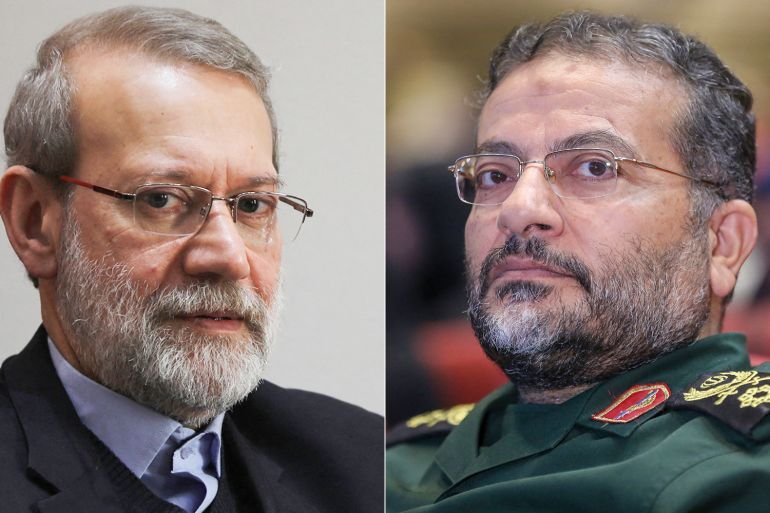
Top Iranian security official Ali Larijani and the commander of Iran’s internal Basij militia, Gholamreza Soleimani, have been killed, Iranian state media confirmed on Tuesday.
Highest-Ranking Casualty
In a statement carried by Iran’s semi-official Mehr news agency, the country’s Supreme National Security Council confirmed the assassination of its secretary, Larijani.
“After a lifetime of striving for the elevation of Iran and the Islamic Revolution, he finally reached his long-cherished wish, answered the call of truth, and proudly attained the blessed rank of martyrdom in the service front,” the council’s statement read.
Larijani is the highest-ranking Iranian official killed in US-Israeli attacks on Iran since former Iranian Supreme Leader Ayatollah Ali Khamenei was assassinated on the first day of the war on February 28.
The Islamic Revolutionary Guards Corps (IRGC) separately confirmed Soleimani’s killing.
Public Figure Until the End
Larijani was last seen publicly on Friday, attending an Al-Quds Day rally in support of Palestinians in Tehran alongside President Masoud Pezeshkian.
A veteran figure in the Iranian hierarchy, Larijani had previously led the nation’s nuclear negotiations with the West and served as speaker of the Iranian parliament, making him a recognizable face both domestically and internationally.
Israeli Leaders Welcome Strikes
Israeli political leaders have responded positively to the claimed assassinations. Defence Minister Israel Katz stated on Tuesday that “the leaders of the regime are being killed and their capabilities terminated.”
“Our army is working with strength to continue to hit and terminate the missile capabilities as well as the strategic infrastructure,” Katz wrote on social media.
Prime Minister Benjamin Netanyahu framed the killing as part of a broader strategy to enable regime change in Iran.
“This morning we eliminated Ali Larijani, the boss of the Revolutionary Guards, which is the gang of gangsters that actually runs Iran,” Netanyahu said in a televised statement. He acknowledged that overthrowing clerical authorities “will not happen all at once,” but added: “But if we persist in this – we will give them a chance to take their fate into their own hands.”
Regional Analysis
Mohamad Elmasry, professor at the Doha Institute for Graduate Studies, characterized the US and Israeli approach as a “game of Whac-A-Mole” as they target Iranian leaders.
“There’s always another leader … so I don’t think this is going to suggest any kind of collapse of the Iranian regime,” Elmasry told Al Jazeera. “Having said that, this is very significant symbolically [and] psychologically.”
Larijani’s Final Message
In a message circulated on Monday shortly before his death, Larijani had stressed that Iran would not relent in its fight against the US and Israel. He appealed for Muslim solidarity, questioning why some Islamic governments had failed to support Iran against what he termed “treacherous aggression.”
“Is the stance of certain Islamic governments not at odds with the Prophet [Muhammad]’s saying: ‘Whoever hears a man calling out, ‘O Muslims!’ and fails to answer him is not a Muslim?'” he said.
Larijani defended Iran’s regional strikes in response to US-Israeli attacks, warning that there is no middle ground in the ongoing confrontations while simultaneously emphasizing that Iran does not seek domination over its neighbours.
“The unity of the Islamic nation, if realised with full strength, is capable of guaranteeing security, progress and independence for all its states,” he said.
About The Author